
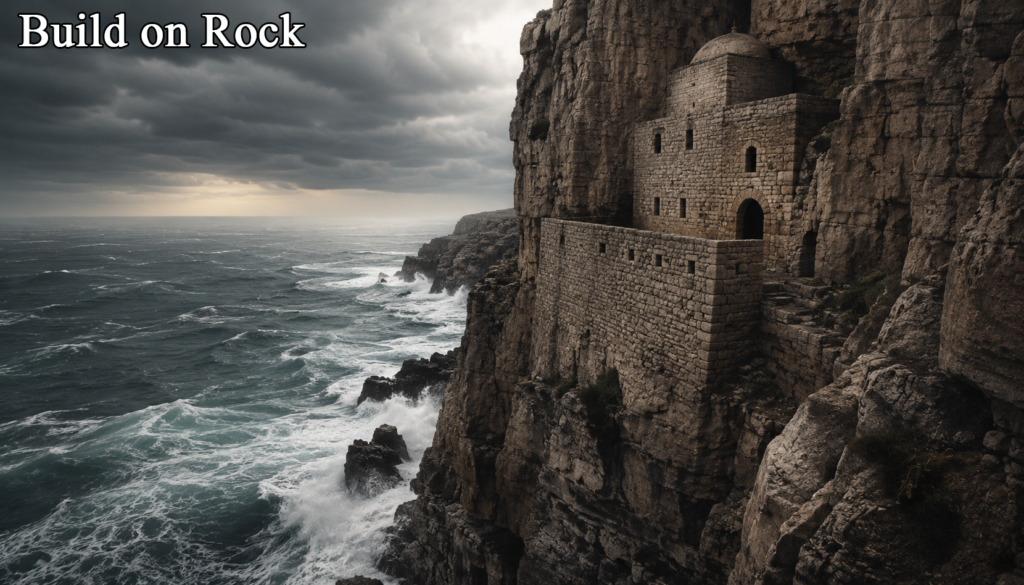
Therefore whoever hears these sayings of Mine, and does them, I will liken him to a wise man who built his house on the rock: and the rain descended, the floods came, and the winds blew and beat on that house; and it did not fall, for it was founded on the rock. But everyone who hears these sayings of Mine, and does not do them, will be like a foolish man who built his house on the sand: and the rain descended, the floods came, and the winds blew and beat on that house; and it fell. And great was its fall. And so it was, when Jesus had ended these sayings, that the people were astonished at His teaching, for He taught them as one having authority, and not as the scribes. — Matthew 7:24–29, NKJV
The storm does not discriminate. It does not check your credentials before it arrives, does not survey your intentions, does not pause at the door to distinguish the sincere from the cynical. The rain descends on both houses. The floods rise against both foundations. The winds beat on both structures with identical force. Jesus does not promise the wise builder a calm season. He promises only that when the storm comes—and it will come—what you have built on will hold.
This is the parable that closes the Sermon on the Mount. It is not a gentle ending. It is a reckoning.
The Waters That Were Always Coming
In the Jewish imagination, water is never simply water. The deep that hovers in Genesis 1:2—tohu vavohu, formless and void, darkness over the face of the deep—is not merely a description of primordial chaos. It is the condition of existence before divine speech orders it. The waters are what was there before the word. They are what remains, always, pressing at the edges of what has been made.
The flood in Genesis 6–8 is not a unique catastrophe. It is the waters returning. The boundary between order and chaos, held in place by divine command, briefly dissolved. What Noah built—at great cost, against all social logic, on G‑d’s instruction alone—held. What the world had built did not.
Jesus is speaking to a Galilean crowd who knows this cosmology in their bones. When He speaks of rain and floods and wind battering a house, He is not offering a metaphor about difficult times. He is invoking the yam—the chaotic sea, the deep—and everything that word carries in the tradition. The storm is not a test you might avoid if you are clever enough. It is the condition of being alive in a world where the waters are always pressing. The only question is what you built before they rose.
Hearing Without Shema
The sand builder was present for the Sermon. Every word. The Beatitudes. The antitheses. The instruction on almsgiving, on prayer, on fasting. The teaching on anxiety surrendered to the kingdom. The narrow gate entered, or so he believed. He heard all of it. His failure is not ignorance. It is something more precise: he separated hearing from kavanah—the interior intention, the directed consciousness, the orientation of will toward what the words are actually pointing at.
The Hebrew word shema does not mean “hear” in the passive sense. It means to hear in a way that transforms the one who hears. “Shema Yisrael”—Hear, O Israel—is not a command to take in sound. It is a command to receive at depth, to let what is spoken work its way through you until it becomes constitutive of who you are. The sand builder received the words. He did not receive the Word.
This is why the Sermon kept pressing beneath the behavioral surface. You have heard it said… but I say to you: not an abolition of what was said, but an excavation of what it was always pointing toward. Do not merely refrain from murder; address the anger. Do not merely refrain from adultery; address the desire. The visible act is the p’shat—the surface. The interior condition is the sod—the depth. The Sermon has been insisting from the Beatitudes forward that you cannot separate them. P’shat without sod is precisely sand: it looks like foundation, it feels like foundation, it yields completely when the waters rise.
Action without kavanah is the same failure named differently. The one who gives tzedakah for recognition has performed the physical act; the kavanah was pointed at himself. The one who fasts visibly—same error. The sand builder has performed the act of hearing. But hearing without kavanah is not neutral; it is a false foundation. It holds the shape of what is asked without any of the substance.
The Rock Beneath the Act
Kavanah is the interior orientation that makes an act what it actually is. But kavanah is not a feeling you summon before an act and set aside after it. Over time, sustained and practiced, kavanah becomes constitutive of the self. The tradition calls this Da’at—not information, not knowledge in the academic sense, but the integrated orientation of a person who has been formed by what they have received. Da’at is what kavanahbecomes when it is no longer situational but structural.
The rock builder does not simply have good intentions before each act. He has been formed by the teachings. The Sermon did not remain in him as information to be retrieved and applied. It passed through him and changed the shape of what he is. The teaching has become Da’at—lived in the body, present in the will, operative in the practiced life. When the storm arrives, there is nothing to collapse, because the distinction between the teaching and the person has already dissolved.
This is what the Sermon has been building across all of Matthew 5–7. Not a code of conduct. Not a superior ethical framework. A person. Anger disciplined. Desire ordered. Speech made precise. Prayer without performance. Giving without audience. Anxiety surrendered. Judgment turned inward. Each teaching pressed past its behavioral surface to the interior condition it was always describing—until the interior condition becomes the person, and the person becomes the foundation.
What the Storm Reveals
The storm does not destroy the sand house. It reveals that the sand house was always already insufficient. The waters do not create the failure—they disclose it. There is a difference. Creation implies the storm is responsible. Disclosure implies the problem was there from the first stone laid, long before the sky darkened.
This forecloses the misreading that has corrupted this parable across centuries of popular Christianity: the idea that right belief, right practice, or sincere effort produces a life exempt from suffering. It does not. The Sermon has never promised that. What it promised is sufficiency—the person formed by these teachings has something that holds when the waters come. Not comfort. Not exemption. Something to stand on.
Pain is inevitable. Trial is inevitable. Suffering and misery are responses.
That distinction is the whole argument. Pain arrives whether you have built on rock or sand. What varies is not the storm but the foundation, and therefore what the storm finds when it arrives. The person who has received the Sermon as Da’at—who has let it form them rather than merely inform them—encounters the same flood and does not fall. Not because they feel no pain. Because what they are built on does not yield.
The Map of the Orchard
The ancient rabbis had a name for what Jesus was doing—and for what the sand builder missed. The Talmud preserves a story, in Tractate Chagigah 14b, of four sages who entered the pardes—the orchard. Ben Azzai glimpsed it and died. Ben Zoma glimpsed it and lost his mind. Acher glimpsed it and cut down the shoots—he apostatized. Only Rabbi Akiva entered in peace and departed in peace. From that encounter, the tradition drew a map of interpretation itself, an acronym hidden in the word pardes p’shat, the surface meaning; remez, the hint beneath it; drash, the teaching drawn into human life; and sod, the esoteric depth at which the text no longer merely informs but transforms. Four layers, descending. The deeper you go, the less the text is something you hold—and the more it is something that holds you.
The sand builder received the Sermon at the level of p’shat—the surface. He heard the words. He may have retained them. He could perhaps recite them. But the Sermon is not a text to be memorized. It is an invitation downward, through remez and drash, into sod—into the depth at which the teaching is no longer instruction but formation. The builder who hears the words alone misses the Word. The builder who hears the Word is formed by it—and he is the one who can weather the coming storm.
The Authority of the Transmitting Vessel
And so it was, when Jesus had ended these sayings, that the people were astonished.
The Greek is exousia—authority. The crowd had heard teachers before. They knew what the scribes sounded like: learned men, trained interpreters of Torah, whose authority derived from their position in the chain of transmission. They taught about the tradition. They cited precedent. They worked primarily at the level of p’shat and drash—the surface and the homiletic—because that is what derived authority handles. You can transmit what you have received. You cannot transmit what you have not entered.
Jesus taught differently because He was something different: a transmitting vessel, not a containing one. The kabbalistic tradition distinguishes between a vessel that holds and a vessel that channels. The vessel that contains eventually corrupts what it holds—sealed from the source, the contents stagnate. The vessel that transmits is an ever-flowing conduit: shefa—divine flow—moving through it without interruption, renewing what it touches, going where it goes. The scribes contained the tradition. Jesus transmitted it from its source.
This is what exousia sounds like. Not the confidence of someone who has mastered a subject. The authority of someone speaking from inside what they are describing. He was not pointing at the rock. He was teaching from it. He was not instructing the crowd in what Da’at might look like from the outside. He was its living demonstration, the kingdom of heaven brought near, the Word made present in the words—shefa flowing through a vessel that did not interrupt the flow.
The crowd recognized something they had no category for. They called it exousia because that was the nearest word they had. What they were actually recognizing was Da’at operating at full capacity—a teacher whose interior formation and exterior teaching had become inseparable, who taught the Sermon on the Mount the way only someone who had built on the rock could teach it. Not as instruction. As invitation.
The Sermon is over. The storm is coming. What you have built on is already decided.

Discover more from Many Lamps, One Flame
Subscribe to get the latest posts sent to your email.