
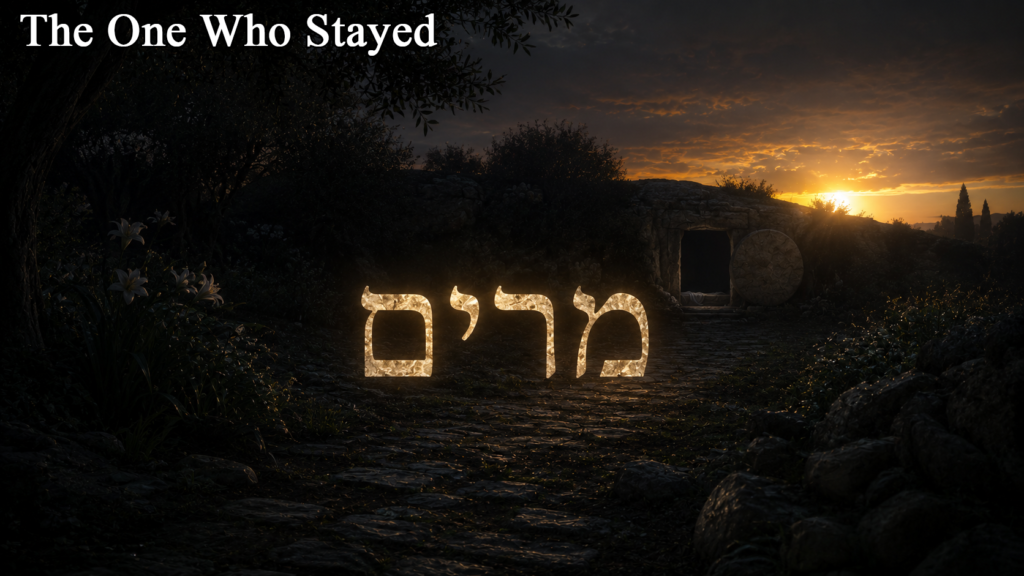
“Jesus said to her, ‘Mary!’ She turned and said to Him, ‘Rabboni!’ (which is to say, Teacher).” — John 20:16, NKJV
Seven.
Before it is a number it is a structure. Seven days and creation is complete—not merely finished but whole, the seventh day itself the completion that gives meaning to the six that preceded it. Seven branches on the menorah. Seven weeks of the Omer counting upward through the sefirot toward Sinai. The seventh year of shemitah when the land rests and debts are released. Seven is the signature of totality in the created order, the number by which the tradition marks what is whole, what is complete, what has been fully brought into being.
When Luke 8:2 tells us that Jesus cast seven demons out of Mary Magdalene, the number is not incidental. It is a theological statement: she had been wholly overtaken. Nothing of the original created order remained intact. And the restoration, correspondingly, would be complete.
Who She Was
The canonical record about Mary Magdalene is considerably more substantial than most readers realize, because the canonical record has been read through a lens that was placed over it fourteen centuries ago and has never been fully removed.
What the text actually says: she is named first among the women who followed Jesus and supported His ministry from their own means—a detail that implies both personal resources and personal commitment. She is present at the crucifixion in Matthew 27:56 when most of the male disciples have fled. She is present at the burial in Matthew 27:61. She is the first to arrive at the empty tomb in John 20:1. She is the first to encounter the risen Jesus. She is the first to be sent as witness—the first bearer of the resurrection announcement to the disciples who remained behind. The Eastern Orthodox tradition, which never accepted the Western conflation, calls her Isapostolos—equal to the apostles—and honors her accordingly.
And: seven demons cast out. Total displacement. Complete restoration. This is the Mary the text gives us.
In 591 CE, Pope Gregory the Great delivered a homily in which he identified Mary Magdalene with the unnamed sinful woman of Luke 7:36–50 and with Mary of Bethany, the sister of Lazarus. There is no textual basis for either identification. The three are distinct figures in the Gospel accounts. But Gregory’s conflation held. For fourteen centuries the Western church read Mary Magdalene primarily as a penitent prostitute—a figure of moral failure redeemed through contrition—rather than as the first witness to the resurrection.
The Catholic Church formally acknowledged the error in 1969, separating the three figures in the revised Roman calendar. The correction came 1,378 years after the conflation.
What was lost in those fourteen centuries was not merely a reputation. It was a theology. The conflation did not simply demote Mary Magdalene within the tradition’s social hierarchy. It replaced the first witness to the resurrection—the woman whose complete displacement and complete restoration made her the most precise embodiment of what the Gospel is actually about—with a moral cautionary tale. That is not a minor error. It is the substitution of p’shat for sod: the surface reading that flattens what the depth would have illuminated.
The Seven
Seven demons. The number marks totality: she was not partially afflicted, not significantly troubled, not struggling with persistent difficulties. She was wholly overtaken. Whatever had overtaken her had done so completely—nothing left outside its reach, nothing of the original order intact.
The restoration corresponds to the condition. Jesus does not partially restore her. He casts out all seven. The created wholeness that seven had marked as absent, seven now marks as returned. Complete expulsion met by complete restoration—and then something more than restoration. Because grace is not the return of what was lost. It is the transformation of the one who receives it. Mary after the healing is not Mary before the seven demons. She is Mary formed by the encounter with the Word that restored her, and that formation is precisely what makes her capable of what comes next.
The early Jesus movement preserved traditions about Mary that the canonical process largely marginalized. The Gospel of Mary—a second-century text carried by minority streams of the tradition and surviving only in fragmentary form—presents her receiving direct teaching from the risen Jesus and reporting it to the disciples, several of whom resist her account. Whatever its canonical status, the text preserves something historically significant: the memory, within early Christianity, of Mary Magdalene as a figure of considerable theological substance—not a bystander to the resurrection but a recipient and transmitter of its deepest teaching.
In that text, the soul’s ascent is mapped against seven powers it must name and move past: darkness, desire, ignorance, zeal for death, the kingdom of the flesh, foolish wisdom of the flesh, wrathful wisdom. Each one a layer of captivity the soul carries; each one requiring naming before it can be released. The framework is not identical to the seven demons cast from Mary—the traditions are distinct and should not be collapsed into each other. But the resonance is not accidental. Seven as the number of totality operates in both registers: the complete overtaking of the one who is consumed, and the complete range of the soul’s interior obstacles on the path toward wholeness. The woman who had lived through the seven carried within her an interior knowledge of what it is to be consumed and restored that no one who had not lived it could possess.
The Irony of Gregory
In 590 CE, the year before his homily conflating the three Marys, Gregory the Great completed his consolidation of what the tradition would call the seven deadly sins. Evagrius Ponticus had identified eight logismoi—eight troubling thoughts that afflict the soul—in the fourth century. John Cassian had brought the framework west. Gregory collapsed eight into seven, folding vainglory into pride and adding envy, and produced the list the Western tradition has carried ever since: pride, greed, lust, envy, gluttony, wrath, sloth.
The number seven is doing the same work it always does: marking totality, the complete compass of human moral ruin, nothing left outside the account.
Gregory reached for seven to map the totality of human moral failure. The following year—590 and 591 CE, the same papacy, consecutive years—he conflated the woman whose seven marked the totality of her restoration with a figure of moral failure he had constructed from three distinct Gospel women. The same theological instinct about what seven means. Applied in one case to produce a framework of human brokenness, and in the other to bury the woman whose seven demons and complete restoration made her the most powerful single embodiment of what grace actually does.
The covenant has never recognized the gates the gatekeepers erect. But the gatekeepers can bury what they cannot gate. And for fourteen centuries, they did.
The Displaced at the Center
This is the pattern the healing series has been tracing from the beginning. The Logos speaks restoration into whatever it touches, across whatever boundary the world has drawn to limit access. The centurion, the Syrophoenician woman, the Samaritan leper, the woman at the well—in every case, the one who was furthest from the center of the covenant structure received the Word most directly and recognized it most clearly. The kingdom does not move from the center outward. It moves toward the displaced.
Mary Magdalene is where this pattern reaches its fullest expression. Seven demons: the most complete displacement in the healing narratives. First witness to the resurrection: the most consequential position in the entire Gospel. The woman most wholly overtaken is entrusted with the first word of new creation. Not despite her seven. Because of what the seven made possible in her.
The displaced are not healed and returned to the margins. They are healed and placed at the center. This is not a social program. It is the nature of grace—which does not seek the whole and the settled but moves toward the broken, and in finding them, makes them the first to carry what it has given.
Miriam
Before dawn. The stone already rolled away. Mary stands outside the tomb weeping, alone, after Peter and the beloved disciple have seen the empty grave clothes and gone home. She does not go home. She stays.
She looks into the tomb and sees two angels. They ask why she is weeping. She turns—and finds herself addressed again, by someone she takes for the gardener:
“Woman, why are you weeping? Whom are you seeking?” — John 20:15, NKJV
She does not recognize Him. She asks whether He has taken the body and where He has laid it. And then He speaks her name.
“Miriam.”
One word. The covenant restored. The name that costs nothing and obligates everything—that builds the channel between creator and created, that draws the named one into the order that includes her, that says: you are mine, I know you, you belong. She recognizes Him in the speaking of it. Not in the face. Not in the wounds. In the name.
John’s resurrection account is structured to echo Genesis 1 and John 1: the garden, the darkness before dawn, the Word spoken into the void. The Logos that called light from darkness in the first creation speaks a name in the garden at dawn and new creation begins. The first morning of the world had no witness—the Word spoke into the dark and light was. The first morning of the new creation has one: the woman who came before dawn, who stayed when the others left, who wept at the threshold of what she could not yet understand.
She is sent immediately. “Go to My brethren and say to them…” The first word of the resurrection. The first commission. Given to the one the tradition spent fourteen centuries misidentifying. Given to the one who had been most wholly displaced and most wholly restored. Given to the one who stayed.
The Word spoke her name. She became the first witness. This is what the healing series has been moving toward from the beginning: not merely that the Logos restores creation, not merely that it crosses every boundary the gatekeepers erect—but that the one it seeks most urgently, the one it places at the center of the new creation’s first morning, is the one who has been most completely consumed.
Seven demons. Complete displacement. Complete restoration. First witness.
Those who have known their own forms of complete displacement will recognize what is being described here—not as theology, but as something that happened.
The kingdom’s grace does not arrive at the margins and offer return to those who wait there patiently. It arrives at the margins, speaks the name of the one who has stayed, and sends her to tell everyone else what she has seen.

Discover more from Many Lamps, One Flame
Subscribe to get the latest posts sent to your email.