
The Mishkan has no windows. The menorah is not there to help anyone see.
Inside a windowless tent, in perpetual shadow, stands a lamp that faces away from every human being who might need its light. Its seven flames are directed inward—toward the central shaft, toward the Parochet, the curtain that screens the Holy of Holies, toward the Presence that requires no lamp at all. This is not a liturgical accident. The menorah’s orientation is its argument. To understand what it is doing here, we have to abandon every assumption about what light is for and read the menorah as what it actually is: a diagram of how covenant moves.
The Beaten Work
The Torah specifies that the menorah must be mikshah—hammered from a single talent of pure gold. It cannot be cast in pieces and assembled; there are no seams, no solder, no joints. Seven branches must emerge from one block of metal, beaten into differentiation under the craftsman’s hammer. This is not manufacturing; it is formation under pressure. The gold yields until the latent form becomes visible.
The menorah’s design makes its theology visible. The base from which the central shaft rises is Malchut—the point of manifestation, where divine abundance enters the world of form. The shaft itself ascends through Yesod, the channel of covenant and transmission, toward Tiferet—harmony, integration, truth—the sefirotic center where the flow is gathered. From Tiferet, three branches extend to the right: Chesed, Netsach, Chokhmah in its lower expression. Three extend to the left: Gevurah, Hod, Binah reaching downward into form.
All six are inclined toward the center; the branches lean inward. Even in gold, the structure refuses dispersion. Everything turns toward integration. The hammered work—mikshah—is not merely a manufacturing technique but a visual argument. The branches emerge from one source and remain oriented toward it.
From each branch hang cups shaped like almond blossoms—gevi’im, from shaked, the root that means to watch, to be wakeful, to hasten toward. The cups are not passive vessels. They are oriented, alert, expectant.
The entire structure faces across the Heichal (the sanctuary’s outer chamber) toward the Parochet and the Presence beyond it—not because of where it is placed, but because of what it is built to do. The shefa flows upward through Yesod into Tiferet, gathered by six branches that will not look away from the center. The branches do not illuminate the tent. They illuminate each other’s source. The light converges.
The Talmud records the tradition’s discomfort with this arrangement. In Menachot 86b, the Sages press the question: does the Holy One require our light? The Creator of light is illuminated by a lamp inside a tent? The answer they give is not a reassurance about divine need. It is a redefinition of the act. The menorah is edut—testimony. Ner le-orah: light directed toward the Light. Israel is not supplying something G‑d lacks. Israel is participating in a directed movement whose meaning lies entirely in its orientation. The flame points. That pointing is the covenant made visible in gold.
Aaron’s Portion
When Aaron watches the twelve tribal princes bring their dedications in Naso, he brings nothing. Each prince presented the same vessels—silver bowls, golden spoons, the same weights, the same materials—and encoded into those identical objects an entirely unique interior world. Bamidbar Rabbah 13:14 records that each prince offered his gift regarding significant matters and according to his own perspective: for one, the silver bowl encoded the seas Solomon would rule; for another, the twenty-four books of Torah; for another, three letters whose gematria equaled the words that had saved Joseph’s life. Twelve tribes. Twelve theological worlds. One set of vessels. Aaron and his tribe bring nothing to that altar. The midrash imagines his silence and answers it: “By your life, your portion is greater than theirs. Theirs was once; yours is perpetual.”
The word perpetual requires examination. The princes brought kavanah—focused intentionality—to an event with a beginning, a middle, and an end. Aaron brings himself, daily, to the same act. The perpetuity is the point: covenant is not an achievement that can be deposited and walked away from. It is ongoing participation. The channel must be tended, or it silts shut.
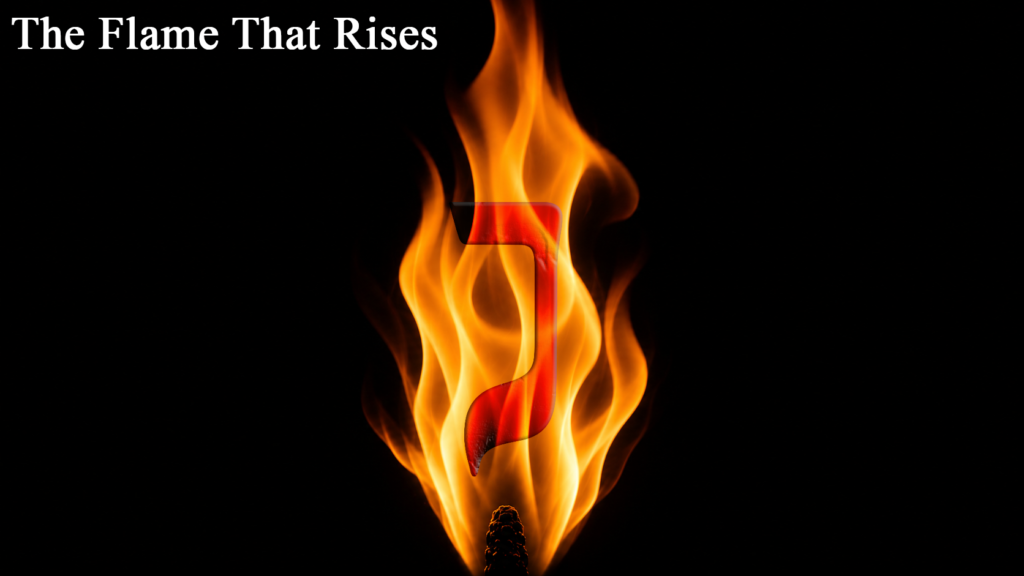
The instruction given to Aaron is precise in its language. Not “when you light the lamps” but b’ha’alotcha et ha-nerot—“when you cause the lamps to ascend.” The halakhic interpretation is exact: the priest holds the flame to the wick until the fire catches and rises entirely on its own, at which point the priest withdraws. Aaron initiates the upward movement; then he removes his hand. When the meeting between human tending and divine fire is genuine, the flame becomes self-sustaining.
This is the two-way structure of covenant made visible in the act of kindling. Not Aaron doing something to the menorah. Not G‑d doing something through Aaron. The flame is the product of both movements simultaneously. The channel must be tended because covenant is not a singular event at the foot of a mountain. It is the quiet, daily discipline that keeps the flow from stopping.
Conduit, Not Container
To be created b’tzelem Elohim—in the divine image—is too often read as a passive designation: humanity as mirror, reflecting divine presence back into the world like a polished surface. But the menorah implies something far more demanding. The image is not about resemblance; it is about vocation. Israel is not created to look like G‑d; Israel is created to act as G‑d acts—to sustain, to tend, to keep the flow moving. To be constituted in the divine image is to be built as a channel through which shefa—divine influx, abundance, vitality—can move in both directions. We are not simple receptacles; we are active participants.
The tribal kavanah from Naso finds its structural complement here. A vessel without human intentionality is nothing but an empty bowl. The same silver, the same weight—without the interior world of the giver, the object remains inert: there is nothing to return to the Source. G‑d provides the vessel and the fire; Israel provides the intention that makes the flame rise. We are partners in creation—not because we add anything to G‑d, but because we have been chosen to participate in creation and accepted His call.
This is the diagram the menorah presents to the camp. Its branches do not retain the light at their extremities. Nothing is hoarded. The shefa flows through, and the human act of tending it—daily, perpetually, with full attention—is what keeps the channel open. When the channel closes, the structure does not collapse. The gold remains. The fire remains. Only the rising stops.
The Inverted Letter
The Talmud in Shabbat 115b–116a cannot quite decide what to do with the nun hafuchah. Rabbi Yehudah HaNasi reads the inverted letters as the boundaries of an entirely separate book—which would make Torah seven books rather than five, the seven pillars of Wisdom in Proverbs 9:1. Others read the inversion as a displacement marker: these verses belong elsewhere in the text, after the arrangement of the tribes in Numbers 2, and the nun signals their misplacement. A third reading treats them as a buffer, a scribal quarantine inserted to prevent two episodes of national failure from touching each other directly in the text.
The tradition circles the nun hafuchah without landing—which is itself significant. These verses resist categorization because they are genuinely anomalous. The inverted letter is the Torah’s own signal that something is happening here that the ordinary tools of reading cannot fully account for.
What those tools miss is the nun itself. The nun is the letter of nefesh—soul—and of nefilah—falling. The connection is not incidental: the Talmud in Berakhot 4b notes that Psalm 145, the great alphabetic psalm of praise, omits the nun verse entirely, because of the nefilah of Israel evoked in Amos 5:2—“Fallen is the virgin of Israel, she shall rise no more.” The nun carries falling in its nature.
To invert it is not to eliminate that weight but to suspend it—to place the letter of collapse in the posture of not-yet-fallen, around the one moment in the wilderness narrative when Israel was not falling. The bracketed verses describe complete covenantal function: the Ark moving, the people moving with it, the Presence leading, the shefa flowing in both directions exactly as the menorah was built to diagram. And the Torah marks that moment with an inverted nun—the letter that knows what it is, that cannot stand upright even here, because nefilah is already written into its form.
The inversion is not notation for failure. It is notation for the unbearable brevity of the moment before it.
The verses themselves read: “Rise up, O L‑rd, and let Your enemies be scattered; let those who hate You flee before You” and “Return, O L‑rd, to the countless thousands of Israel.” The Ark moves. The people move with it. The Presence leads and, when the journey rests, is called back. The shefa descends; Israel is oriented upward and forward, moving as one toward the destination. The covenantal two-way flow is operating exactly as the menorah was built to diagram—for two verses.
Then the craving begins.
The demand for meat. The weeping for the fish of Egypt. The rejection of the manna—which arrived each morning as pure shefa, requiring only that it be gathered and received. Manna is received; meat is demanded. Manna participates in flow; meat satisfies possession. The people turn from conduit to container. They want to fill and to hold and to consume. The flame that was rising stops rising—not because G‑d withdrew the fire, but because the human side of the two-way movement closed.
The nun inverts not to mark a near-miss or a fragile moment. It inverts to mark an interruption. The letter is present but cannot stand upright, because something passed through here that could not be held. The Torah’s own editorial notation on two verses of complete covenantal function, surrounded on both sides by collapse.
The Flame That Rises
The menorah keeps burning. Aaron enters the dark, windowless tent the next morning, and the morning after that, tending the wicks regardless of what is happening in the camp outside. The perpetual light is not contingent on Israel’s faithfulness in the wilderness. The Mishkan holds the ideal that the people keep losing in the desert dust.
But the Zohar insists on something the plain reading of the text obscures: the Mishkan was not built in the image of the human being. The human being was built in the image of the Mishkan. The exterior sanctuary is the externalization of an interior structure that already exists in the soul—which means the menorah in the tent has a counterpart in every human heart. The same base. The same central shaft. The same six faculties, each a distinct expression of the divine image, each built to incline toward center rather than disperse outward into appetite. The soul has a Tiferet. It has a Yesod through which shefa moves. It has branches that either turn toward their source or turn away from it.
This is the interior work Aaron’s perpetual tending points toward. The priest who holds the flame until it rises on its own and then withdraws is modeling what kavanah does in the soul: the daily, deliberate reorientation of the interior branches toward center, until the flame becomes self-sustaining. Not once. Not at a mountain. Daily. The channel silts shut without tending.
What the wilderness narrative shows is what happens when the soul’s menorah is left untended. The branches of Israel’s collective interior—stirred, oriented, briefly and completely aligned during those two bracketed verses—disperse the moment the craving begins. The soul turns from its center toward its appetite. The shefa that was flowing stops flowing, not because the Source withdrew, but because the branches stopped inclining inward. The flame that was rising stops rising.
The nun hafuchah is not a record of failure. It is a record of two verses in which Israel was, briefly and completely, what it was created to be: a living channel through which shefa descended and kavanah ascended and the flame rose between them. The letter inverts because the text knows what comes next. The people did not. The diagram remains—in the sanctuary, and in the soul. The question of whether the interior branches will incline toward center, whether the tending will be daily and deliberate, whether the flame will be held until it rises on its own—that question is handed forward, still open.

Discover more from Many Lamps, One Flame
Subscribe to get the latest posts sent to your email.