
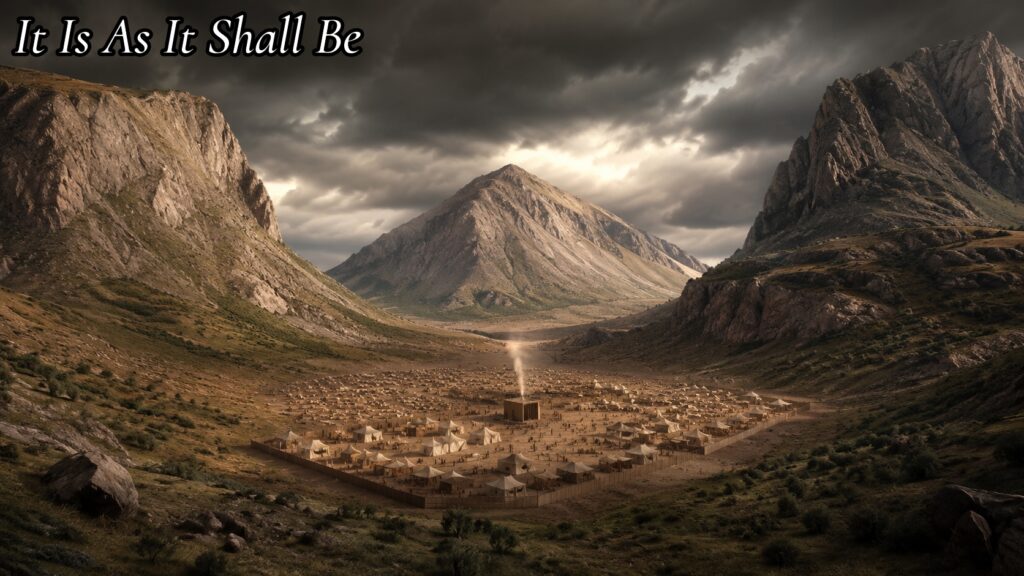
G‑d said to Balaam: You shall not curse the people, for they are blessed. — Numbers 22:12
Balak watches the first oracle end and does the only thing his frame allows him to do: he moves Balaam to another mountain. Not because the first location failed—the oracle came through with complete clarity. Not because he doubts his diviner—Balaam’s credentials are not in question. He moves because he cannot conceive of a world in which reality is not positional—in which what is true does not shift with the angle of approach. The conditions must have been wrong. The summit must have been imperfect. A different mountain will produce a different oracle. He does not yet know that it is as it shall be.
The second mountain produces the same oracle. So does the third. Balak is not being stubborn. He is acting with perfect consistency inside a cosmology that cannot account for what he is encountering.
The Logic of Relocation
To understand what Balak is doing, you have to take his worldview seriously. He is not a fool. In the ancient Near East, blessing and cursing were not wishes—they were forces that operated according to specific conditions. The right practitioner, the right ritual, the right positioning relative to the object of the curse. Balaam is known throughout the region as genuinely effective. Numbers 22:6 makes this explicit: “For I know that he whom you bless is blessed, and he whom you curse is cursed.” Balak has hired the real thing.
When the first oracle blesses Israel instead of cursing it, Balak’s conclusion is entirely rational within his frame: the conditions were imperfect. He never questions Balaam’s legitimacy. The instrument has proven itself before. The failure therefore cannot reside in the practitioner. It must reside in the ritual conditions surrounding the act. So he adjusts the conditions. He takes Balaam to the top of Pisgah, then to the peak of Peor. Three mountains. Three altars. Three sets of seven bulls and seven rams. The technique is identical each time. Only the position changes.
This is not superstition in the dismissive sense. It is a coherent operational theology. It just happens to be wrong about the nature of the divine.
What the Three Oracles Actually Do
The structure of the three oracles is the essay’s argument made in narrative form. Balak’s strategy at each relocation is contraction: reduce the exposure, shift the angle, limit the field of interaction, find the position where the curse becomes available. What he gets is the precise opposite. Each successive oracle moves in the opposite direction from what he intends.
The first oracle, at Bamot Baal, establishes Israel’s separateness: Numbers 23:9— “a people that dwells alone, not reckoned among the nations.” It is a statement of identity. The second oracle, from the top of Pisgah, moves toward covenant: Numbers 23:21— “G‑d is with him, and the friendship of the King is in him.” The relationship itself is declared inviolable. By the third oracle, from the peak of Peor, something has shifted in the text itself.
The first two oracles note that G‑d “put a word in Balaam’s mouth.” The third is different. Numbers 24:2 reads: “the spirit of G‑d came upon him.” Balaam stops seeking omens entirely. What begins as blessing becomes declaration. What begins as statement becomes ontology. The oracles are not repeating—they are escalating in universality precisely as Balak escalates his attempts at tactical reduction. The narrowing and the widening are happening simultaneously, in direct proportion, and Balak cannot see that his repositioning is not neutral. It is, in some sense, producing the amplification.
Ein Sof and the Geometry of the Absolute
Balak’s strategy only makes sense if the sacred is localizable. If divinity occupies position the way kings occupy territory, then a divine force has approach angles, jurisdictional limits, blind spots that can be exploited from the right vantage point. This is a very old way of thinking about G‑d—and it is not entirely without logic. The gods of the ancient Near East were territorial. They had domains. They could be approached more or less advantageously depending on where you stood relative to their sphere of influence.
What Balak keeps encountering is a different kind of divine reality entirely. The kabbalistic tradition names it Ein Sof—the limitless, the without-end. Ein Sof does not possess a perimeter. It has no blind spots, no jurisdictional edges, no angle of approach that is more or less favorable than another. A god with jurisdiction can be manipulated. Ein Sof cannot. The shefa—the divine flow—is not bound to location. It does not strengthen as you approach it from one direction and weaken as you approach from another. It simply is, in all directions, at all distances, without remainder.
Balak is playing a game of tactical positioning against a reality that does not have positions. Every mountain he climbs brings him no closer to an angle of leverage, because there is no such angle. This is not a failure of his technique. It is a failure of his cosmology—and cosmological failures cannot be corrected by better execution of the same approach.
The Distinction That Balak Collapses
There is something important to preserve here, because the alternative reading flattens the argument. Position is not irrelevant. Where one stands genuinely matters—it shapes the angle of encounter, determines what work is available from a given vantage point, governs what becomes visible and what remains obscured. Balak’s instinct that positioning is significant is not wrong.
What he collapses is the distinction between two entirely different claims. Position governs encounter. It does not govern truth. Where you stand determines how you engage with reality. It does not determine what reality is. These are not the same claim, and confusing them produces exactly the catastrophe Balak enacts across three mountains: the belief that if you can find the right angle, the right elevation, the right approach, you can make the curse available—that is, you can make reality yield to preference by repositioning yourself relative to it.
The wilderness has been making this argument since Sinai. The spies at Kadesh looked at the land from their own vantage point and concluded that the future was closed. Korach looked at the structure of Israelite holiness from the position of one who wanted what he did not have and concluded that his claim was covenantal. Moses at Meribah looked at the people’s need from the position of someone who had carried them for forty years and concluded that striking the rock was what the moment required. In each case, a particular vantage point produced a particular conclusion—and in each case, the vantage point was mistaken for the truth. Balak does not rebel, does not grasp at holiness, does not overreach his authority. His error is more fundamental. He believes that reality itself is positional. That what is true depends on where you stand before it.
What Every Mountain Teaches
The mini-series that has been building through these wilderness portions names a single pathology across four variations. The eye that refuses what it sees. The intention that bends holiness toward possession. The vessel that exceeds its capacity. And now the position that attempts to relocate truth itself. Each is a different failure mode of the same underlying error: the insistence that reality can be made to conform to the self by altering one’s relationship to it. Fear adjusts the gaze. Ambition corrupts the intention. Exhaustion overreaches the role. And the deepest version—Balak’s version—simply moves to another mountain and tries again.
What makes Balak’s error the most architecturally fundamental is that it operates below the level of rebellion. He is not defying G‑d. He does not know he is doing anything wrong. He is executing a perfectly rational strategy within a frame that cannot account for what he is encountering. The frame itself is the problem. And frames of that kind are not corrected by argument or by failure. Balak does not repent at the end of the portion. He does not have a moment of recognition. He simply runs out of mountains.
The Last Mountain
There is a particular quality to the moment when there are no more positions to try. As long as another summit remains—another angle, another approach, another altitude from which the world might rearrange itself into something more agreeable—the project can continue. The self that believes reality is positional can always defer its reckoning. One more relocation. One more set of altars. One more attempt to find the geometry that makes the curse available.
But Balak climbs three mountains and receives three oracles, each more expansive than the last, and there is nowhere left to go. He does not find a fourth summit. He does not commission a different diviner. Numbers 24:25 records the end with the same ledger-entry economy the wilderness uses for everything it wants you to feel without explaining: “Balaam arose and went and returned to his place, and Balak also went his way.”
Each went his way. There is no resolution in that sentence. No recognition, no transformation, no moment where Balak understands what the three mountains were trying to teach him. He simply stops. He runs out of mountains and goes home.
The wilderness keeps returning the same answer regardless of where one stands within it. Reality is not obligated to negotiate. It does not have an angle of approach that makes it more yielding, a vantage point from which it becomes more amenable to what the self prefers. It simply is—complete, unyielding, untouched by repositioning—waiting at the bottom of every mountain for the moment one stops climbing and finally looks at what has been there all along.

Discover more from Many Lamps, One Flame
Subscribe to get the latest posts sent to your email.