
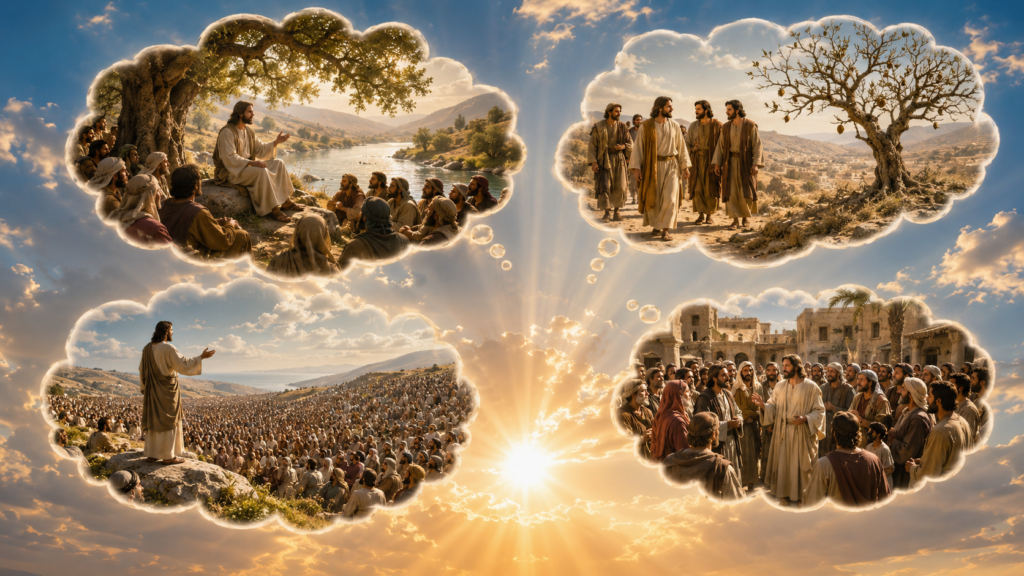
Jesus told stories. That much everyone agrees on. What those stories were, what form they took, what argument they were making, and who they were aimed at — on those questions, two thousand years of Christian reading have produced something that bears only passing resemblance to what was actually happening.
This series is a recovery project. Thirty-four essays covering the complete parable corpus, working through each text as what it actually was: a compressed legal and theological argument delivered by a Second Temple Jewish rabbi to a Jewish audience steeped in Torah, in the oral tradition, and in the live disputes of first-century Judaea. Not a moral illustration. Not an allegory with a key. Not a devotional meditation dressed in narrative clothing. An argument — and one designed to make the listener convict himself before he realizes he has been asked to render a verdict.
To read the parables on their own terms requires understanding three things: the interpretive tradition within which Jesus was working, the specific teaching form he was using, and what it means to excavate a text rather than merely describe it. Each of those has a name.
PaRDeS, Mashal, and the Work of Excavation
Jewish biblical interpretation has operated for centuries within a four-level framework known by the acronym PaRDeS — which is itself the Hebrew word for orchard. The name is not incidental. To enter the orchard of interpretation is to move through layers of meaning that deepen as you go, and the tradition carries a warning: not every reader who enters the orchard comes back out intact. The four levels are not a ladder to be climbed in sequence; they are simultaneous dimensions present in every text, each illuminating something the others cannot reach alone.
Peshat is the plain meaning — the literal, surface reading of the text as it stands. It is the necessary starting point, and it is never simply discarded. But it is not the destination.
Remez is the allusive or allegorical layer — the veiled hint, the deeper implication that the surface meaning gestures toward without stating directly. A word that carries more weight than its plain sense, a image that points beyond itself.
Derash is the comparative and parabolic layer — the level at which metaphor, analogy, and the teaching story operate. It is the level of the mashal. When a rabbi says ‘to what is this comparable?’ and then tells a story, he is working at the derash level: making an argument through compressed narrative rather than direct proposition.
Sod is the esoteric and mystical layer — the hidden meaning, accessible only through deep engagement with the text, that carries the teaching’s most radical implications. It is the level that institutional reading most consistently ignores, domesticates, or fears.
The parables of Jesus live primarily at the ‘derash’ level by form — they are ‘mashal’, the rabbinic teaching story — but the excavation this series undertakes pushes toward ‘sod’: the layer beneath the layer, where the argument’s most unsettling implications have been waiting.
The ‘mashal’ is not illustration. This point cannot be overstated, because the Christian tradition has spent two millennia treating the parables as illustrations — narrative wrappers around moral propositions, stories that make abstract truths easier to swallow. That is precisely what the ‘mashal’ is not. The ‘mashal’ is a compressed argument designed to make the listener’s own reasoning do the work. It sets a situation. It names a tension. And then it watches what the audience does. The listener is not a passive recipient of a lesson; he is the instrument through which the teaching lands.
The paradigm case is in 2 Samuel 12. The prophet Nathan comes to King David after David has taken Bathsheba and arranged the death of her husband Uriah. Nathan does not accuse. He tells a story: a rich man with many flocks takes the one beloved lamb of a poor man to feed a guest. David, hearing the story, is furious. He renders judgment immediately: the man who did this deserves to die. Nathan says: you are the man. David has convicted himself. He rendered the verdict before he knew what he was being asked to decide. That is the ‘mashal’ working at full strength.
Jesus uses the form fluently, deliberately, and with full awareness of what it demands from its audience. When the Pharisees and scribes grumble that he receives sinners and eats with them, he does not argue the point. He tells three stories. When a lawyer asks who is his neighbor, Jesus does not answer the question. He tells a story and then asks the lawyer which character in it acted as a neighbor. The lawyer answers correctly and has thereby answered his own question — in a way he could not have refused to answer had it been put to him directly. That is the form. That is what these essays are working with.
The Teacher
Jesus of Nazareth was a Jewish rabbi. He was born into a Jewish family, raised in a Jewish community, educated in the Jewish tradition, and spent his ministry teaching Jewish audiences in Jewish idiom about Jewish questions. He interpreted Torah. He debated ‘halakha’. He argued with Pharisees not because he rejected their tradition but because he was operating within it — pressing it, deepening it, recovering what had been buried under institutional accretion.
This is not a controversial claim among scholars of Second Temple Judaism. It is, however, a claim that two millennia of Christian institutional reading have systematically obscured — for reasons that are themselves part of the history this series will occasionally examine. When Jesus speaks of the Kingdom of heaven, he is not introducing a concept foreign to his audience. He is pressing on a live debate his audience is already having. When he quotes the Shema — ‘Hear O Israel, the Lord our G‑d, the Lord is one’ — as the Greatest Commandment, he is not offering a new teaching. He is naming what was always at the center.
To read the parables as the teachings of a Greek moral philosopher, a Christian theologian, or a universal spiritual teacher untethered from any particular tradition is to misread them at the foundation. The soil in which they grew was specific. The arguments they were entering were specific. The audience that first heard them knew immediately what was being said — and knew, in many cases, that they were the target. Recovering that specificity is not an act of scholarship for its own sake. It is the condition of understanding what was actually said.
The Corpus and the Clusters
How many parables did Jesus tell? The answer depends on how strictly you define ‘mashal’. Some lists count only the extended narrative parables — the Prodigal Son, the Good Samaritan, the Sower. Others include the brief sayings that operate by the same compressed-argument logic: the lamp on the stand, the new wine in old wineskins, the mustard seed. This series takes the broadest defensible view. If Jesus is using the parabolic form to make a theological point, it belongs here.
That produces 34 essays covering the complete corpus, organized into ten thematic clusters. The clustering is thematic rather than strictly chronological — though the broad arc of the series honors the historical movement from Jesus’s early Galilean teaching through Luke’s travel narrative and into the confrontational Jerusalem material of the final week. Where brief parables share a single argument with a longer companion, they are treated together in one essay rather than padded into false independence.
The ten clusters:
The Nature of the Kingdom The Matthew 13 cluster — the largest single parable session in the Gospels. Three essays cover seven parables, all describing the Kingdom from the inside: what it is, how it grows, who it gathers, and what it costs to understand it.
• The Mustard Seed, the Leaven, and the Growing Seed
• The Sower, the Seed, and the Owner of a House
• The Wheat, the Tares, and the Dragnet
The Old and the New Two parables, always paired, making one concentrated argument: the teaching cannot be contained within structures built for something else. Jesus is naming his own project.
• New Cloth, New Wine
Light and Witness What the Kingdom asks of those who enter it — visibility, full commitment, and the posture of one who has done what was required.
• The Lamp on a Stand
• The Cost of Discipleship and the Master’s Servant
Prayer and Persistence Three parables on the interior life of the Kingdom: persistence in prayer, and the relationship between forgiveness received and love expressed.
• The Friend at Midnight and the Persistent Widow
• The Moneylender
Kingdom Reversal The consistent inversion logic of the Kingdom across seven parables: the last are first, the excluded are welcomed, the self-exalted are brought low, and the presumed insiders discover they have been standing outside all along.
• The Laborers in the Vineyard
• The Other Prodigal
• The Pharisee and the Tax Collector
• The Lowest Seat and the Great Banquet
• The Rich Man and Lazarus
• The Two Sons
Who Is Greatest? The disciples argue about precedence repeatedly. Jesus answers from multiple angles, each time redirecting toward the small, the overlooked, and the easily missed.
• Becoming Like Children and Servant of All
• The Lost Sheep and the Lost Coin
Wealth and Power Jesus returns to the question of wealth more often than nearly any other subject. These parables are not about money management; they are about the structural distortion that accumulation produces in the soul and in the community.
• The Rich Young Ruler and the Eye of the Needle
• You Cannot Serve Two Masters
• The Widow’s Offering
• The Rich Fool
• The Shrewd Manager
Kingdom Priorities in Action What the Kingdom looks like when it meets concrete situations: questions of neighbor, purity, Sabbath, authority, and the Greatest Commandment itself.
• The Good Samaritan
• Sabbath Healing and Human Flourishing
• What Defiles a Person
• Render Unto Caesar
• The Greatest Commandment
Confrontation and Accountability The Jerusalem parables and the eschatological cluster — the most confrontational teachings in the corpus, delivered in the final week, aimed directly at institutional failure, saturated with urgency about what is coming.
• The Wicked Tenants
• The Unforgiving Servant
• The Talents and the Minas
• The Fig Tree, the Signs, and the Ten Virgins
• The Sheep and the Goats
• The Watchful Servants
• The Unfruitful Fig Tree
The Shepherd and the Gate John 10 stands apart from the Synoptic corpus — no parallel, different formal register — but it is mashal, and it closes the series by revealing that the parabolic teacher is himself the door.
• The Sheep, the Shepherd, and the Gate
What this series is not: devotional commentary, denominational adjudication, or the treatment of the parables as timeless wisdom literature detached from their historical moment. The parables were not timeless when they were told. They were aimed — at specific arguments, specific audiences, specific failures of understanding and imagination that Jesus could see from where he was standing.
What this series is: thirty-four essays recovering the ‘mashal’ as the Jewish teaching form it always was, reading each text in the voice of the rabbi who taught it, aimed at the arguments his community was actually having. The ‘peshat’ is always established first. Then the excavation begins — down through the ‘derash’ level where the parabolic argument lives, and where possible toward the ‘sod’ level where the most radical implications have been waiting for someone to dig far enough to find them.
Two thousand years is a long time for material to be buried. The orchard is deep. Enter carefully.

Discover more from Many Lamps, One Flame
Subscribe to get the latest posts sent to your email.