
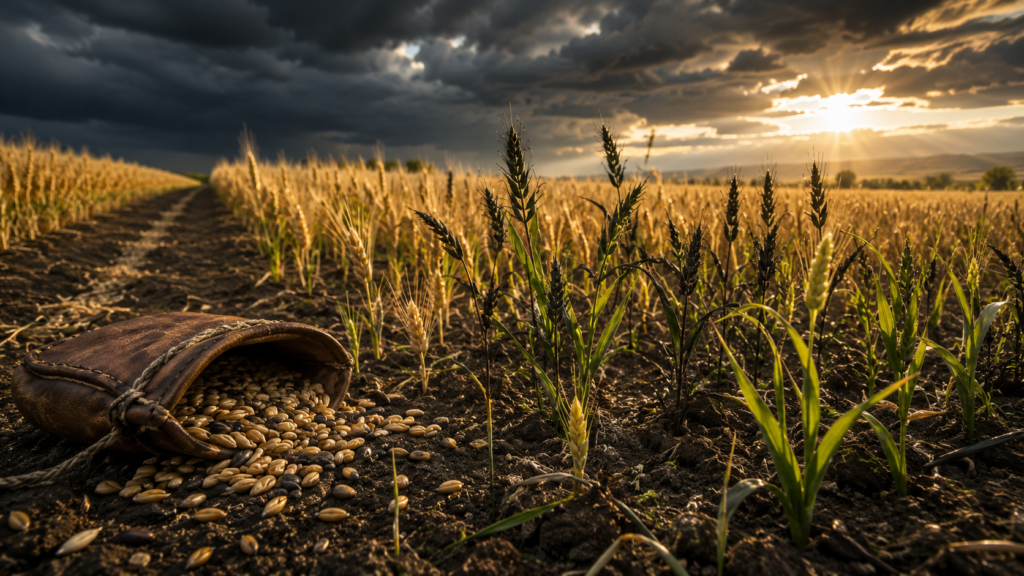
| The Sower and the Seed “Behold, a sower went out to sow. And as he sowed, some seed fell by the wayside; and the birds came and devoured them. Some fell on stony places, where they did not have much earth; and they immediately sprang up because they had no depth of earth. But when the sun was up they were scorched, and because they had no root they withered away. And some fell among thorns, and the thorns sprang up and choked them. But others fell on good ground and yielded a crop: some a hundredfold, some sixty, some thirty. He who has ears to hear, let him hear!”— Matthew 13:3–9, 18–23 (NKJV) | The Wheat and the Tares “The kingdom of heaven is like a man who sowed good seed in his field; but while men slept, his enemy came and sowed tares among the wheat and went his way. But when the grain had sprouted and produced a crop, then the tares also appeared… Let both grow together until the harvest, and at the time of harvest I will say to the reapers, “First gather together the tares and bind them in bundles to burn them, but gather the wheat into my barn.””— Matthew 13:24–30, 36–43 (NKJV) |
A crowd gathers expecting revelation.
Instead of explanation, Jesus begins talking about dirt.
Matthew 13 records the scene with unusual specificity: the same day, out of the house, by the sea, a boat required because the crowd pressing from every city has grown too large for the shore. Mark’s parallel account (Mark 4:1–20) and Luke’s (Luke 8:4–15) preserve the same parable with only minor variation—the verbal proximity across all three Synoptics is close enough to suggest a common source preceding any of them. What all three agree on completely: Jesus doesn’t address the crowd directly. He tells a story about a farmer.
Two parables follow in Matthew 13. The first describes what happens when the word meets different conditions of soul. The second describes what the enemy does while the householder is sleeping. Together they form a complete diagnostic of why the Kingdom is received by some and not others—and why the failure is seldom the sower’s.
The Sower
The sower goes out—and scatters without strategy. No selection, no curation of audience, no adjustment of technique based on what he sees. Seed falls on the path, on rocky ground, among thorns, on good soil. The word goes out to all conditions of soul equally, and what happens next is determined entirely by what the receiver brings to the encounter.
Four soils. Four states of orientation.
This is not a typology of four kinds of people sorted by moral quality. It is a description of four states of receptivity—four configurations of the soul relative to the divine source from which the word flows. The sower is not assessing his audience. The shefa—the divine flow—does not limit its initial movement according to the state of the recipient. It moves outward indiscriminately, a constant, and the variable is never the light. It is always the geometry of the vessel.
Not Pedagogy. Judgment.
Between the parable and its interpretation, the disciples ask the question directly: why do you speak to them in parables? Jesus answers with Isaiah 6:9–10:
“Hearing you will hear and shall not understand, and seeing you will see and not perceive; for the hearts of this people have grown dull. Their ears are hard of hearing, and their eyes they have closed, lest they should see with their eyes and hear with their ears, lest they should understand with their hearts and turn, so that I should heal them.”
This is the passage G‑d gives Isaiah at his commissioning—not a pastoral observation about human limitation, but a judicial declaration. The prophet’s word will simultaneously reveal and harden. Those already turned toward the divine will find illumination; those turned away will find the word confirming their misorientation. Isaiah is not sent to fix the resistant. He is sent to speak, and the speaking itself will disclose what is already present in each soul.
Jesus places himself squarely within this tradition. The mashal does not create the division between those who understand and those who do not. It discloses what is already present. The parable goes out to everyone equally—indiscriminate sowing. What each soul does with it depends entirely on which direction it is already facing.
There is mercy in this concealment. The mashal mediates—it steps the voltage down to a level the soul can encounter without being overwhelmed. A vessel not yet oriented toward the divine cannot receive the direct force of shefa without shattering. The parable wraps the teaching in narrative form, creates the conditions under which a soul can inch toward what it could not survive receiving directly. The hardening is not cruelty. It is the tradition’s acknowledgment that some vessels must be prepared before the light can enter them.
Hochmah, Binah, Da’at
The Sower is the only parable in the corpus Jesus explains directly. Mark frames the stakes plainly: if you don’t understand this one, how will you understand any of them? The interpretation is not decoration. It is the key.
Read through the Jewish mystical architecture already latent within Torah—the same framework the Kabbalistic tradition would later articulate formally—the four soils describe four states of the soul’s capacity to receive shefa.
The hardened path: Hochmah fires — the primordial flash of the word arrives, instantaneous and undifferentiated. It finds no entry. The vessel is already closed, already facing away from the source. Binah never engages. Da’at never forms to govern what is already moving in the soul. The adversary — ha-satan in its oldest sense, the prosecutorial force — adjudicates what the ground has already decided: the word cannot take root where the yetzer hara runs ungoverned. The seed lands. The ground was never waiting for it.
The rocky ground: Hochmah fires and is received—received, even, with joy. But there is no depth for Binah to develop what was perceived. The flash illuminates without taking root. When the cost appears—tribulation, persecution arising because of the word—there is nothing beneath the surface to hold. The orientation was real but momentary, and what is momentary cannot bear weight; it is forgotten.
The thorny ground is the most complex case. The seed takes root. Binah begins its work. But competing orientations enter in—the cares of the world, the deceitfulness of riches, what Mark names as “the desires for other things”—and choke the shefa before it can bear fruit. The vessel is not closed. It is divided. A soul that has opened to the word and simultaneously to its competitors cannot sustain the flow through to Da’at—the integrated knowing that is the Kingdom of Heaven made present within the soul.
The good soil: Hochmah fires, Binah receives and develops, Da’at forms. The word moves all the way through to fruit. Luke names what this requires: hypomonē—steadfast endurance, the capacity to remain under the weight of what has been received rather than throwing it off when the cost becomes apparent. Orientation is not a single moment of turning. It is the sustained posture of the soul.
The Enemy’s Seed
But the Sower describes only the internal problem—what the soul brings to the encounter with the word. Matthew 13 is not finished.
While the householder sleeps, an enemy comes and sows zizania—darnel—among the wheat. The servants discover it when the grain begins to head. Didn’t you sow good seed? Where did the weeds come from? The householder knows immediately: an enemy has done this.
Darnel in its early growth is visually indistinguishable from wheat. It draws from the same ground, competes for the same resources, looks identical until maturity forces the difference into visibility. The deception is structural, not superficial. And the servants’ instinct—to go immediately and uproot it—is exactly wrong. You cannot pull the zizania without pulling the wheat alongside it. Let both grow until the harvest. The angels will sort at the end.
The enemy moves while men sleep—and that sleep is not negligence or moral failure. It is the human condition: the inevitable rhythms of fatigue, diminished awareness, the fallow periods that follow intense waking. The counter-sowing happens precisely in the gaps that finite existence cannot close. Which is why the householder’s instruction is not a rebuke but a recognition: the sorting is not yours to do.
Jewish mysticism names this phenomenon precisely—the klipot, the husks or shells that surround and obstruct the movement of shefa, growing not from the soul’s own misorientation but sown deliberately into even prepared ground. This is not absence of orientation. It is active counter-sowing into a vessel that has already opened. The enemy does not waste seed on the hardened path or the rocky ground. He sows where wheat is already growing.
The parable identifies his method: misdirection, misinformation, seeds of discontent and confusion planted precisely where orientation was taking root. And his patience: he sows at night, while men sleep, and waits for the harvest to reveal what he has done. The task of the soul in the meantime is not to uproot what the enemy has sown. It is to continue bearing fruit despite it.
The Complete Diagnosis
Two parables. One complete picture.
The Sower asks: what does the soul bring to the encounter with the word? Is the vessel open? Is the orientation sustained? Can Hochmah move through Binah into Da’at—the knowledge that is the Kingdom of Heaven made present within the soul?
The Wheat and the Tares asks: even if the vessel is open, what else has been sown in it? The counter-sowing is deliberate, patient, and designed to be undetectable until it is too late to remove cleanly.
Together they answer what the Isaiah passage names: why the word goes out to all and bears fruit in some but not others. The failure of reception is seldom the failure of the sower, never the inadequacy of the seed. It is the condition of the ground—and the ground has more than one kind of enemy.
What the Field Already Knows
The mashal does not tell the listener what kind of soil he is. It engineers the conditions under which he discovers it himself. Jesus does not accuse. He describes a farmer, a field, a harvest—and then an enemy who moves in the dark. The listener renders the verdict.
The question the parable leaves—the one it will not answer on anyone’s behalf—is the same one Isaiah carried into his commissioning: which direction are you facing? And what has been growing in you, undetected, while you slept?

Discover more from Many Lamps, One Flame
Subscribe to get the latest posts sent to your email.