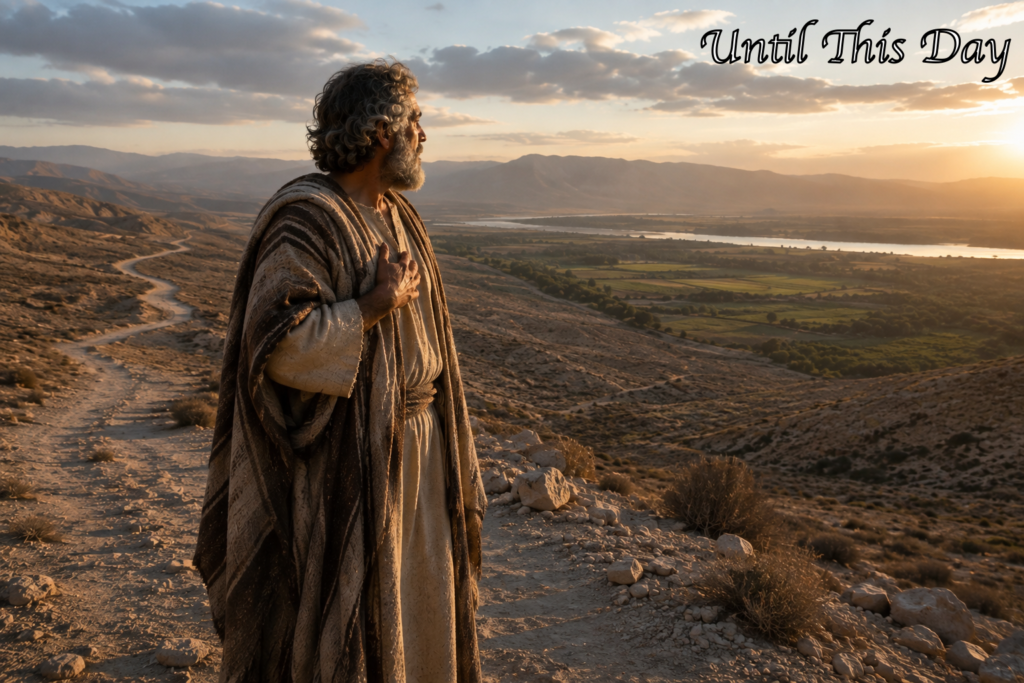
Moses has been speaking to these people for forty years. He led them out of Egypt, stood between them and the sea, carried their complaints through the wilderness, watched a whole generation dissolve into the sand. And now, near the end, standing on the plains of Moab with the Jordan in sight, he says something that should stop the reader cold. He tells them that only now—hayom hazeh, this very day—have they become a people. And a chapter later he tells them why they could not have understood any of it until this moment: the L-rd had not, until this day, given them a heart to know.
Forty years of miracles, and the capacity to grasp them arrives last.
Today?
The line comes in the middle of Moses’ instructions for the covenant ceremony Israel is to enact after crossing the Jordan—blessing and curse arranged across two mountains. In the midst of it, Moses and the Levitical priests turn to the people and say, hasket ushma Yisrael, hayom hazeh nih’yeta l’am—“Be silent and hear, O Israel: this day you have become a people to the L-rd your G-d” (Deuteronomy 27:9).
The word that should catch is hayom. Today. These are the descendants of Abraham, Isaac, and Jacob. They received the covenant of circumcision generations back. They stood at Sinai and heard the voice out of the fire. They have been a people by every ordinary measure for a very long time. In what sense do they become one only now, in the final weeks of Moses’ life, on the far side of a wilderness?
Rashi, reading the same word, refuses to let hayom dissolve into ceremony. “Each day let them be in your eyes as though you entered the covenant with them this day.” The becoming is not a date on which a status was conferred. It is a way the covenant is meant to be held—as if the whole thing were happening now, and again now, and the freshness never wears off into habit. Rashi has taken a verse that reads like a historical announcement and turned it into a description of how the relationship stays alive: by refusing to become old.
But that reading raises a harder question than it answers. If becoming a people is something that can happen today, and today, and today—what was missing on all the days before? What is it that a person can stand inside the covenant for forty years and still lack?
The Heart That Was Not Given
Moses answers it directly, and the answer is startling. Two chapters on, he gathers them again and says: atem re’item et kol asher asah Hashem—“You have seen all that the L-rd did before your eyes in the land of Egypt”—the signs, the great trials, the wonders. They saw it. They were there. And then: v’lo natan Hashem lachem lev lada’at v’einayim lir’ot v’oznayim lishmo’a ad hayom hazeh—“yet the L-rd has not given you a heart to know, and eyes to see, and ears to hear, until this day” (Deuteronomy 29:3).
The eyes saw. The heart did not know. Moses draws the sharpest possible line between witnessing an event and comprehending it—and he insists these are not the same faculty and do not arrive together. A person can stand at the sea with the water standing up on either side, can eat bread that fell from the sky every morning for four decades, and still not possess the organ by which any of it becomes understood. The seeing was immediate. The knowing was not yet given.
And Moses dates the arrival of that knowing to the same word he used two chapters earlier: ad hayom hazeh, until this day. The heart to know and the becoming-a-people are pinned to the same moment. Rashi, on this very verse, makes the connection explicit. He recounts that on the day Moses gave the Torah scroll to the tribe of Levi, the rest of Israel came to him in protest—we also stood at Sinai, we also received it, why should it be handed to Levi as though it were theirs alone? And Moses, Rashi says, rejoiced at the objection, because it meant they had finally begun to grasp what they held and to want their portion in it. That is the day, Rashi says, that Moses meant when he told them hayom hazeh nih’yeta l’am—this day you have become a people. The grasping and the peoplehood are the same event. A people is not a crowd that witnessed the same miracles. It is a body that has come to know what it witnessed—and to fight for its share in it.
Forty Years
Why then? Why does the heart arrive at the end and not the beginning, when the wonders were fresh and the deliverance still wet on their feet?
The Talmud finds something intrinsic in the delay. In Avodah Zarah 5b, Rabba takes Moses’ own words—the L-rd has not given you a heart to know until this day—and draws a principle from the arithmetic: “a person does not fully grasp the mind of his teacher until forty years have passed.” The years were a sentence, in part; the generation that came out of Egypt did not, in the end, cross into the land. But the same span, Rabba hears, is also the measure of how long comprehension takes when the thing to be comprehended is large enough. It was not simply that they failed to understand for forty years. It took the forty years to understand—because that is what understanding of this order requires.
This reframes the entire wilderness. The desert was not merely a delay between the miracle and the land, an interval to be waited out. It was the duration of formation itself—the span across which a mind is slowly made capable of holding what it was shown. The manna, the water, the cloud and the fire, the daily dependence with no reserve and no storehouse: this was not the interval before the lesson. It was the lesson, administered at the only speed a human being can actually absorb it. Moses is not telling them they wasted four decades. He is telling them the four decades were the making of the heart that can now, finally, know.
There is something in this that resists every instinct toward the instantaneous. Revelation, in the Sinai account, is a single overwhelming moment—thunder, fire, a voice. But the capacity to have received it is built the slow way, grain by grain, over a lifetime. The event is sudden. The person who can understand the event is not.
Not Alone
There is a further strangeness in how Moses says it, and it is easy to read past. When he tells them hayom hazeh nih’yeta l’am—this day you have become a people—the verb is singular, a whole camp addressed as one. And the heart that was missing is given to that same collective—lachem, to all of you—a single lev, one heart, between them. Many who saw; one heart to know; one people. The grammar will not by itself carry a doctrine, but the picture it draws is hard to unsee: the knowing appears not merely as private attainment but as something belonging to the body they have become.
This cuts against the way comprehension is usually imagined. We tend to think of understanding as the most private thing a person owns—a light that goes on behind one set of eyes, incommunicable, alone. But the Torah locates the arrival of knowing at the exact moment a crowd of individuals becomes a people, and it treats the two as inseparable. What was missing in the wilderness was not forty years of private study. It was the slow forging of a common body that had been through one crucible together—the same sea, the same bread, the same fire, the same forty years—until the seeing that each did alone could finally become a knowing they held in common.
This is why the desert had to be shared. A single person can witness a wonder. But the kind of knowing Moses is describing—the knowing that makes a covenant hold—is not assembled inside one skull. It is what a people arrives at when its members have carried the same weight long enough that the weight becomes a shared possession. Rashi’s image catches exactly this: the people come to Moses together, as one voice, demanding their portion in the Torah. That demand is the heart to know made audible—the sound a people makes when it has finally understood what it is holding, and understood that it holds it in common.
Every Day, the Covenant Is New
Return now to Rashi’s reading of hayom—“each day let them be in your eyes as though you entered the covenant this day.” Placed beside the heart that took forty years to form, the instruction turns from pious encouragement into something structural.
If comprehension is built slowly, then it is also losable slowly—the way any built thing decays when it is no longer tended. The heart to know is not a possession acquired once and kept in a drawer. It is closer to a discipline, a capacity that stays alive only by being exercised. This is what Rashi is guarding against when he insists on today. The danger to a covenant that has become old is not that anyone forgets its terms. It is that the knowing goes cold—that the miracle becomes a fact one has always known rather than a wonder one is still grasping. The remedy is to receive it again. Not to re-enact a ceremony, but to hold the whole inheritance as though the heart to know it were being given this morning, and had to be exercised before nightfall.
Notice what this does to the word today. It unfastens it from any single date. The day the heart was given was a specific day at Moab—but Rashi makes it a day that recurs, that can be this day, for anyone standing inside the covenant at any point in the long chain after. The becoming-a-people is not sealed behind us in history. It is the standing offer of the text: that the capacity to understand what you are part of can arrive today, if you will hold it as though it might.
The Gift Before the Capacity
There is one thing left, and it is the strangest of all, though it has been sitting in plain sight the whole time.
The covenant was given first. Sinai came at the beginning of the forty years, not the end. The people received the whole of it—the law, the terms, the binding—four decades before Moses tells them they finally have the heart to know what they received. The gift preceded the capacity to hold it by a lifetime.
This inverts the order a reasonable person would expect. We assume you must understand a thing before you can be bound by it—that comprehension comes first and commitment follows, that no one should be asked to keep what they cannot yet grasp. The Torah does it the other way. It gives the covenant to a people who cannot yet understand it, and trusts the understanding to arrive over forty years of living inside what they already agreed to. The keeping comes first. The knowing ripens within the keeping.
Which means the heart to know was never the price of admission. It was the yield. The people did not earn their way into the covenant by first understanding it; they were handed it whole, in advance of any capacity to hold it, and the capacity grew inside the holding. Hayom hazeh nih’yeta l’am—this day you have become a people—is not the record of a graduation. It is what a gift sounds like, forty years on, when the ones who received it before they could understand it have finally, together, grown the heart to know what they were given.

Discover more from Many Lamps, One Flame
Subscribe to get the latest posts sent to your email.