
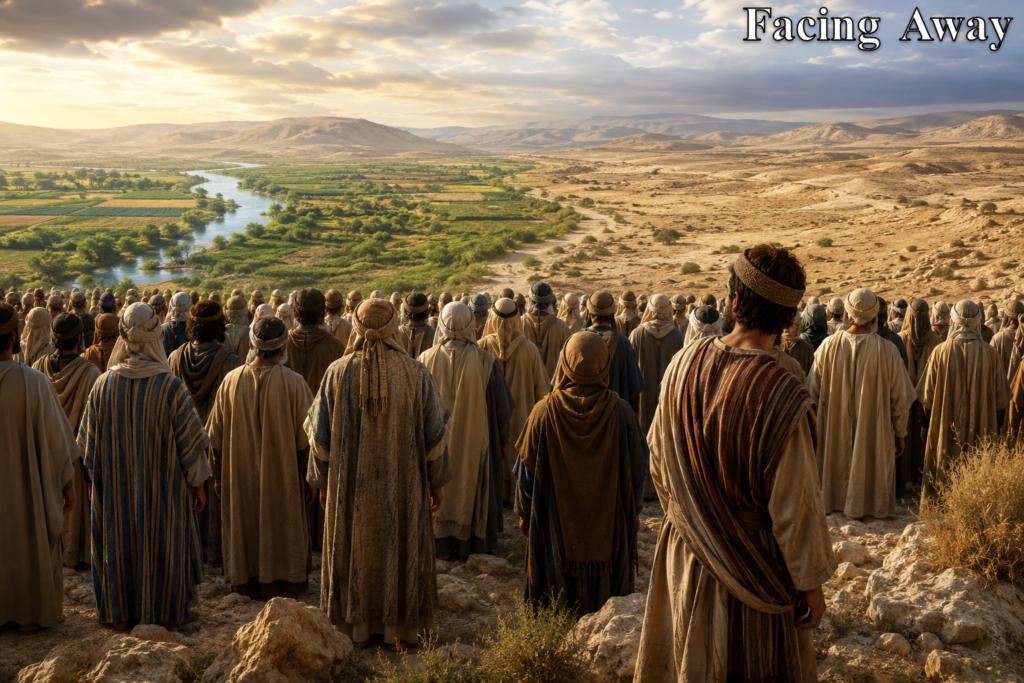
Perchance there is among you some man or woman, or some clan or tribe, whose heart is even now turning away from the L-rd our G-d to go and worship the gods of those nations—perchance there is among you a stock sprouting poison weed and wormwood. When such a one hears the words of these sanctions, he may bless himself in his heart, thinking, “I shall be safe, though I walk in the willfulness of my heart”—to the sweeping away of the watered with the dry. The L-rd will not be willing to forgive him. Rather shall the L-rd’s anger and passion rage against that man, till every sanction recorded in this book comes down upon him, and the L-rd blots out his name from under heaven.— Deuteronomy 29:17–19
He has served no foreign god. The verse before has his heart turning, and its purpose clause is lalechet la’avod—to go and serve—an infinitive of intention, not a record of anything done. He is standing in an assembly. He is listening to terms being read aloud. And somewhere in the middle of that reading, without moving and without speaking, he performs the one act in this parashah that draws the sentence lo yoveh Hashem s’loach lo.
The Man Who Was Counted
The chapter opens with one of Torah’s most exhaustive statements of inclusion. Atem nitzavim hayom kulchem lifnei Hashem Elokeichem—you are standing today, all of you, before the L-rd your G-d—and then the enumeration begins and refuses to stop. Tribal heads. Elders. Officials. Every man of Israel. Children, wives, the ger within the camp. And then, as though the list might still be read as covering only those who count, mechotev etzecha ad sho’ev meimecha: from your woodcutter to your water-drawer.
Midrash Tanchuma, reading this opening, hears in kulchem the principle the Talmud derives from Leviticus—that all are arevim zeh bazeh, guarantors for one another. And Tanchuma presses it in both directions. One person’s failure can implicate the generation. But also afilu tzaddik echad beineichem, kulchem omdim bizchuto—even one righteous person among you, and all of you stand by his merit. Responsibility travels across the body. So does merit.
Hold that. The enumeration is not scenery.
Nine verses after the roll call closes, the passage that has just assembled everyone performs its one act of hivdil. V’hivdilo Hashem l’ra’ah mikol shivtei Yisrael—the L-rd will separate him out for misfortune from all the tribes of Israel. The verb of havdalah, of division, the word for making one thing not the other thing.
Ramban supplies the connection, and it is not the one a reader expects. The severity follows from the man’s own position: she’eineni mekabel alai hash’vua—that he does not accept the oath upon himself—keivan sheba bivrito lefanai im kol Yisrael, since he came into His covenant, before Him, with all Israel. The refusal is generated by the entry. He is not an outsider who declined. He is inside, enumerated, standing somewhere between the elders and the water-drawer, and from that position he exempts himself.
Two Directions of Walking
The passage gives two destinations for a single motion, in consecutive verses, using the same verb of going.
The first is named plainly: lalechet la’avod et elohei hagoyim hahem, to go and serve the gods of those nations. That is the direction the tradition has always been able to see, and it is why the verse is usually read as a warning against idolatry.
The second appears one verse later, in the man’s own mouth: ki bishrirut libi elech—for in the willfulness of my heart I will walk. Same verb. No foreign god anywhere in the sentence. The destination is interior.
Onkelos shifts the emphasis inward, rendering the phrase b’harhor libi ana azil: according to the thought of my heart I walk. A man consulting the only counsel he still recognizes.
And the text does not wait for the first walk. It answers the second.
That speed is worth holding still for. After the calf, Moses asks that Israel’s sin be borne, and the answer he receives is mi asher chata li emchenu misifri—whoever has sinned against Me, him will I blot out of My book—followed immediately by deferral: uv’yom pokdi ufakadeti aleihem chatatam, on the day of My accounting I will bring their sin to account. Blotting is there. Delay is there. What is not there, after an act of worship actually performed, is the sentence that appears here before any act at all: that G-d will not be willing to forgive.
Ramban is careful about that timing, and the care matters. V’lo yislach lo, he writes—He will not forgive him—aval ye’ashan alav apo az k’sheyecheta, but His anger smokes against him then, when he sins. The unwillingness attaches now. The reckoning waits for the deed. Which means the passage is not describing punishment for an inclination. It is describing a rupture that has already occurred at the level of the relationship, before anything visible has happened in the world.
What He Kept
What makes the rupture is a grammatical fact, and it is easy to walk past in translation.
V’hitbarech bilvavo. Rashi will not let the reflexive slip by; he glosses it benoir soi in the vernacular of his readers and files it alongside “he shaves himself” and “he prays.” Lashon berachah, he says—the language of blessing—yachshov b’libo birkat shalom l’atzmo: he conceives in his heart a blessing of peace for himself.
He has not abandoned blessing. He has removed the one who blesses.
And the self-issued blessing keeps the covenant’s own shape. Shalom yihyeh li. Not that the L-rd will grant him peace, not that peace will be given—simply that peace will be his. A sentence with no counterparty in it at all. The words are the covenant’s words, berachah and shalom, and they are being used by a man who has turned from being with—me’im Hashem Elokeinu, the verse says, not merely away from but away from being with—and who therefore has no one in front of him from whom anything could come. So he addresses himself. The self-blessing is not bravado. It is what withdrawal sounds like from the inside: a man ruling on his own case because, from where he now stands, there is no longer anyone across the table.
There is a deformation here worth naming. Moses returns repeatedly in this book to a single boundary: lo tosifu al hadavar asher anochi metzaveh etchem v’lo tigre’u mimenu, do not add to the word and do not subtract from it. The terms are not amendable by the parties bound to them. This man adds nothing and subtracts nothing. He has not changed what Torah says. He has changed whom he believes Torah is saying it to—which is the inverse of the discipline the same book asks for elsewhere, where darash refuses to accept a reading merely because it feels right.
The Watered and the Dry
The verse ends in a phrase that has never been securely translated: l’ma’an sfot haravah et hatz’mei’ah, to sweep away the watered with the thirsty. It occurs nowhere else in Tanakh, and the major readings do not agree.
Ibn Ezra takes ravah and tz’mei’ah as people. The watered are the righteous; the dry, the wicked. And on that reading the man’s interior reasoning becomes fully articulate: he will survive by the righteousness of the righteous, because they are many and he is one sinner among them. His self-blessing is not a fantasy about consequences evaporating. It is a calculation about coverage.
His premise is correct. Collective merit is not something he invented to excuse himself. The Tanchuma, reading the roll call that opened this scene, said it in as many words: even one righteous person among you, and all of you stand by his merit. He has understood the structure he is standing in.
His error is finer than a mistake about how covenants work. He has taken the covenant’s shared merit seriously and its shared obligation selectively.
Rashi and Onkelos read the phrase along a different axis. For them ravah and tz’mei’ah are conditions rather than persons—the drunk who acts without knowing what he does, and the thirst that acts deliberately, wanting what it wants. Rashi’s gloss is that the inadvertent transgressions, the shogeg acts passed over until now, are added to the account alongside the deliberate ones. Not reclassified; the past does not become intentional. Simply no longer overlooked. The exemption he issued himself reaches backward and closes a leniency that had been operating quietly behind him.
Two readings, two mechanisms. But they refuse the same thing. In Ibn Ezra he wants the community’s righteousness to run toward him. In Rashi he wants his own history to keep receiving a mercy he has just declared himself not to need. Both are claims that the covenant runs asymmetrically in his favor, and neither reading grants it.
Solidarity as Insurance
Rambam, approaching the same problem from the laws of teshuvah, arrives at haporesh min hatzibur—one who separates himself from the community. The reason he gives is not disciplinary. It is structural: lefi shebizman she’ya’asu teshuvah lo yihyeh imahen v’eino zocheh imahen bizchut she’osin—because at the time they make teshuvah he will not be with them, and he does not merit with them in the merit they acquire.
He is not saying the separated man is denied a benefit as a penalty. He is saying the man will not be there when it is made.
Set beside Ibn Ezra’s calculation, the two texts close on the same point from opposite ends. The man wants the merit of the many to reach him while his obligation to the many reaches no one. He is not wrong that covenantal merit can be shared. He is wrong that he can sever covenantal obligation without severing his claim upon covenantal merit. Solidarity is not a policy one holds. It is a position one occupies, and it pays outward before it pays in.
This is what the roll call was establishing. Kulchem was never a courtesy extended to the woodcutter. It was the description of a body in which no one’s covenantal standing is entirely private.
Shalom Yihyeh Lachem
The phrase does not stay in Deuteronomy.
Jeremiah, indicting the prophets of his own generation, does not merely borrow Nitzavim’s vocabulary. He reproduces its two signature clauses. Omrim amor limna’atzai, diber Hashem, shalom yihyeh lachem; v’chol holech bishrirut libo amru, lo tavo aleichem ra’ah. They say to those who spurn Me: the L-rd has spoken, peace shall be yours. And to everyone walking in the willfulness of his heart: no evil shall come upon you.
Both signature phrases, together, in one verse. And one thing altered. Shalom yihyeh li has become shalom yihyeh lachem. To me has become to you.
What was performed silently by one man inside an assembly is now said aloud, to other people, on the authority of a Name. The private manufacture of absolution has acquired a pulpit and a congregation. It is the inverse of the communal answerability Shoftim imposes even where no individual guilt can be found. And Jeremiah’s other use of the phrase gives the posture its shape: vayelchu b’mo’etzot bishrirut libam, they walked in their own counsels, in the willfulness of their heart.
The Word the Chapter Never Uses
Then something happens in the text that is easy to miss because it takes the form of an absence.
The root ס־ל־ח—to forgive—appears in this passage exactly once. It is at 29:19, inside the refusal. From that verse to the end of chapter 30 it does not appear again. The Torah raises the category of forgiveness one time, in order to withhold it, and then drops the word.
What floods the space it leaves is a different root. Vahashevota el levavecha. V’shavta ad Hashem Elokecha.V’shav Hashem Elokecha… v’shav v’kibetzcha. V’atah tashuv. Yashuv Hashem. Ki tashuv el Hashem Elokecha. Seven occurrences of ש־ו־ב in ten verses, against one occurrence of ס־ל־ח in the verse that refused it.
Shuv—return.
And in 30:3 the sound of return doubles back on itself: v’shav Hashem Elokecha et sh’vut’cha. Rashi stops there. The text should have written v’heishiv, he says—He will bring back, the causative form appropriate to a rescuer retrieving something from a distance. Instead it says v’shav: He will return. And the rabbis heard in that grammar the Shekhinah dwelling with Israel in the misery of their exile, so that the ingathering is not performed upon them from outside it. He returns with them.
So the answer to lo yoveh Hashem s’loach lo never comes in the terms the question was asked. The passage does not circle back to say the man is forgiven after all. It changes the vocabulary and does not change it back. What he wanted was shalom without shuv—the settled state without the turn that produces it. The chapter withholds the first and then says the second seven times.
Impede, Not Prevent
The tradition names his condition precisely. Mishnah Yoma: ha’omer echteh v’ashuv, echteh v’ashuv, ein maspikin b’yado la’asot teshuvah—one who says I will sin and repent, I will sin and repent, is not given the wherewithal to return. The Mishnah states the rule and does not explain it. He has folded the remedy into the offense in advance. The remedy was never what he was reaching for. He was reaching for permission.
Rambam places that man among the four gravest of twenty-four impediments. And then, having built the list, he refuses to let it harden: af al pi shem’akvin et hateshuvah, ein monin otah—though they impede repentance, they do not prevent it. If a man does teshuvah from them, he is a ba’al teshuvah. The impediment is real. The impossibility is not.
The frame the passage built closes on the verb it opened with. At 29:17 the heart was foneh, turning. At 30:17, the last time the word appears, v’im yifneh levavcha—if your heart turns away. Between those two turnings the heart is everywhere in the passage, and almost everywhere it is something the man acts within, or toward, or with: he blesses himself in his heart, he brings the matter back to his heart, he returns with all of it. In one place only is the heart the direct object of a verb belonging to someone else. Umal Hashem Elokecha et levavecha.
Ibn Ezra marks what is unusual there. Unlike the circumcision of the flesh, he says, she’atah chayav limol oto—which you are obligated to perform yourself—hu ya’azrecha, He will help you, and circumcise your heart. The one operation in the chapter that a person is told he does not have to accomplish alone is the operation on the organ this man claimed as his sole jurisdiction. Bishrirut libi elech: I will walk by my own heart. It is the single thing in the chapter he was never going to be asked to do by himself.
So the passage neither pardons him nor seals him. It states his condition once, in the hardest sentence available to it, and then declines to keep discussing him. What replaces the discussion is not a milder verdict but a description of terrain—a way back that runs from the ends of heaven and that G-d walks as well. The parashah stops arguing his case and starts describing a road.
Turning is not arrival. The chapter is exact about what the road costs: to listen to His voice, to keep what is written in this book, to return with all the heart and all the soul. But every one of those is downstream of a single motion, and it is the motion he has not made. He is not being kept from the road. He is standing with his back to it, calling the view peace. And the road does not move while he stands there—which is the smallest mercy the chapter offers him, and the largest one it has.

Discover more from Many Lamps, One Flame
Subscribe to get the latest posts sent to your email.