
The portion opens by commanding a world of gates.
Shoftim ve-shotrim titen lecha be-khol she’arecha—“judges and officers you shall appoint in all your gates”.
From that first verse Shoftim assembles the most complete apparatus of accountability in the Torah. Courts and their appeals. A king bound beneath a book of the law, forbidden to multiply horses or wives or silver. Priests who rule on every dispute and affliction. A prophet raised up to speak. The rule that will not convict on the mouth of one witness but only two or three. Cities of refuge, measured and roaded, so that even the accidental killer has somewhere to run and someone to face. Every death, every quarrel, every moved boundary-stone is routed inward toward a gate where a person stands and answers for it. The whole portion is an argument that justice is a matter of gates.
And then it ends outside all of them.
The Body in the Field
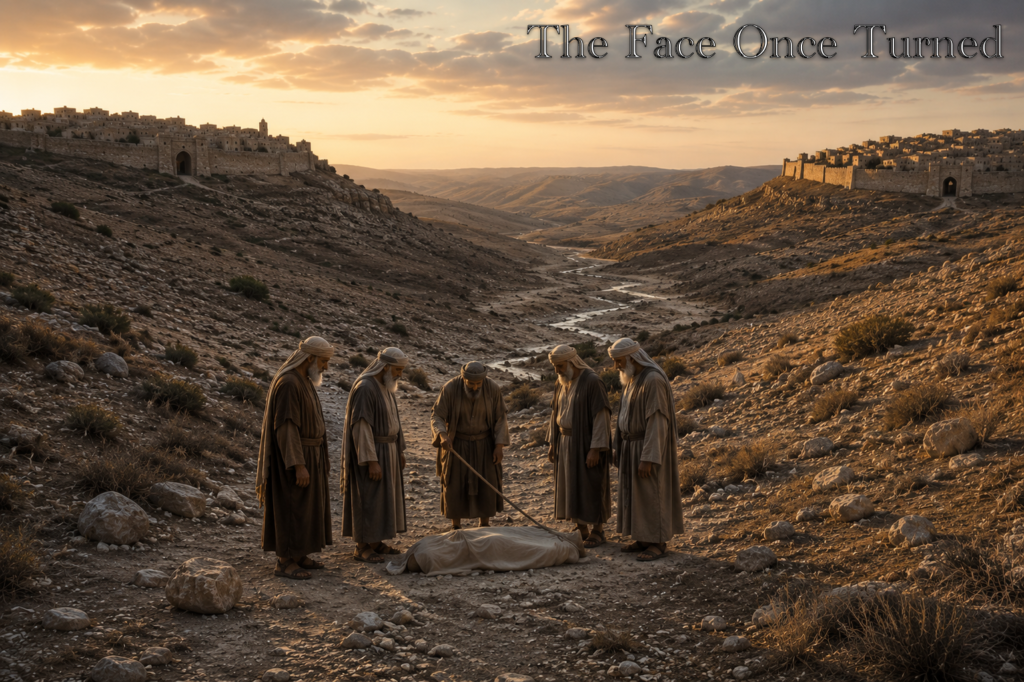
The last law of the portion is not a law about a gate at all. It is about a place with no gate: the open country between towns, where a body is found and no one knows how it got there.
If someone slain is found lying in the open, in the land the L-rd your G-d is giving you to possess, and it is not known who struck the blow, your elders and judges shall go out and measure the distance to the towns around the corpse. The elders of the town nearest the body shall take a heifer that has never been worked, that has never pulled in a yoke, and bring it down to an ever-flowing wadi, which is neither tilled nor sown, and there in the wadi they shall break the heifer’s neck. … And all the elders of that town nearest the corpse shall wash their hands over the heifer whose neck was broken, and they shall declare: “Our hands did not shed this blood, nor did our eyes see it done. Absolve, O L-rd, Your people Israel whom You redeemed, and let no guilt for innocent blood remain among Your people Israel.”
— Deuteronomy 21
Read it slowly and it stops making sense. A man is dead. No one saw it; no one is charged. And the response the Torah legislates is not an investigation that ends in a verdict but a ceremony: the elders of the nearest town measure the ground, take a young heifer that has never worked, walk it down to a barren wadi that has never been worked, break its neck there, wash their hands over it, and swear that they did not do this. They swear it about a killing everyone already knows they did not commit.
It is one of those places in the Torah where the ground gives way. And it gave way for the tradition’s greatest readers exactly where it gives way for us.
What the Rabbis Could Not Let Pass
The Talmud asks the obvious question first, and Rashi carries its answer into the verse. On the elders’ oath, “our hands did not shed this blood,” he writes what the sages already knew any reader would be thinking: would it enter our minds that the elders of the court are murderers? Of course not. So what are they confessing? Rashi, in his comment on Deuteronomy 21:7, gives the Talmud’s answer from Sotah: they are swearing lo re’inuhu u-fetarnuhu belo mezonot u-velo levayah—we did not see him and let him leave without food, without escort. The oath was never about the blade. It is about whether a town let a man walk out alone into the country, unfed and unaccompanied, into the road where he died. The elders answer for the conditions of anonymity, not for the wound.
Maimonides takes the rite in a wholly different direction, and a colder one. In the Guide for the PerplexedIII:40, he reads the whole ceremony as a device for solving the crime. The procession of the elders, the public measuring, the striking of a valuable animal in a strange rite—all of it forces the killing back into the mouths of the people. “By making the event public,” he writes, “the murderer may be found out, and he who knows of him, or has heard of him, or has discovered him by any clue, will now name” him. The heifer is a Bronze-Age instrument for breaking a silence: make a spectacle at the edge of town, and the witness who would otherwise say nothing begins to talk.
Nachmanides will not follow him there. On Deuteronomy 21:4 he presses the practical reading until it cracks: were the aim to make people notice and talk until the killer surfaced, a good field fit for sowing would serve far better than a hard wadi no one visits—the setting works against the very publicity Maimonides needs. And so, he writes, the Sages counted eglah arufah mi-klal ha-chukim, among the statutes, its reason like that of the offerings made outside the Temple: the sa’ir ha-mishtale’ach, the goat sent to Azazel, and the parah adumah, the red heifer. These are the rites that do their work where instrumental explanation runs out.
Rashi, meanwhile, has already left a door open toward something deeper. On Deuteronomy 21:4 he gives the sages’ image for why this animal in this place: let a heifer that produced no fruit, killed in ground that produces no fruit, come and atone for the killing of a man who was cut off from producing his fruit—his children, his years, the deeds he will now never do. The rite is built out of severed potential answering severed potential.
And then the strangest fact the tradition records without flinching. The Mishnah, in Mishnah Sotah 9:9, says the ceremony was abolished: mi-she-rabu ha-ratzchanim, batlah eglah arufah—“when murderers multiplied, the broken-necked heifer ceased.” Read narrowly, the note is procedural: the rite applied only to the anomalous case of lo noda mi hikahu, and once bloodshed grew common and open, the conditions that summoned it no longer held. But read for what it implies, it is chilling. The rite depends on a society that still finds an unclaimed corpse a scandal—rare enough that a whole town must go out and answer for it. It is a technology of collective conscience, and the tradition has recorded the day it stopped working: the ceremony did not fail so much as self-destruct, the moment a people stopped being shocked by a body in a field.
The Turned Face
Beneath the law, the kabbalists found a grammar for the strangeness the chok only named.
The clue is in the killing itself. The heifer is not slaughtered at the throat, from the front, as an offering is. Its neck is broken at the oref—the nape, the back of the neck. Rabbeinu Bachya, in the kabbalistic layer of his comment on Deuteronomy 21:1, makes that anatomy carry the weight. The heifer, he writes, is given over to midat ha-din ha-kashah, the severe measure of judgment, and the oref is the sign of that severity—the hard, stiff back. Bachya does not yet speak in the full grammar of panim and achorayim that later Kabbalah would develop, but the geometry is already there: the face is the aspect turned toward, in relationship; the back is the aspect turned away, where severity gathers. And he says the rite is enacted there for a reason: hafach ha-Shem eleinu oref ve-lo panim—the Name turned to us the back, and not the face.
Hold that against what the killing was. A murder that no eye saw, in a field no gate encloses, is a death that happened precisely where the face was turned away. It belongs to the oref of the world. So the repair is worked on the oref—you do not approach this wound through the front, through offering and relationship, because it did not open there. You approach it from behind, in the dimension of the concealed. And the elders’ hand-washing, in Bachya’s reading, is the counter-motion: mei ha-chesed, the waters of lovingkindness, drawn down over the severity so that midat ha-din will not rule. The rite reaches into the back of the world and begins to turn it.
The Field and the Shattered World
The Arizal takes that intuition and runs it through the whole machinery of his cosmology, and under his hands the nine verses stop being a strange law and become a map of the beginning of the world.
His reading survives in the Lurianic Likutei Torah ve-Ta’amei HaMitzvot—the teachings of R. Isaac Luria set down by his student R. Chaim Vital, transmitted, not authored, “mouth to mouth,” as the book’s own masthead says. In the section on Mitzvat Eglah Arufah he begins with a sentence that gives the whole game away: kol mitzvot sovevot al metziut ha-sheva melachim she-metu—all the commandments revolve around the reality of the seven kings who died. Those seven kings are the primordial kings of Edom whose reigns and deaths, in Lurianic language, cipher shevirat ha-kelim, the shattering of the vessels—the catastrophe in which the first structures of creation could not hold the light poured into them and broke, scattering sparks of holiness down into the lower worlds.
And then he reads Deuteronomy 21:1 as a description of that shattering, word by word. Ki yimatze chalal—“if a slain body is found”: the chalal, the slain one, the emptied one, is Ze’er Anpin of the world of Nekudim, the configuration whose vessels shattered, “emptied of the life within it, its vessels broken.” Ba-adamah, “in the earth”: the realm of severities, and adamah as Edom, the kings who reigned and died. Nofel ba-sadeh, “fallen in the field”: the descent itself, the broken sparks falling through world after world—chalal in Beriah, nofel in Yetzirah, ba-sadeh down into Asiyah, the lowest. The corpse in the open country is the broken world, holiness fallen where it does not belong.
The measuring, too. When the elders go out and measure the distance to the surrounding towns, the Ari reads the survey as an act of kav ha-middah, the line of measure, and the surrounding cities as concentrations of dinim, the forces of judgment lodged among the fallen vessels. The elders are not pacing off forensic geography. They are discerning where the break has settled and what surrounds it. It is the same labor the whole portion has been performing—every court and witness and boundary a way of telling one thing from another—now carried into the one place where the ordinary means of telling have failed.
But the sentence that turns the whole reading is his refusal to let the catastrophe be an accident. The shattering, he writes, hayta be-khavana mekhuvenet le-tzorech berur ha-tov min ha-ra—was intended, with purpose, for the sake of separating the good from the evil—ki lo hayta mitat melachim al tzad ha-mikreh, for the death of the kings was not by chance. The breaking was not a failure. It was the condition that made the sorting possible—the separating of what could be rescued from what could not. Which means the corpse in the field is not merely a disaster to be mourned. It is the world’s first unbearable question—something whole has broken, life has fallen where it does not belong, and no one knows the cause—posed again, in miniature, on a road between two towns. And the answer the Torah gives is the one the cosmos itself is enacting: go out, find what has fallen, measure where the break lies, and begin the work of separating and lifting.
That They Return to the Face
The third movement of the Ari’s reading is where his cosmology and Bachya’s grammar of the face turn out to be the same teaching.
It falls on the priestly plea, kapper le-amkha Yisrael—“absolve Your people Israel.” Here the reading runs through gematria and the yichudim, the unifications of divine names that Lurianic Kabbalah works with the way a mathematician works an identity; the arithmetic is dense, and a reader who wants to walk it can work it in the source. But the result needs no arithmetic to land. Of the words le-amkha Yisrael, the Ari says: gimatriya shemot achorayim, le-khaper she-yashuvu panim—they equal, in number, the divine names in their achorayim, their “back-facing” state, and the purpose of the atonement is that they return to the face.
That is the entire teaching in four words. Murder produces a world turned backward. The dead man is turned from his life; the killer is turned from his community; the town is confronted by blood it cannot account for; the very ground is implicated. Everything has swung achor el achor, back to back. And the rite exists to turn it—panim el panim, face to face. The same passage reads the closing words, ve-nikaper lahem ha-dam, as the dinim, the severities, being sweetened and undone.
Two readers, centuries and worlds apart, arriving at the identical gesture. Bachya the medieval commentator, reading the broken neck as the oref, the averted back that must be turned toward the panim. The Ari, reading the whole ceremony as the return of names from achorayim to panim. One works from the anatomy of the animal, the other from the arithmetic of the names, and they meet exactly. The broken-necked heifer is the turning of a face.
The Zohar had already laid the ground beneath both of them. In Parashat Vayera, in the passage the tradition names for our very verse—ve-arfu et ha-eglah ba-nachal, “and they shall break the heifer’s neck in the wadi”—it teaches that when a murderer takes a life, he draws out the soul ad lo mata zimneih, before its appointed time had come, wresting it from the order that governs when a life ends. The killing is not damage to one man only; it is a tear in the fabric, a wound in Malchut, the divine indwelling that touches the world. The eglah repairs the tear and keeps the forces of accusation from fastening onto the breach. The Ari took that Zoharic intuition—that a single murder disorders the whole—and ran it through the full apparatus of shattering, sparks, sorting, and repair.
Elul
None of this is read in a vacant month. Shoftim falls at the head of Elul, the weeks of return that climb toward the Days of Awe, and the placement is not decoration.
The Izbica master, in the Mei HaShiloach on the portion, reads the unsolved killing inward. The body no one can account for, he suggests, is the community’s nistarot—the concealed faults lodged in the collective heart, the failures that do their damage precisely because no one sees them clearly enough to name them. The rite is the community’s admission that it is answerable for what it cannot see, and its resolve to clarify what has gone hidden within it. Kapper le-amkha Yisrael becomes a people asking to be refined of a corruption it cannot locate.
And that is what Elul is. Teshuvah, in the language the kabbalists have been speaking all along, is nothing other than the turning of achorayim back into panim—rotating the averted face back toward relationship. What the broken-necked heifer does for the body politic, the month asks each person to do alone: reach into the concealed, the ungated, the back-side of a life, and turn it toward the face. The elders going out to a body in a field they did not watch is the communal shape of the private labor Elul demands—accounting for what happened in the spaces no one was guarding.
There is an old thread the tradition keeps near this one. When Jacob’s sons come back from Egypt insisting Joseph is alive, the aged father does not believe them until he sees the agalot, the wagons Joseph has sent—and Rashi, on Genesis 45:27, preserves the wordplay the brothers were signaling: eglah arufah, the last passage Jacob and Joseph had studied together before the years of loss. The Ari draws the same wagons into his chain of displaced holiness—sparks scattered from Adam, through the Flood, through the golden calf, and answered at last by agalot sent to carry a broken family home. The sign that raises Jacob’s spirit is the very law of blood whose spiller is unknown. Recovery announced by the emblem of irrecoverable loss.
The Field Between the Gates
A justice built entirely of gates can only ever weigh what comes through the gate. It can try the accused, hear the witness, bind the king, shelter the one who killed by accident—but only once a person has been named and made to stand.
What it cannot do is answer for the death that happened where no one was standing, the life that fell in the country between jurisdictions, the blood with no name attached to it. That is the case the portion saves for last, and it does not pretend the gates can reach it.
Our reflex, faced with blood, is gevurah—the severe measure: find the guilty, exact the consequence, let the punishment answer the crime. That reflex is not wrong; it is one arm of justice, and Shoftim spends itself building the institutions that give it hands.
But an arm of severity with nothing to balance it does not stay justice for long. Left alone, it runs toward punishment for its own sake, toward vengeance, toward the satisfaction of the blow returned—until the instrument raised to restrain the yetzer hara is quietly serving it.
The broken-necked heifer is where the other arm reaches over the first: mei ha-chesed drawn down over midat ha-din, the severities sweetened, the averted back turned toward the face. It does not cancel the gate’s question—who did this?—so much as refuse to let it stand alone.
Beside it, it sets the question the gate has no way to ask: what has been broken here, and where does the repair begin?
The balance the portion arrives at—the harmony the tradition seats in Tiferet, the center that holds the two arms of severity and mercy together—is that a people is not finally measured by the verdicts it hands down.
It is measured by whether, standing over a death it cannot solve, in ground it did not sow, it reaches for the waters of mercy rather than the reflex of blood—and so keeps its own justice from becoming the thing it was raised to answer.

Discover more from Many Lamps, One Flame
Subscribe to get the latest posts sent to your email.