And then, with finality…
rav lakh
Much, for you.
Fulfilled, it is sufficient
and that is the gift.
Let the words of this time come forth.And they did.
But not as words spoken,
for he no longer had a voice with which to speak.
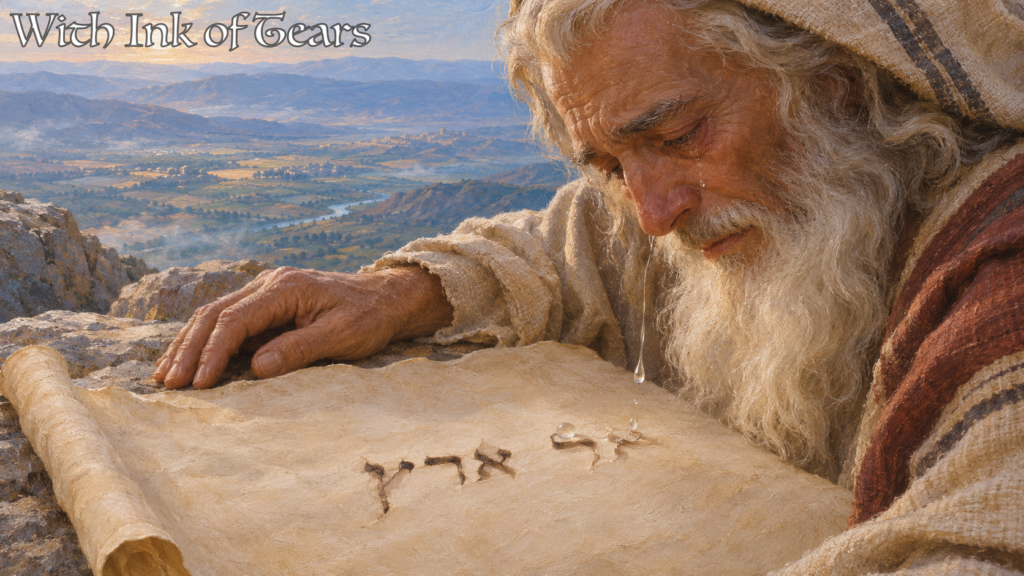
Nor did he have a reed with which to write.He had only tears.
Tears of sorrow, tears of joy.
Tears of longing, tears of contentment.
Tears of rage, tears of tranquility.As the tears struck the parchment,
they became the ink of his end.And when they no longer fell,
a quiet silence took hold of the air.It was done.
—With Ink of Tears
בִּדְיוֹ שֶׁל דְּמָעוֹת
The Matter Is Decided
Deuteronomy gives the request in Moses’ own voice. In Parashat Va’etchanan he tells Israel what he asked for: let me cross over, please, and see the good land beyond the Jordan (Deuteronomy 3:25). The account opens with a single verb, va’etchanan, I pleaded.
The midrash will not let the pleading be brief. Devarim Rabbah 11:10 counts it: the letters of va’etchanan add up to five hundred and fifteen, and that, it says, is the number of his prayers. In the same passage Moses puts on sackcloth, draws a small circle on the ground, stands inside it, and says he will not move from the spot until the decree is annulled. He prays until heaven and earth and the order of creation shake. Sifrei Devarim 357 has him bargain downward. If he cannot enter as a king, let him enter as a commoner. If he cannot enter alive, let him enter dead. The answer covers every offer: neither king nor commoner, neither alive nor dead.
The Torah’s own answer is two words. Rav lakh (3:26)—literally, much, for you. English Bibles give it as “Enough,” and the verse continues: speak to Me no more of this matter. Rashi hears it two ways. It is a stop, so that no one will say how hard the Master is and how stubborn the disciple. And it is a measure: more than this is kept for you, and much is the good stored up for you. The word that closes the door is the word for abundance.
What follows the refusal is a sight and a task. Go up to the top of the Pisgah, lift your eyes west and north and south and east, and see it with your eyes (3:27). Then charge Joshua, strengthen him and give him courage, because he is the one who will cross (3:28). The Torah records no further plea. By chapter 31 Moses says it flatly to all Israel: G-d has said to me, you shall not cross this Jordan (31:2). He teaches the song. He finishes the scroll and hands it to the Levites—take this scroll of the Torah (31:26). He blesses the tribes one by one, and he climbs. At the summit G-d shows him the whole of it and says the thing once more: I have let you see it with your eyes, and there you shall not cross (34:4).
The next verse is the one he has to write.
The Sentence He Could Not Write
And Moses, the servant of G-d, died there, in the land of Moab, at the word of G-d.—Deuteronomy 34:5
The scroll is Moses’ scroll, written at G-d’s dictation from its first letter, and the Talmud asks the plain question in Bava Batra 15a and again in Menachot 30a: is it possible that Moses was alive and wrote “and Moses died”?
One answer is the obvious one. Moses wrote up to this point, and from here on Joshua wrote. Rabbi Shimon will not have it:
Is it possible that the scroll of the Torah was missing a single letter? It is written, “Take this scroll of the Torah.” Rather: up to this point the Holy One, blessed be He, says, and Moses says and writes. From this point on the Holy One, blessed be He, says, and Moses writes be-dema.
The passage then brings a verse to show what dictation looks like. Barukh the scribe is asked how he wrote Jeremiah’s scroll, and he answers that the prophet recited all the words to him from his mouth, “and I write them on the scroll in ink” (Jeremiah 36:18).
A law hangs from this. The last eight verses of the Torah are read in the synagogue by a single reader and are not divided between two. The Talmud asks whether that rule assumes Joshua wrote them, and answers that it holds for Rabbi Shimon as well: since they were changed, they were changed. Rashi says what the change was. They were written be-dema, and in that they differ from all the rest of the scroll.
Everything rests on two words.
Two Words
Kotev be-dema. This is the Hebrew of the rabbis and not of the Bible, and each of its parts can be turned more than one way.
Kotev is “writes.” Its weight is in what no longer stands beside it. Until this verse the formula has two verbs for Moses—he says and he writes. Here one of them is gone.
Be- is the particle that means both “with” and “in.” A man writes with a pen and with ink; a man also writes in haste, or in grief. The sentence the Talmud quotes from Jeremiah ends ba-deyo, with ink, and be-dema stands in the next sentence where the ink stood.
Dema is the hinge. Jastrow’s dictionary of rabbinic Hebrew gives it two entries. The first is a tear, or weeping, and its example is this very line; Jastrow adds that the Munich manuscript of the Talmud has the ordinary plural here, bi-dema’ot, with tears. The second is the priest’s portion of the harvest, the terumah, and from that sense comes a verb, dimma, for mixing what is consecrated into ordinary produce, and a noun, dimua, for the mixture. The Bible has the word once. “Your fullness and your dema you shall not delay” (Exodus 22:28), where it is something that comes from the press. Ibn Ezra, citing Saadiah Gaon, takes it as the oil: when the olive is trodden, the oil comes down drop by drop, like a tear.
A tear. What a pressed thing gives up. A mixing of the holy into the ordinary. The commentators use all three.
What the Tears Were
Under every reading is the Talmud’s own question: what it is for a living man to write his death.
Rashi takes be- as “in.” Moses writes, he says on Menachot 30a, “and he did not say it after Him, from his great sorrow.” The tears accompany the writing; what has changed is the voice. The Torah Temimah puts the scene in four words: he writes and weeps, writes and weeps. Here the sentence goes down in ordinary ink, from the hand of a man who cannot bring himself to say it.
Others take be- as “with,” and the tears move from the man to the page. The Mizrachi glosses be-dema “and not in ink,” so that these eight verses would stand apart from the whole Torah. Rabbi Yitzchak Karo, in the Toledot Yitzchak, gives the image that has lasted: he shed so many tears that he dipped the pen in them. The pen is a kulmus, a reed—the plant that Taanit 20b says earned the writing of Torah scrolls because it is soft where the cedar is hard. The Ben Yehoyada reports those who carry it further. The day was Shabbat, when ink was forbidden, so Moses wrote in his tears; the letters held, by a miracle, until Shabbat was over, and Joshua passed a pen of ink across them. They read a psalm by this light—“Put my tears in Your flask; are they not in Your book?” (Psalm 56:9)—and the book is the Torah scroll whose end was written in tears. They read a verse of the parashah by it as well. The Torah stops to say that at a hundred and twenty his eye was not dimmed (34:7), so that no one will suppose that eyes which ran like a stream had failed.
Once the tears are the ink, the scroll itself is in question. The Maharal of Prague objects, in the Gur Aryeh, and his objection is law: a Torah scroll not written in ink is invalid. He adds a point of language. Be-dema is the falling of tears, the weeping itself; for tears as a substance the Talmud would have said bi-dema’ot. His own reading turns the weeping into the answer to the Talmud’s question. Moses wept over his death, as in “those who sow in tears” (Psalm 126:5), and that weeping is the beginning of the death. And Moses died is already true while the hand is moving.
In all of these the tears are tears, and the question is what Moses could bear. The Vilna Gaon asks something else: how a sentence can stand in the scroll before it has happened. As the HaKtav VeHaKabalah reports him, he goes to the word’s other meaning. Dema here is the dema of Exodus, and its sense is mixture. Moses wrote the eight verses as combinations of words and letters, “and they are the names of the Holy One, blessed be He,” and what stood on the parchment did not read “and Moses died” but other words, according to the secrets of the Torah. After his death Joshua wrote them as they stand. Both rabbis in the Talmud are right. Moses wrote the hidden Torah and Joshua the revealed one, and no letter was missing. The sentence was in the scroll before it was true, and it could not be read until it was.
Each of these takes one meaning of dema and builds on it, and they do not agree. The Talmud itself says only the two words. Heard beside the ink of Jeremiah, they say this much: the tears are what the writing came through as, and they became the ink.
Acceptance
Moses neither stopped nor did he hand over the expectation. He was told by G-d that the matter was decided. This was surrender as acceptance.
He did not stop on his own. He pleaded until G-d closed the matter, and the stopping began there, in a word he had not chosen.
Nothing in the sources makes it a small thing. The circle on the ground, the five hundred and fifteen prayers, the offer to come in as a commoner or as a corpse—these are what the acceptance had to come through. He wanted the land to the end, and the refusal is repeated to him at the summit with the land in front of his eyes. Acceptance here is the decision to stop fighting the flow, made by a man who did not wish to stop.
It is also an act. Rabbi Chaim of Czernowitz, in the Sidduro Shel Shabbat, reads the Talmud’s line this way: because G-d told him to write “and Moses died,” it was dear to him to fulfill the word and to complete his mission, so that the Torah would not lack eight verses, and he took the decree of death upon himself in order to do it. He accepts by writing the sentence.
On what he felt as he wrote, the commentators divide, and neither side gives way. Rashi says great sorrow. The HaKtav VeHaKabalah, having given the Gaon’s reading, says the opposite in as many words: Moses was not grieved at his death; he died willingly, with a glad soul, to fulfill his Creator’s command. Midrash Tannaim stages it as a conversation at the moment of death, built from Psalm 116. Moses asks his soul whether it is weeping the way one weeps over the dead, and the soul answers from the psalm: Heaven forbid—“my eyes from tears.”
The eyes weep and the soul does not, and both belong to the one man. The Tanya gives each its own source in a person and quotes the Zohar for the result. In the Zohar (3:75a) it is Rabbi El’azar who says it, weeping beside his father after a teaching he had never heard before: “Weeping is lodged in my heart on this side, and joy is lodged in my heart on that side.”
One Reader
The law about these verses has not changed. One reader takes all eight, and they are not divided between two.
Israel wept for Moses thirty days in the plains of Moab, and the days of weeping came to an end (34:8). The Torah’s last words are before the eyes of all Israel (34:12), and the eye that saw the page had not dimmed.
Rashi’s sorrow and the glad soul are not given to two voices. One can be sad in the face of acceptance, and even know joy. A tear can be both.
Source note: Scripture, Talmud, Midrash and the commentators are translated here from the Hebrew and Aramaic, with reference to Aryeh Kaplan’s The Living Torah, the JPS Hebrew-English Tanakh, The Zohar: Pritzker Edition, and the Babylonian Talmud on Sefaria. Online links are provided for reference; their translations may differ from those quoted here.

Discover more from Many Lamps, One Flame
Subscribe to get the latest posts sent to your email.