
Your business is with action alone; not by any means with fruit.
—Bhagavadgîtâ 2.47, trans. K. T. Telang
“Give it to G-d.”
“Let Jesus take the wheel.”
People say these things in times of great difficulty. A diagnosis comes back wrong. A debt comes due that cannot be paid. Someone we love has gone where we cannot reach them. The ordinary means have been tried, the thing has not moved, and the words arrive.
Is this an abdication of agency? Or is something more happening when they are said?
What the Words Ask
The words answer a feeling of helplessness: the sense that outside forces, beyond our control, are acting upon us in ways we cannot counteract. Agency seems to have been lost. Nothing we do will set things straight, so we ask for the one intervention that could.
In that first moment the words are a request, and a specific one. The speaker has a rescue in mind: the scan clean, the debt lifted, the loved one home. To give it to G-d is to ask G-d to bring that about.
The request is old. Psalm 55:23 says, “Cast your burden on the Lord and He will sustain you.” The Hebrew verb is hashlekh, cast or throw, and nothing in the psalm around it is calm. It is said from inside the trouble.
This is not exactly surrender as the traditions define it. It is also not far off. A request names the outcome it wants; surrender, in the traditions that have thought hardest about it, names none. The distance between the two is short, and the words can be said from either side of it.
The River
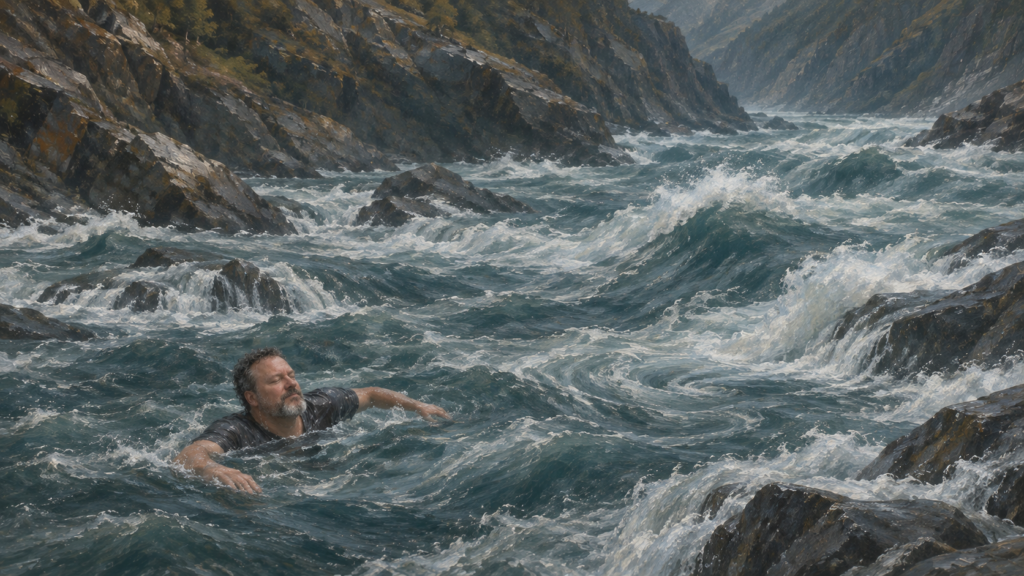
No one acts on still water. We are partners in creation; we have agency and free will; our lives are not planned out for us, and the future is not charted in advance. All of that is true. It is also true that a life moved in a chosen direction seldom goes where it was pointed. As with any complex system, many forces are acting in many ways, and you cannot simply point in a direction and go straight there.
Some of those forces are other people. Each of us enters the river, and the entrance changes the water. Sometimes it makes little more than a ripple. Sometimes it is a splash, and it leaves a great deal of eddies in its wake. A few find a way to redirect the river altogether. All of these have an impact on all of us; everyone swims in water that others have disturbed.
Under the ripples and the eddies is the flow itself. It is always there. It is a natural thing, and it does not have to be produced. To fight it is to alter the outcome, and that is not always a fault; altering outcomes is part of what agency is for. But the degree to which any one swimmer can effect change is limited. The current is not a guide. It is a force, often a force to be reckoned with, and sometimes the only way to reckon with it is surrender.
Most people understand this, some more intuitively than others. The understanding does little until fatigue arrives. There is a point at which a person becomes so tired of fighting the current that he simply stops. That is the point at which the words are most often said. It is also the point at which some people drown.
The Swimmer at Lüliang
The Zhuangzi tells of Confucius visiting the falls at Lüliang, where the water drops from a great height and tears on for miles, so violent that no fish can live in it. He sees a man go in. Taking him for someone in despair who means to die, he sends his disciples along the bank to pull him out. A short way downstream the man climbs out by himself and walks along the embankment, hair loose and wet, singing.
Confucius runs after him and asks whether he has a way of staying up in such water. The man says he has no way. “I go under with the swirls and come out with the eddies,” he says; he follows where the water goes, with no thought for himself (Zhuangzi: Basic Writings, “Mastering Life”). Pressed to explain, he offers only this: the land was where he began, and he was at ease on it; the water was where he was raised, and he became at ease in it; as for why he does what he does, he cannot say.
He is easy to mistake for a man who has stopped trying. He has not. He is swimming, in water that kills. What he has given up is the contest. Navigation is not always an active thing; sometimes the answer is to ship the oar and stow it. A shipped oar is still in the boat. The paddle thrown away, surrendered to despair, is another matter.
Confucius’s mistake deserves respect. From the bank, the man who has gone into the water to die and the man who is at home in it look the same. Whatever separates them does not show in the act.
And the swimmer has no method. He decided nothing at the water’s edge. What carries him through the cataract was formed in him long before that day, and he can describe it only as what he was used to. Confucius asked for a way. What he was shown is a different way of being in the water, one the swimmer himself does not count as a way at all.
The Stone and the Bank draws a line that applies here. Orientation is which way a person is facing, and it can be settled in an instant. Alignment is whether the rest of him follows. To say “give it to G-d” is orientation: a turning toward G-d, made in the time it takes to speak, and a real one. Alignment is what the swimmer has. Nothing in him is turned anywhere else, and nothing in him pulls against the water he is in.
Set beside him the more familiar figure, the one who says the words and then continues to try to force the situation in a specific direction. He has turned, and part of him has not come round; it is still aimed at the outcome he had in mind. He is oriented and not aligned. His thrashing adds eddies of his own to the ones already there, and when he is dragged under, it is by the currents around him and the ones he has made.
All of them can say the same words. The words do not tell them apart.
Trust and the Step
Torah has its own version of the moment. At the sea, with Pharaoh’s army behind and the water ahead, Moses tells the people that G-d will fight for them and that their part is to be still. Hold Your Peace follows what comes next. G-d’s answer to the outcry is an instruction: “Speak to the Israelites, and let them start moving” (Exodus 14:15). The fight is G-d’s. The walking is theirs.
The Talmud presses the scene further. In Sotah 37a, Rabbi Meir says the tribe of Benjamin went into the sea first. Rabbi Yehuda says that is not how it happened. Each tribe said, I am not going down into the sea first—until Nachshon ben Amminadav leapt and went down. The verses the passage gives him are from Psalm 69: the waters have reached his neck, and he asks not to be swept away, not to be swallowed by the deep. He is in the sea, and he is still asking.
At that hour, the passage continues, Moses was lengthening his tefillah. The Holy One said to him: “My beloved are drowning in the sea, and you lengthen your prayer before Me?” Moses answered, “Master of the world, what is in my hand to do?” He was told: speak to the children of Israel, that they go forward, and lift your staff.
What is in my hand to do. Moses speaks the helplessness in which every such moment begins, and the answer does not dismiss the asking; Nachshon goes on asking as the water rises. The answer puts something back in the hand. In the Torah’s own telling the sea is divided and then the people enter (Exodus 14:21–22); in Rabbi Yehuda’s, the step comes first. Both keep the step.
Three chapters later the fighting itself is Israel’s. Amalek attacks, Joshua leads the battle in the valley, and Moses stands on the hill with his hands raised (Parashat B’Shalach). The Mishnah asks the obvious question: “Did the hands of Moses make war or break war?” Its answer: so long as Israel looked upward and subjected their hearts to their Father in heaven, they prevailed, and if not, they fell (Rosh Hashanah 3:8). The swords were real all day. The Mishnah names two things: the eyes turned upward, and the hearts handed over. Its verb for the second is meshabdin, they subjected them. Turning the eyes is orientation. Giving the heart is the rest of the person following. The arms fought, and the hearts were given.
Maimonides writes this into law. Once a soldier has entered the thick of battle, Rambam rules, he is to lean on the Hope of Israel, take his life in his hand, and neither fear nor tremble. He is not to think of his wife or his children; he is to wipe their memory from his heart and turn from everything to the war (Hilkhot Melakhim 7:15). Trust and the fighting stand in a single sentence. This is what the tradition means by bitachon and hishtadlut, trust and one’s own effort: the soldier is asked for both at once, with the same heart. And bitachon, as When the Forest Arrives reads Bachya ibn Paquda, is not the expectation that things will resolve in one’s favor.
Then Rambam says something harder. Whoever fights with his whole heart, without fear, his kavanah to sanctify the Name alone, “is assured that he will meet no harm, and no evil will reach him.” Soldiers who fight that way are killed; no one who codifies the laws of war supposes otherwise. Rambam goes straight on, in the same breath, to a faithful house in Israel, merit for the man’s children, and the life of the world to come, and his proof-text speaks of a soul bound up in the bond of life. The assurance stands in the halakhah beside the battlefield, and he does not reconcile them.
Assured of what?
The Cup
Jesus of Nazareth, a Jewish rabbi, prays inside this frame on the night of his arrest. In Matthew’s account he falls on his face and asks: “let this cup pass from Me.” In the same sentence he yields to his Father’s will (Matthew 26:39).
The Greek matters here. The verb is parelthatō, from parerchomai: to pass by, to pass away. Matthew uses it of heaven and earth passing away, of a road no one could pass along, of an hour already gone by. In English a cup that is passed goes to the next person at the table. The Greek carries none of that. Jesus asks that the cup go by. No one else is being handed it.
He prays a second time, and the words have changed. Now he says that if the cup cannot pass unless he drinks it, his Father’s will be done (26:42). The imperative is gone. The wish is not; it is still there inside the “if.” What stands where the imperative stood is a sentence that already contains the drinking. Matthew says he prayed a third time in the same words (26:44). Mark’s account has no such movement; there the second prayer repeats the first. The progression is Matthew’s.
The first prayer is never taken back, and no one rebukes it. He prays three times, and each time he brings the cup before his Father. That is the asking, and it does not stop. What changes between the first prayer and the second is the claim on the answer. The first has a rescue in view. The second still wants the cup gone and no longer requires it. That is what was handed over in the garden. The cup was not handed over; it is still there. Neither was the effort, since he gets up, wakes the others, and walks toward the men coming for him (26:46). Neither was the asking. What he gave to G-d was the expectation.
The cup does not pass.
Direction and Alignment
Rambam’s word for what the soldier brings to the battle is kavanah. It is usually rendered as intention. Its root means to aim, to direct, to set straight, and it names an aim more than a state.
An aim at what? If the heart is aimed at coming through safely, then nothing has been surrendered; the petition has only been given another name. Surrender performed in order to arrive is still steering. No technique unties that knot, because the knot is the one who wants a technique. Rambam’s soldier is aimed at the Name alone, and the memory of everything he could lose has been wiped from his heart.
An aim can be divided. That is the condition of the one who says the words and keeps forcing: he has turned toward G-d, and some part of him is still turned toward the rescue. Orientation is the turning. It is quick, and it matters; without it nothing else begins. Alignment is the aim undivided, the whole of a person following where he has turned. The expectation is the part that has not yet come round.
Alignment comes in more than one way. The swimmer’s was formed over a lifetime in the water, so long ago that he cannot say how. In the garden it is reached in a single night, across three prayers, by a man in anguish. The exhausted moment can do either work. It can show a person which way the whole of him was already going, and it can be the hour in which the last of him comes round. That is why the words hold truest there.
The Bhagavad Gita opens on such a stop. Arjuna, between the armies, “cast aside his bow together with the arrows” and sat down in his chariot. The tradition titles that chapter the yoga of Arjuna’s dejection, and Krishna does not accept the dejection as surrender. “Cast off this base weakness of heart, and arise,” he says. The teaching that follows returns again and again to one axis: “Your business is with action alone; not by any means with fruit.” Near its end Krishna says, “Forsaking all duties, come to me as (your) sole refuge,” and Arjuna answers, “I will do your bidding” (The Bhagavadgîtâ, 1.47, 2.3, 2.47, 18.66, 18.73).
The man who takes refuge picks the bow back up. The collapse at the beginning dropped the action; the refuge at the end returns him to it, with his claim on its fruit gone. Seventeen chapters lie between the two (When the Forest Arrives).
Patanjali states the result with his usual economy: “From submission to G-d comes the perfection of samādhi” (The Yoga Sūtras of Patañjali, II.45). The practice is Īśvara-praṇidhāna, surrender to the Lord, and its fruit is a state of the one who surrenders. Patanjali does not promise a circumstance.
So the surrender is itself the doing. It is finished when the whole person has done it, and it is aimed at no outcome, including the outcome of having surrendered well.
Where the Water Carries
It is natural, having come this far, to expect that the one who surrenders in this way will be carried to shelter. Sometimes he is. The swimmer at Lüliang walks out singing. The force that could not be fought may well carry a person to safe water.
Other times it pulls him under. Nachshon prays not to be swallowed because a man can be swallowed. The water at Lüliang kills, and Confucius was right to send his disciples running. Other times still, it sets a person down in the center of the melee. That is where the garden ends: swords and clubs, a kiss, an arrest.
The one who has surrendered is not made safe. He can drown, in the plain sense of the word, and that exposure is what gives the act its weight.
There is a second drowning, and it is a condition, as the first is an event. It is to go under still gripping the expectation, dragged by eddies of one’s own making. The first can happen to anyone, the aligned swimmer included. The second cannot happen to him.
The first drowning is a death. Nothing said here makes it less of one.
It is also a passage. The traditions of the East have long held that what looks like an end is a change, and the observable world is on their side; nothing in it simply stops. When Zhuangzi’s wife died he looked back to her beginning and saw one more change among changes, like the turning of the four seasons (So I Stopped). None of this requires a doctrine of what comes after. It requires only that an ending be seen for what it is.
Shelter, the deep, the center of the melee. Surrender does not choose among them.
The Harbor
We take a harbor to be a place. It is out of the current, behind a wall, where the water lies flat. That is the place the first prayer asks for. It is what “set things straight” pictures, and what the wheel is handed over in order to reach.
The swimmer was not in harbor when he reached the embankment. He was in it in the cataract, going under and coming up. The man who rises in the garden and says that it is time to go has no shelter ahead of him, and he walks toward the swords from inside the only harbor that night contains. Read from here, Rambam’s assurance describes the man: the one who has wiped from his heart everything the field could take.
The harbor is the condition of the one who surrendered, wherever the water carries him: the aim undivided, nothing in him turned elsewhere. The outcome may be nothing he desired, and the harbor is not undone by that.
Which leaves the place. Of everything held in the hand at the edge of the water, the picture of the harbor as somewhere to be delivered is held longest, because it does not look like an expectation. It looks like the meaning of rescue. The words asked for it from the first breath. It is the last thing given.
Source note: Translations draw on Burton Watson’s Zhuangzi: Basic Writings, Edwin Bryant’s The Yoga Sūtras of Patañjali, Kashinath Trimbak Telang’s The Bhagavadgîtâ (Sacred Books of the East, vol. 8), Aryeh Kaplan’s The Living Torah, the JPS Hebrew-English Tanakh, and the Hebrew of the Mishnah, the Babylonian Talmud, and Maimonides’ Mishneh Torah, translated here. Online links are provided for reference; their translations may differ from those quoted here.

Discover more from Many Lamps, One Flame
Subscribe to get the latest posts sent to your email.