
My God hath shown me concerning mine enemies, that Thou shalt not slay them, lest they should at last forget Thy law: disperse them in Thy might.
Augustine, The City of God 18.46 (Dods translation), quoting Psalm 58:11–12 in the Greek and Latin numbering
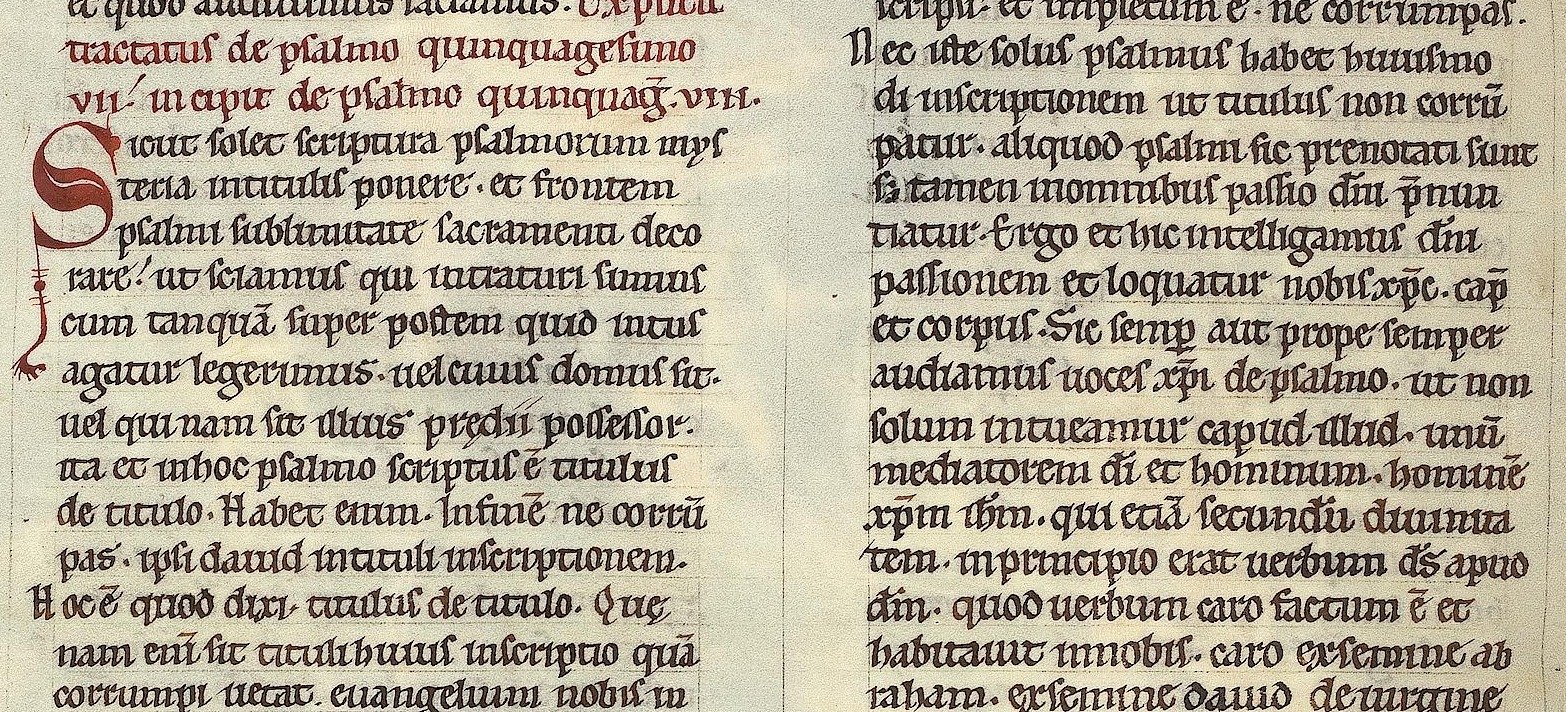
In The City of God, Augustine of Hippo reads a psalm about enemies and identifies the enemies as the Jews. The law they must not forget is the Hebrew Scripture. And the verse says two things, not one. It was not enough, Augustine explains, for the psalmist to say “Slay them not” without adding “Disperse them,” because if the Jews had only been in their own land with that testimony of the Scriptures, and not everywhere, the Church, which is everywhere, could not have had them as witnesses among all nations.
Preserve and disperse. The whole doctrine sits in a single verse, along with a policy that would shape the Jew’s place in Christian Europe, with many variations, for centuries. What that policy protected, why, and for whose benefit is the question.
Our Book-Carriers
Augustine did not invent the problem. The Church had to explain two things at once: why the people who produced its Scriptures had not accepted their fulfillment, and why that people, with the Temple destroyed, still lived on in communities across the diaspora. Paul had sketched an answer in Romans 11. Augustine supplied a function.
The Jews, he argued, carry the books. Wherever the Church spreads, Jewish communities hold the same prophecies the Church cites about Christ, so no pagan can claim the Christians forged them. He called the Jews “our book-carriers,” capsarii, the word for the servant who carried his master’s children’s books to school and then sat outside while the lesson went on. Elsewhere they were “our librarians” and “guardians of our books.” In his sharpest image, they carry Scripture the way a blind man’s face appears in a mirror: others see it, and he does not.
The image outlived him. Isidore of Seville, the seventh-century bishop of Spain’s Visigothic kingdom, asked what the Jewish people was now, if not “a kind of scriniaria of the Christians,” a keeper of their book-chests, “bearing the law and the prophets as testimony to the Church’s assertion.”
The doctrine protected something specific, and it was not simply the Jew’s life. Writing to Paulinus of Nola, Augustine argued that Jews forced to take up the rites of the gentiles would lose their own religious identity, and then no one would be left to bear witness. Compulsion would destroy the evidence. What “slay them not” preserved was the Jew as a Jew, observant and unconverted, because that was where the testimony lay. Augustine had used the verse earlier, in two sermons on Psalm 59 that Fredriksen tentatively dates between 410 and 415.
Scholars disagree about what to make of this. Paula Fredriksen, whose book on the subject carries the subtitle A Christian Defense of Jews and Judaism, finds in Augustine a real defense of Jewish survival against Christians who wanted Judaism ended. Jeremy Cohen, whose Living Letters of the Law follows the doctrine across the Middle Ages, cautions that “one ought not to characterize Augustine as an advocate of Jews and Judaism.” The texts support both readings. The Augustine who argued against forcing Jews to abandon their law charged his Jewish contemporaries, in his Tractatus adversus Iudaeos, written at the end of his life, with having led Christ “to his death” in their parents, and counted their subjugation as part of the testimony. In Cohen’s summary, the Jew belonged in Christendom “in much the same way as the Old Testament belonged in the Bible.”
The doctrine also looked forward. Augustine kept Paul’s hope that the Jews would turn, and placed it at the end of history, so the Jew already had a part to play at the close of the drama. And the verse itself came late. Fredriksen shows that he had built the doctrine around Cain and the mark that kept Cain from being killed, and that by the time he found Psalm 59 he did not need it. The Middle Ages reached for it anyway.
The Carrier Had Been Reading All Along
A function lasts only as long as the performance it expects. By the twelfth century, the Christians who inherited Augustine’s doctrine were no longer sure the Jews were still giving theirs.
Cohen traces the change to several pressures. The Jew had been unique, and now he was classed with heretics and other unbelievers. The new scholastic habit of reason found the Jew’s literalism and his Talmudic homilies irrational. And by the thirteenth century, popes and friars had discovered that the Jews living beside them were not simply carrying the Old Testament. They had built on it: an oral Torah, a Talmud, rabbinic authorities of their own. The people cast as carriers of the books had always had a tradition of reading them. Christians now noticed, and called it betrayal. In the eyes of those churchmen, Cohen writes, the Jews had “consciously distorted the biblical testimony and the testimonial function that God had allotted to their ancestors.”
The protection did not vanish. “Officially,” Cohen writes, “the medieval Catholic Church never advocated the expulsion of all Jews from Christendom or repudiated the doctrine of Jewish witness.” But late medieval Christendom “frequently ignored the mandates implied in ‘Slay them not.’” The Jew was kept, and kept at bay.
Canon law condemned Christian lending at interest, and the Jew, permitted to lend, was left that work and despised for doing it.
Luther’s arc, from 1523 to 1543, shows what happens when toleration comes with an expected conversion: the kindness curdles when the conversion does not come.
A Future in Someone Else’s Script
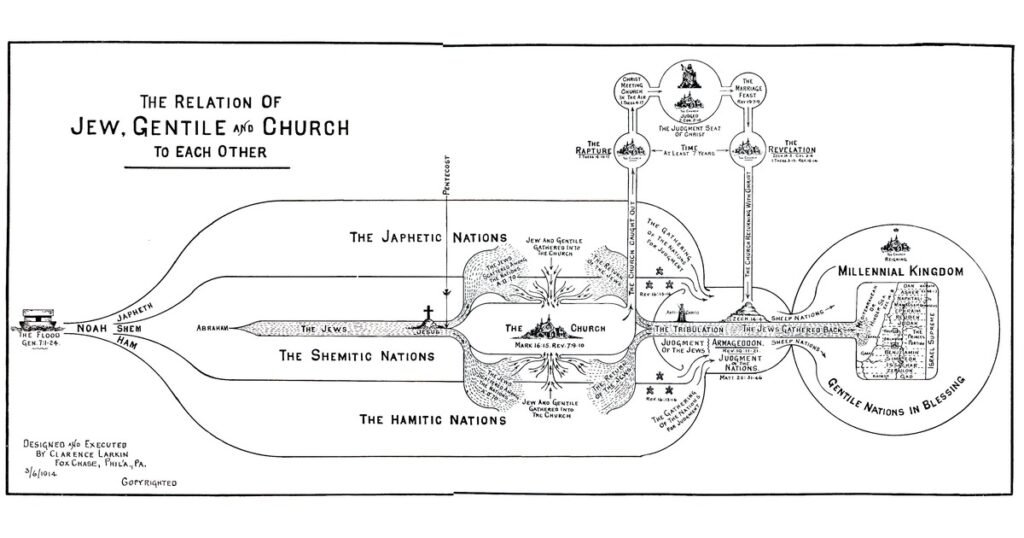
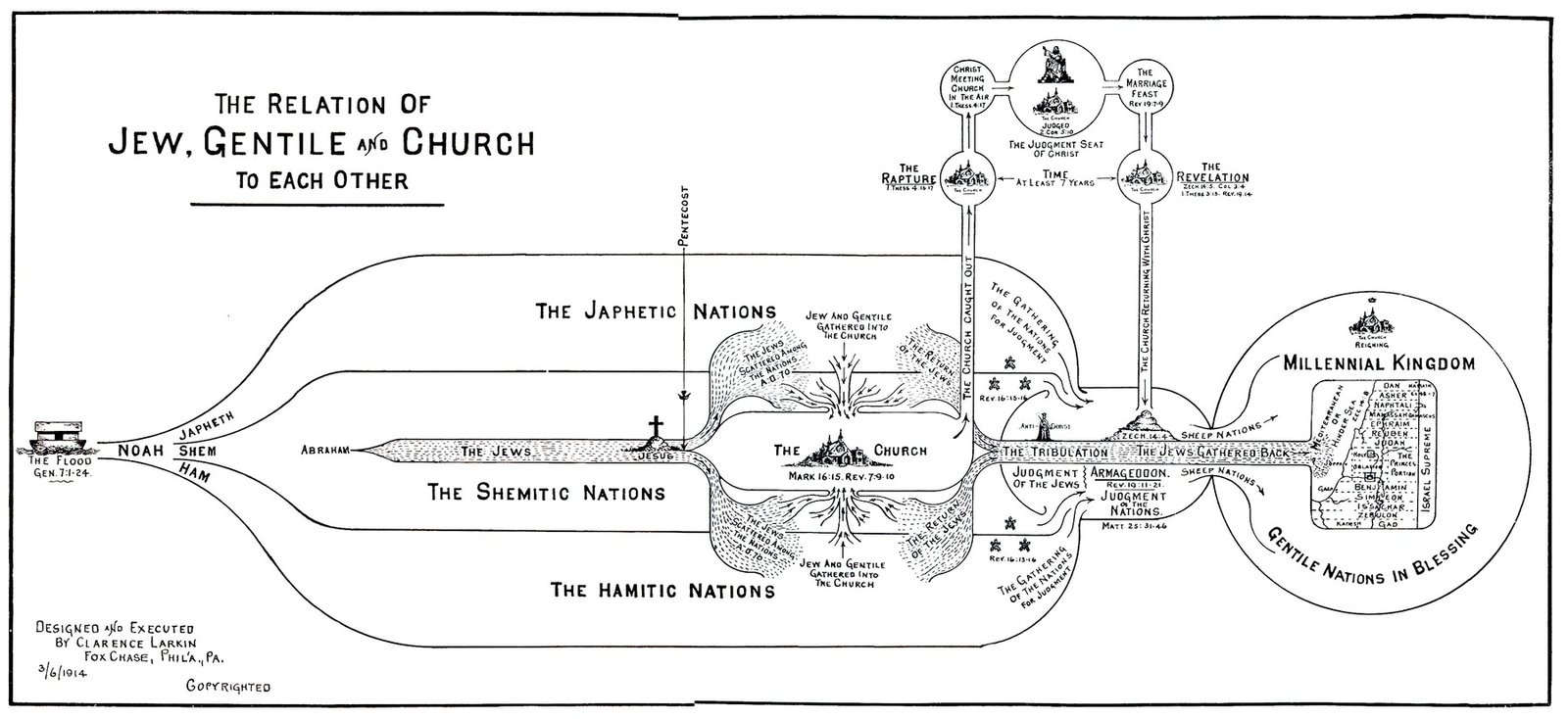
In 1840, in a series of lectures in Geneva, the Anglo-Irish Brethren teacher John Nelson Darby set out a different part for the Jew.
Darby divided God’s people in two. The Church was a heavenly people, called out in the present age. The Jews were “God’s earthly people,” set aside for now but not discarded. When the Church was caught up, the Jews would remain on the earth for a final persecution: “the remnant of the Jews, whose ‘blood will be shed like water.’” As Darby put it: “But where is the Church then? It will be entirely out of the scene at the time of these last persecutions.”
Darby rejected replacement in the plainest terms. The promises to Israel did not pass to the Church. The “gifts and calling of God,” as Paul says in Romans 11, “are without repentance”; to whom does the apostle apply that? “Not to us, but to the Jews.” This is the basis on which Dispensationalism could present itself as the Jews’ best friend, and its sincerity should not be doubted.
But compare the jobs. Augustine’s Jew was a witness to the past: his books proved the prophecies were old. Darby’s Jew was an actor in the future: regathered, persecuted, converted, vindicated, on a timetable drawn by someone else, while the Church watched from elsewhere. The function was different. The structure was the same. The Jew’s existence was indispensable to a drama whose author and audience were Christian.
Notes in the Margin
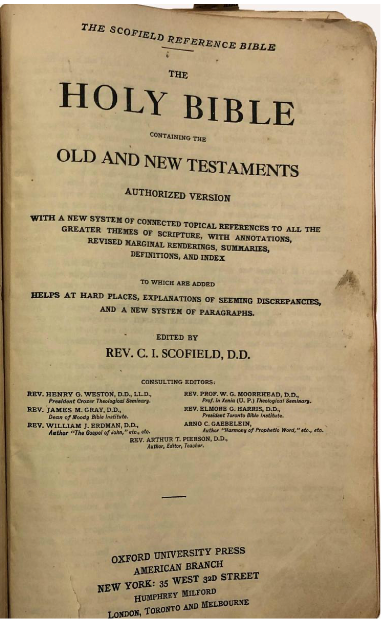
Darby delivered lectures. C. I. Scofield put the system in the margin. The Scofield Reference Bible, published by Oxford University Press in 1909, set its notes in a band beneath the King James text, so the reader met the doctrine on the same page as the verse. The title page names the consulting editors, and two of them reappear later in this essay: James M. Gray, dean of the Moody Bible Institute, and Arno C. Gaebelein.
The note on Romans 11:26 states the Jew’s assignment as a mission. Israel “was chosen for a fourfold mission”: “to witness to the unity of God in the midst of universal idolatry”; “to illustrate to the nations the blessedness of serving the true God”; “to receive, preserve, and transmit the Scriptures”; and “to produce, as to His humanity, the Messiah.” The third item is the duty Augustine assigned. Then the note turns to the future: Israel, “regathered from all nations, restored to her own land and converted,” is to “have her greatest earthly exaltation and glory.”
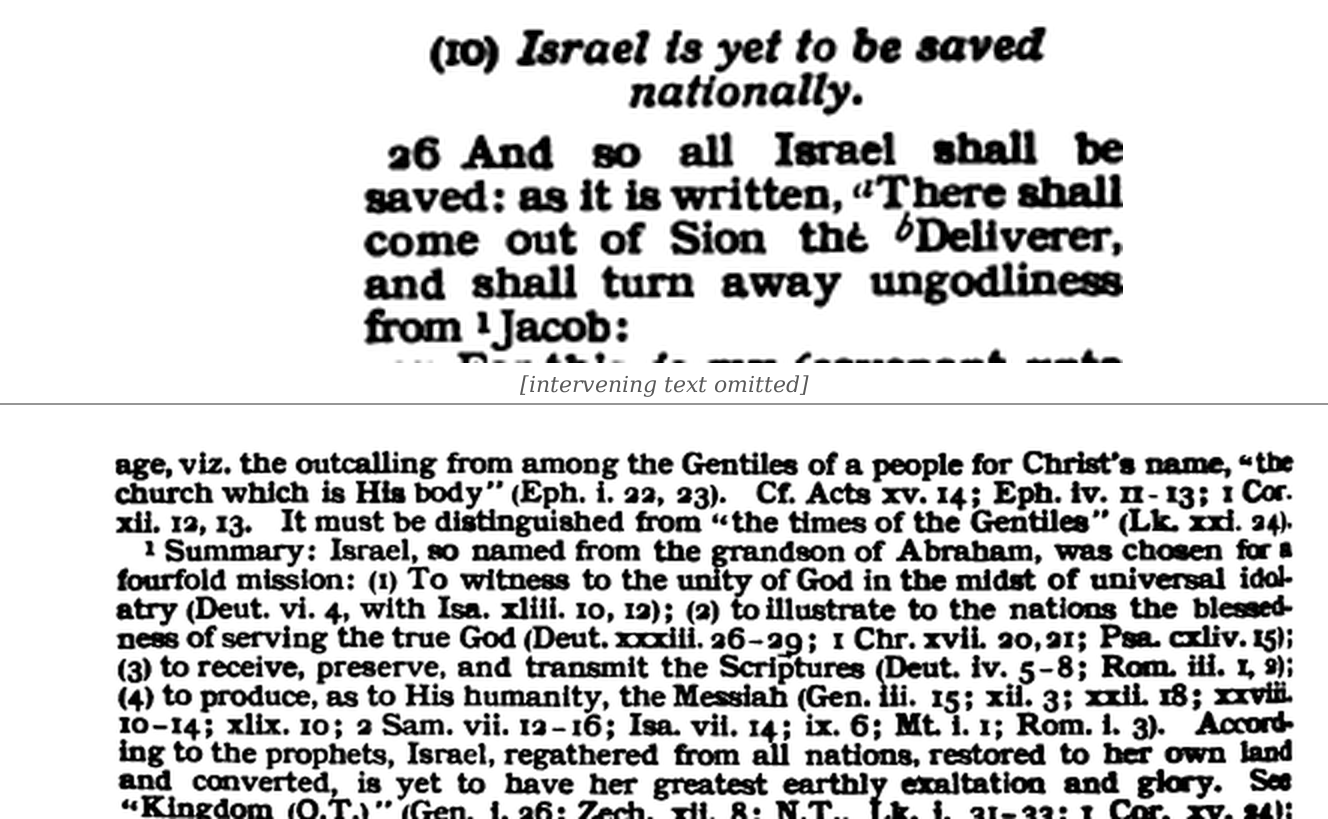
A few pages earlier, the old word returns. During the great tribulation, the note on Romans 11:5 says, “a remnant out of all Israel will turn to Jesus as Messiah, and will become His witnesses after the removal of the church.” Some will be martyred, some spared to enter the millennial kingdom. In the note on the Abrahamic covenant in Genesis, protection takes on a motive that benefits the Gentile: “It has invariably fared ill with the people who have persecuted the Jew—well with those who have protected him.” And the same Bible that rejects the idea that the Church is the true Israel describes the Talmud and its cognates as a mass of tradition laid over the Law until obedience passed from the Law itself to its interpretation. That is the complaint Cohen traces to the thirteenth century, and it appears again on the page in 1909.
The old task and the new sit side by side on the same pages: carry the book, wait for the end, and be the reason the Gentile fares well.
The Forgery Comes to Church
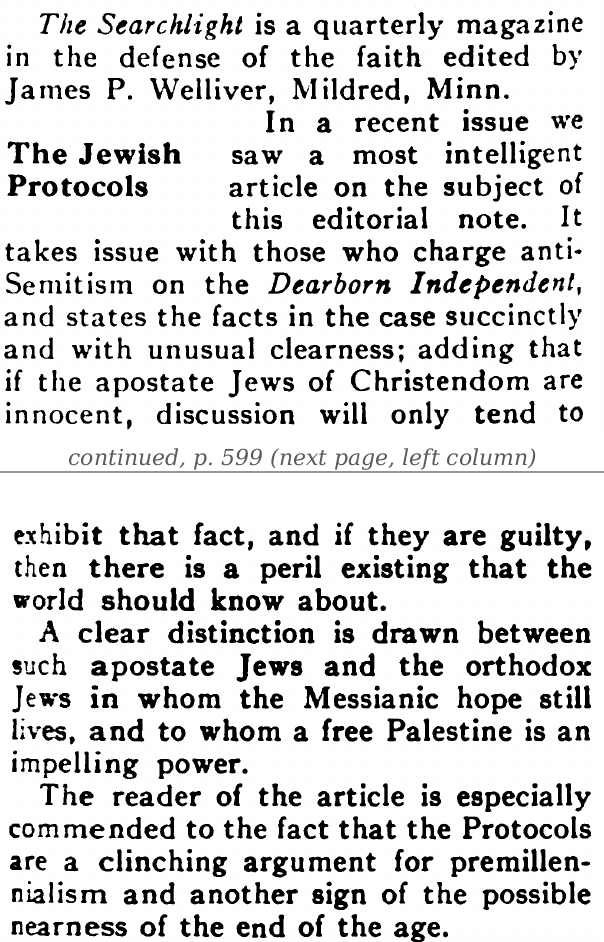
The charge was in place before the forgery arrived. Writing in 1910, a decade before Henry Ford brought The Protocols of the Elders of Zion into mass American circulation, the New York pastor I. M. Haldeman said of the Jews that “as a nation, [the Jews] crucified their king, and the nations have crucified them.” Timothy Weber records the line in On the Road to Armageddon, and it shows what the forgery found waiting. In 1920 Ford’s newspaper, the Dearborn Independent, began a series of articles based on it. The reaction among dispensationalists was not uniform.
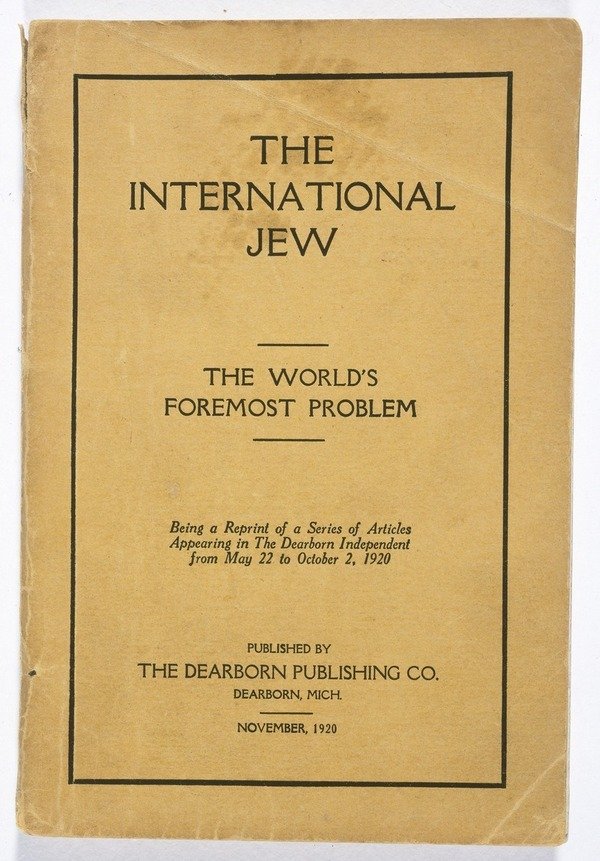
In October 1921 the Moody Bible Institute Monthly, whose editor-in-chief was James M. Gray, ran a short item on the forgery that Weber credits to Gray. It praised an article that defended the Dearborn Independent against those who charged it with prejudice against Jews, and it left the question of Jewish guilt open: “if they are guilty, then there is a peril existing that the world should know about.” The reader was told that the Protocols were “a clinching argument for premillennialism and another sign of the possible nearness of the end of the age.” Arno C. Gaebelein referred to the Protocols four times in his magazine Our Hope in the early 1920s. Charles C. Cook of the Bible Institute of Los Angeles announced their authenticity and added, in the King’s Business, that “the Jewish race is morally fully capable of doing all that is charged against it.” Weber’s judgment is that dispensationalists often “accepted anti-Semites’ analysis of why Jews were despised in the world,” and so were “remarkably susceptible” to conspiracy theory.
The counterweights are real. Joseph Hoffman Cohn, head of the American Board of Missions to the Jews, called the Protocols an obvious fraud, refuted them point by point, and rebuked Ford.
Cohn was a Jewish-born missionary, and the “love” he urged was the offer of the Gospel.
In 1933 the Hebrew Christian Alliance Quarterly criticized the Moody Bible Institute Monthly and others for promoting the forgery. The Monthly’s January 1934 editorial answered with an unsigned reply. It recalled that the magazine had told the Gentile nations they must answer for their treatment of the chosen people, and went on: “we believe that God is thus using Germany today.” It was not a new note. In 1927 the Monthly had called Henry Ford’s retraction “another link in the chain of prophecy,” adding that “we believe he had good grounds for publishing some of the things about the Jews which he did publish.”
In January 1935 Gray took to the radio. He said anti-Semitism had “no place in our Christian civilization,” called the Protocols “alien and hostile to the Bible, and to God,” and advised Christians: “Let us confine ourselves to the Bible and leave the Protocols alone.” The same broadcast said that “Jehovah has awfully cursed Israel for her sins, and His curse rests upon her today.” Weber notes that Gray never took back the “clinching argument” line. Many fundamentalists drew back from Gerald Winrod, who continued to defend it and was indicted for sedition in 1942. Weber concludes that dispensationalism was “not inherently anti-Semitic,” and that its adherents sincerely condemned Jew-baiting.
Both were true at once. The sincerity and the borrowed contempt lived in the same men. The mechanism is visible in Gray, who fitted the forgery into the prophecy he already held. A theology that already expected a hidden hand behind history, and a final confederacy against Israel, had a slot ready for a conspiracy. The forgery from the secular age found a place already cut for it.
The Part He Was Given
In the standard scenario that grew from Darby and Scofield, the end of the age runs as follows. The Antichrist sets up his image in the Temple. A hundred and forty-four thousand Jews, twelve thousand from each tribe, become missionaries to the world. The Antichrist turns on the Jews in general. Weber summarizes: “Most Jews (the favorite estimate is two-thirds, after Zech. 13:8) will perish.” The remnant sees the Messiah return, hails him, and joins him in establishing the kingdom.
The two-thirds figure is worth tracing. Zechariah 13:8 says “two parts therein shall be cut off and die; but the third shall be left therein.” Scofield’s own note says only that verses 8 and 9 “refer to the sufferings of the remnant” before the great battle. The arithmetic belongs to the teachers who came after him, and Weber calls two-thirds their “favorite estimate.” Milton Lindberg, writing in 1940, supplied the other half of the scenario, in which the 144,000 Jewish evangelists preach and the result is a revival: “What a mighty revival will result when these enemies of Jesus Christ become His devoted servants!”
Weber’s own summary of the scenario is blunt: “What lay ahead for Jews was far worse than anything they had experienced in the past. Before all Israel was saved, most Jews would have to be destroyed.” The doctrine that loves the Jew requires him to be preserved, regathered, tested, thinned, and converted. It has a part for him, written in advance.
Lest My People Forget
The verse has another voice. In the Hebrew, Psalm 59:12 (58:12 in the Greek and Latin numbering Augustine and Isidore used) reads pen yishkechu ammi: “lest my people forget.” The speaker is David, and the superscription places him under threat from Saul’s men. The ones who might forget are the psalmist’s own people. It is not a gentle psalm. It asks that the enemies be scattered and brought down. But nothing in the verse assigns the nations a lesson.
Augustine’s Latin read “lest they forget thy law,” a rendering that follows some Greek versions. Jerome, his contemporary, knew that reading. Writing about the verse, he reports that in the Greek it is written “of your law,” but that the Septuagint and the Hebrew do not have “your people,” but “my people,” “and so we have translated.”
Isidore quotes it with the two readings run together in a single line: Ne occideris eos, nequando obliviscantur populi mei legis tuae; disperge illos in virtute tua, et depone eos, “my people” and “your law” side by side, followed by “scatter them in your power, and bring them down.” The Jews, he writes, have merited only dispersion, and a king who finds them with the sign of the law “does not kill them; that is, does not bring it about that they are no longer Jews.” That sentence is Augustine’s, lifted nearly word for word from Against Faustus XII.13.
Bernard of Clairvaux knew the verse as “my people” too. In Letter 363, as Cohen translates it, he tells crusaders that the Jews “are not to be persecuted, killed, or even put to flight,” and gives the verse to the Church as speaker: “God instructs me concerning my enemies, ‘Slay them not, so that my people should not forget.’” The Jews, he goes on, are “living letters of Scripture, constantly representing the Lord’s passion,” dispersed so that, in enduring just punishment for such a crime, they may be “the witnesses of our redemption.” The words had changed. Bernard still gave the line to the Church and put the Jews in the place of its enemies. Innocent III, who decried alleged Jewish violations of the old protections and advocated more oppressive discrimination, still invoked Augustine in declaring that the Jews “ought not to be killed, so that the Christian people should not forget the divine law.” Cohen reads the line as an attempt to reconcile Augustine’s “your law” with the Vulgate’s “my people.”
The reading could be corrected, merged, or reassigned. The doctrine was already in place when Augustine took up the Psalm, and it survived every wording his successors gave the line. It rested on a need, and a need does not consult the Hebrew.
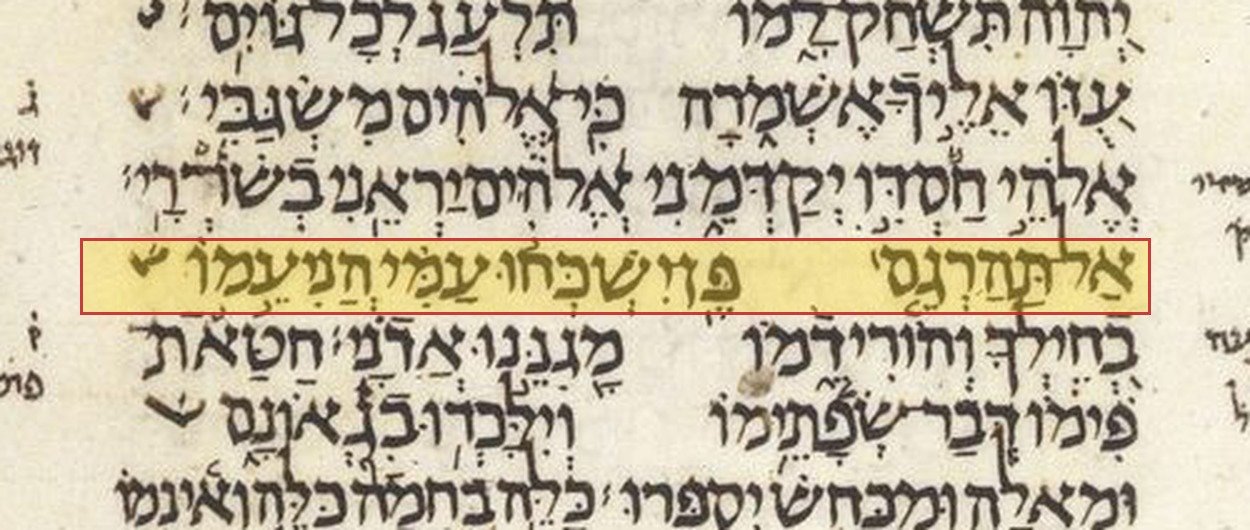
Augustine heard a reason for the Jews to keep the law. Bernard, speaking as the Church, heard a reason for his own people to remember the Lord’s passion in the Jews’ suffering, and Innocent a reason for the Christian people to remember the divine law. In the Hebrew, the psalmist’s people are the ones who might forget, and he leaves the thing they must remember unnamed. Lest my people forget.

Discover more from Many Lamps, One Flame
Subscribe to get the latest posts sent to your email.