
The snake did not merely tempt Eve. It left something behind.
What passed between the serpent and the woman in the Garden was not only a conversation. It was a transaction—and the serpent did not leave empty-handed. Something remained after the encounter: a contamination, a residue, a film deposited into the channel between the human being and the Divine. The rabbis gave it a name: zohama. And they understood it to be the origin of a condition carried by every human being ever born—an inheritance no one chose, and no one, until Sinai, could escape.
The Architecture
To understand what zohama actually compromised, we have to understand what it did not destroy.
Genesis 1:27 states, with a precision that translation has not always honored, that G‑d created the human being b’tzelem Elohim—in the image of G‑d. The phrase has accumulated centuries of theological commentary, most of which collapses immediately into a question about physical resemblance, and collapses just as immediately into the obvious problem that Ein Sof has no body to resemble. The question is the wrong question. B’tzelem Elohim is not a description of appearance. It is a description of structure and purpose.
An archaeological discovery in southern Lebanon is instructive. Excavations uncovered stones at the entrance to an ancient temple bearing the root tzelem alongside individual names—left, scholars concluded, as representations of the named: a delegated presence, a stand-in for those who could not themselves be present. Tzelem did not mean “resemblance.” It meant representative of. The human being is not a portrait of G‑d. The human being is G‑d’s representative in the physical world—a delegated presence, a channel through which the Divine creative energy, the shefa, was designed to move into creation.
The Zohar identifies Adam with Netsach—the sefirah of enduring principle, purpose, and creative mission. Adam was not simply the first biological human. He was primordial humanity in alignment: the channel open, the flow unobstructed, the shefa moving through him without restriction. The Zohar says Adam’s light shone from one end of the world to the other. This is not poetic hyperbole. It is a precise description of what an unobstructed conduit looks like from the outside.
This is what b’tzelem Elohim was always pointing toward. Not resemblance. Not moral flattery. A specific architecture, built for a specific function: to receive shefa from above and transmit it into the world below. The human being, rightly ordered, is the being through whom the Divine creative flow moves without interruption. That was the design. That is what was at stake in the Garden.
What the Serpent Left
Eve, in the kabbalistic reading, corresponds to Hod—the left side, the sefirah of emotional motivation, of feeling and response, of the heart’s orientation toward the moment. The issue here is not femininity but sequence: the serpent approaches through the motivational structure rather than the principled one. Hod is not weak; it is the essential complement to Netsach, the motivating energy that drives principled purpose into action. But Hod is also the sefirah that carries the potentiality for yetzer ha‑ra—the inclination that, unmoored from principle, becomes the pull of the immediate, the seduction of the surface, the appetite for what is pleasant over what is true.
The serpent did not approach Adam directly. It did not attack the principled architecture, the Netsachfunction, head-on. It worked through the motivational structure—through desire and feeling and the persuasion of the senses. And the contamination it introduced entered through exactly the sefirah most susceptible to it.
This is the kabbalistic anatomy of the fall: not a moral failure in the simple sense, but a Netsach‑Hod rupture. The left side became unmoored from the right. Emotional motivation severed from principled purpose. The channel that had been perfectly aligned—receiving from above, transmitting below—was now introducing interference into the signal.
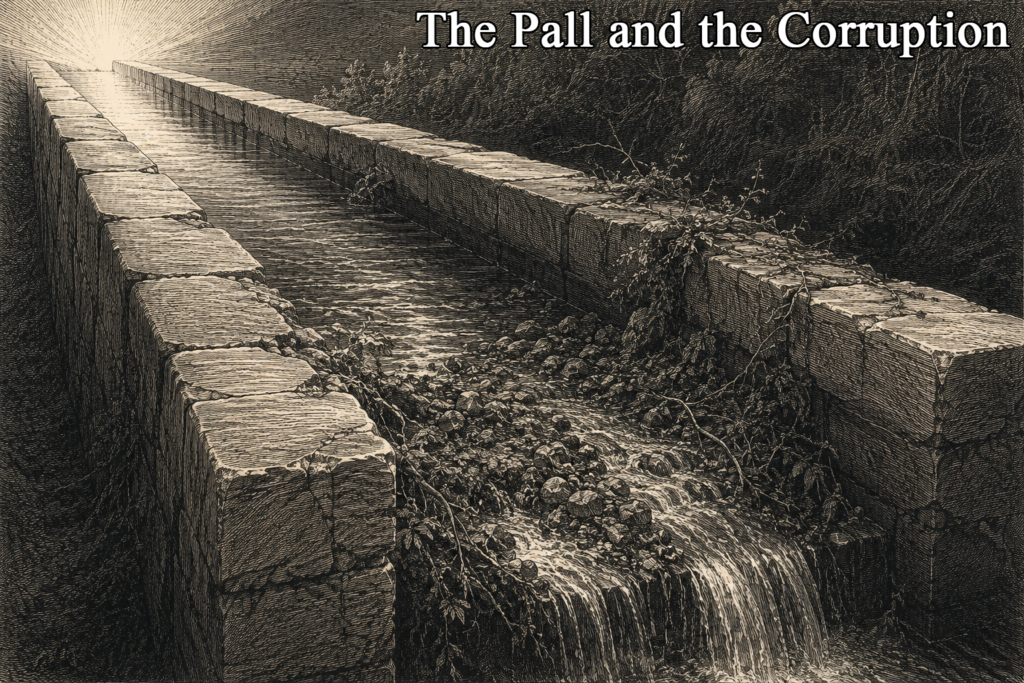
But notice what did not happen. The architecture was not destroyed. The b’tzelem Elohim—the conduit structure, the representative function, the capacity to receive and transmit shefa—remained intact beneath the contamination. The zohama is not a shattering. It is an occlusion. Something was introduced into the channel that restricts the flow—a filter, a sediment, a residue deposited by the encounter and accumulating across every generation since. The shefa still presses through. The source is unchanged. But what emerges at the human end is filtered through what the serpent left, and that filtration has been thickening for a very long time.
The Moment It Lifted
The Talmud records something extraordinary. In b. Shabbat 146a, the rabbis teach that when Israel stood at Sinai and received Torah, the zohama was lifted from them. Temporarily. Provisionally. But genuinely. The contamination ceased. The channel cleared. The Adamic condition—the human being as unobstructed conduit, the shefa moving through without the filter—was briefly, actually recovered.
This moment is not merely a theological claim. It has visible consequences, recorded in b. Shabbat 88a. When Israel declared Na’aseh v’Nishma—we will do and we will hear, doing and understanding arriving simultaneously—six hundred thousand ministering angels descended and placed two crowns on every Israelite. One for na’aseh, one for nishma. These crowns are not decorative. They are the physical, visible manifestation of the Adamic condition restored: the zohama stripped away, the channel open, the representative function operating as it was designed to operate.
Then came the Golden Calf. The zohama returned. The crowns were stripped. Israel stood again in the condition they had carried since the Garden—the channel occluded, the Netsach‑Hod rupture re-inflicted, the second fall playing out at the collective level with a speed that should disturb anyone who reads it carefully.
But Moses stepped forward and claimed the forfeited crowns for himself. And the text tells us the consequence: his face shone with a light so intense he had to wear a veil when speaking to the people (Exodus 34:29–35). The radiance of Moses’s face is not a supernatural reward. It is the visual marker of an unobstructed conduit—the shefa visible in the face of a human being from whom the filter has been removed. The veil he wears is not modesty. It is a barrier between what flows through him and a people who are no longer structured to receive it directly: the klipah—the shell of spiritual concealment—made literal, the occlusion externalized.
Moses passed through the lahat ha-cherev ha-mithapekhet—the flaming sword that turns in every direction, the barrier at the threshold of Eden—because he was constitutionally aligned; what is a wall for the unprepared was gossamer to him. But the people around him still experienced it as a wall. His veil is the threshold made visible and portable: the boundary between what flows through an unobstructed conduit and a community not yet structured to receive it directly. The Parochet in the Mishkan will later institutionalize exactly this: a membrane marking the difference between the prepared and the unprepared, permeable from one side, impenetrable from the other. Moses wore it on his face first.
Moses becomes the living proof of the essay’s central claim. The architecture beneath the zohama was always intact. The channel can be cleared. The b’tzelem Elohim function—the representative capacity, the conduit for shefa—remains available to the human being willing to clear it. The pall is not the person. The occlusion is not the architecture.
The Hinge
Paul of Tarsus was a trained Pharisee. Whatever else he became, he was formed in precisely the tradition that carried zohama—the vocabulary, the categories, the understanding of what the serpent introduced into the channel and what it meant for every generation that followed. He knew Sinai as the moment the contamination lifted. He knew the crowns. He knew Moses’s radiant face. He knew the Golden Calf as a second fall.
When he wrote to the Romans, he was not inventing new theology. He was translating Pharisaic categories for a Hellenistic, largely pagan audience that had no access to the rabbinic framework in which those categories lived. Romans 5:12 is the passage on which everything turns: sin entered the world through one man, and death through sin, and spread from there to all. The Adam‑Jesus typology Paul builds from this is structurally a tikkun argument—one man introduced the contamination; one man effects the repair. That architecture is not Greek. It is deeply Jewish, dressed in Greek rhetorical clothes.
To Paul, Jesus becomes the permanent and universalized Sinai event. As Israel standing at the mountain experienced the temporary lifting of zohama, the restoration of the crowns, the Adamic condition briefly recovered—so Paul’s Jesus makes that lifting available without limit. Not one people at one mountain in one moment, but a cosmic tikkun: the filter removed, the channel cleared, the representative function of b’tzelem Elohim restored without the Golden Calf waiting on the other side.
Paul is the hinge. He carries zohama across the threshold between the rabbinic world and the Hellenistic world, partially translated, partially transformed—but still recognizable to anyone who knows what he is drawing on. The question is what happens when the concept arrives somewhere that does not.
The Relocation
Augustine of Hippo did not know what Paul was drawing on.
Working without the Pharisaic formation that shaped Paul—without zohama, without Sinai as proof of concept, without the crowns and the radiant face and the tradition that had carried all of it for centuries—Augustine filtered the concept through a Neoplatonic lens that had no category for contamination that can be lifted. He was also reading a Latin translation that had already hardened what the Greek left fluid. The Vulgate rendered Romans 5:12 as in quo omnes peccaverunt—“in whom all sinned”—attributing collective guilt to Adam’s act specifically. The Greek, eph’ ho, is considerably more ambiguous: “because all sinned,” or “on the basis of which.” The Latin closed a question the Greek had held open.
In a Neoplatonic framework, substance and essence are the fundamental categories. Contamination that cannot be lifted by human agency does not remain a contamination—it becomes a corruption of the underlying substance. A filter becomes a wound. A wound becomes an ontological rupture: damage to the will itself, to the structure of human nature, so fundamental that no human effort could contribute to its repair. What is required is not the clearing of a channel but the remaking of what was broken at the foundation.
The doctrine Augustine produced is internally coherent. That must be said clearly. He was not reasoning carelessly or maliciously. He was reasoning with the tools he had, within categories that Paul never inhabited—and those categories had no room for Sinai. No concept of tikkun. No experience of a moment when the pall actually lifted and the crowns descended and the channel ran clear. In the absence of that framework, “contamination that can be lifted” is not a coherent category. Contamination that persists must be corruption. Corruption requires not repair but replacement.
And so zohama—a transmitted occlusion, serious and consequential but never ontologically destructive—became original sin: hereditary guilt, damaged will, a human nature so compromised that no human effort could contribute to its repair. The concept was not merely transmitted. It was relocated—from a vocabulary of repair into a vocabulary of ruined substance. And what was lost in the relocation was the most important thing the tradition had carried: the knowledge that the filter can be removed. That Sinai happened. That Moses’s face shone.
What the Relocation Cost
This is not merely a historical argument about the transmission of ideas. The relocation of zohama into original sin installed a specific anthropology into Western civilization—one in which human nature itself is the problem, rather than the occlusion of human nature. And that anthropology has consequences that extend far beyond the church door.
If the will is damaged at the ontological level, if the engine was broken before you turned the key, then failure carries a different weight. It becomes not just expected but theologically rationalized. The tradition tells you the foundation is compromised; the bar for what counts as genuine effort drops accordingly. Original sin can function—has functioned—as its own justification. Not for everyone, and not always, but the exit ramp is structurally available in a way the Jewish framework never permits.
Zohama is real and consequential, but it is not an excuse—precisely because the architecture beneath it remains intact. The channel can be cleared. Teshuvah is meaningful. The expectation of alignment is not removed by the contamination; it is complicated by it. That is a harder anthropology to live with. It demands more, not less.
The Augustinian framework requires grace to act as a cosmic override—a divine life-support system for a ruined nature. The rabbinic framework requires something different and in some ways more demanding: the sustained, patient, often painful work of clearing a channel that was always built to run clean. One tradition looks at the human being and sees damage requiring rescue. The other looks at the same human being and sees occlusion requiring excavation.
These are not merely different theological positions. They are different descriptions of what the spiritual life fundamentally is—and what the human being fundamentally needs.
Obscura
The image of G‑d in us is not what the serpent left. It is what the serpent found already there and could not destroy. The zohama is real. The Netsach‑Hod rupture is real. The occlusion is real, and it has been accumulating since the Garden. But the architecture beneath it—the conduit, the representative function, the b’tzelem Elohim structure that makes the human being G‑d’s presence in the physical world—was never broken. Sinai is the proof. Moses’s face is the proof. The tradition that knew to record both of these moments knew what it was recording.
What Augustine lost—what the translation across metaphysical worlds cost—was not a theological nuance. It was the memory of Sinai as a category of human experience. The knowledge that the pall actually lifts. That the crowns can descend. That there exists a condition in which the channel runs clear and the human being stands, briefly or otherwise, in the alignment it was built for.
The serpent obscured the image. It did not erase it.

Discover more from Many Lamps, One Flame
Subscribe to get the latest posts sent to your email.