
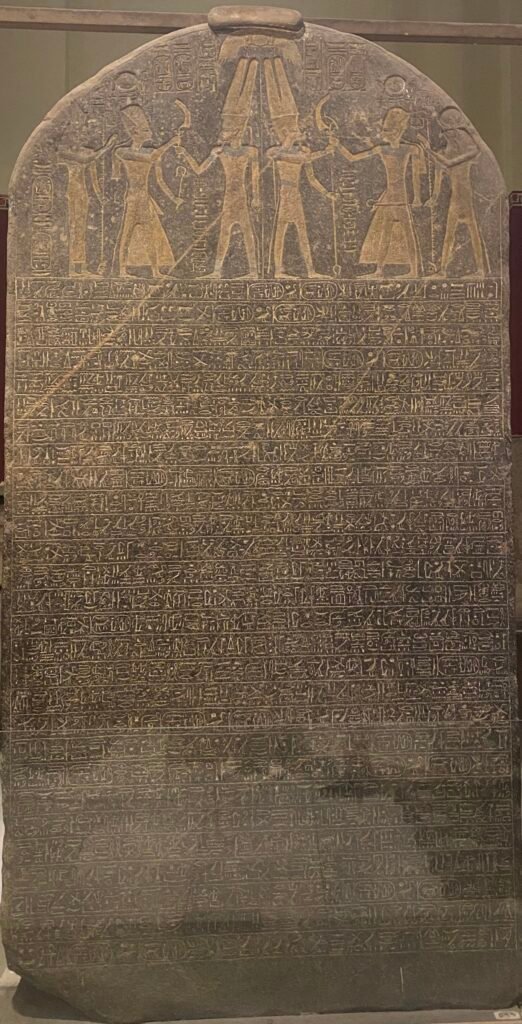
A slab of black granite stands in the Egyptian Museum in Cairo. It is ten feet tall, covered edge to edge with hieroglyphic text recording the military campaigns of Pharaoh Merneptah, son of Ramesses the Great. The inscription dates to approximately 1208 BCE. Near the bottom, almost as an afterthought among the catalog of defeated peoples, a single line names a people whose neighbors would spend the next three millennia attempting to explain why they should not exist.
Israel is laid waste; its seed is no more.
Egypt did not record this grudgingly. It was a boast—evidence of conquest, of civilizational power. And in boasting, Egypt preserved what it tried to erase. The Merneptah Stele is the oldest known extrabiblical reference to Israel as a people. It establishes, in Egypt’s own hand, that Israel existed as a recognized entity in the ancient Near East more than three thousand years ago.
The erasure failed. The stone remained.
Three centuries later, an Egyptian priest writing for a Greek-reading world would try a different approach. Not erasure this time. Rewriting.
The Egyptian Invention
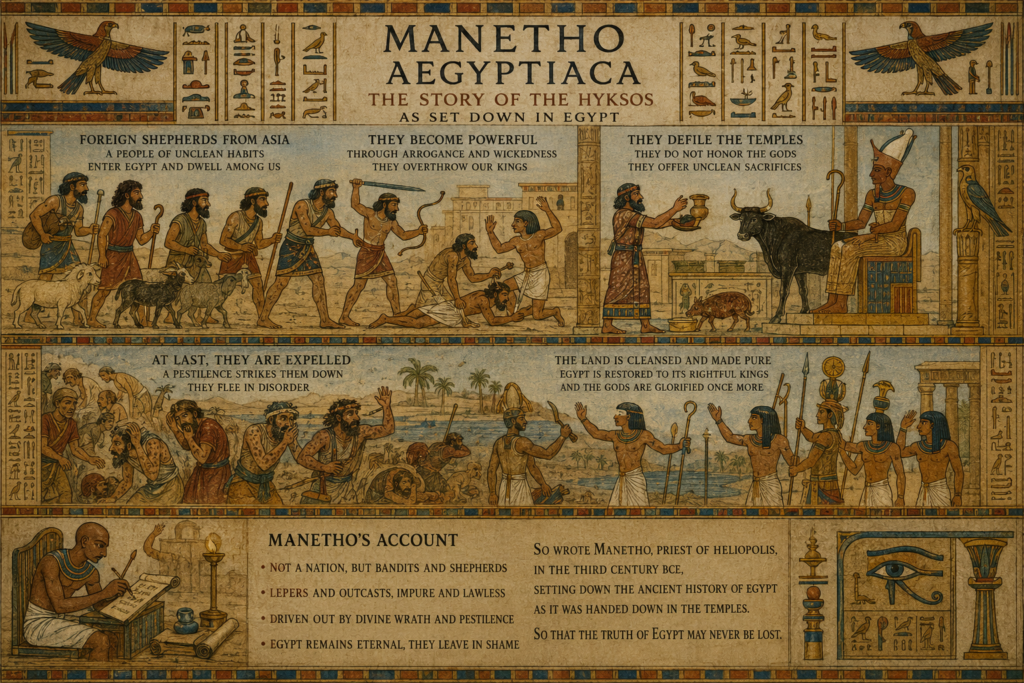
Manetho was a priest of the temple at Heliopolis, writing in the third century BCE under the Ptolemies—those Greek successors of Alexander who ruled Egypt and commissioned histories of it for Hellenistic audiences. His Aegyptiaca was a history of Egypt from its beginnings, written in Greek, designed to establish Egyptian civilization’s dignity and priority in the competitive intellectual world of Alexandria. In it, Manetho told the story of the Exodus.
He did not tell it as the Torah tells it.
In Manetho’s account, as preserved in Josephus’s Contra Apionem, the ancestors of the Jews were not Hebrews liberated from bondage by divine intervention. They were lepers, diseased outcasts, and social undesirables who had been quarantined in the region of Avaris because their physical corruption threatened the Egyptian population. Their leader was not a man called by G-d at a burning bush. He was a renegade Egyptian priest named Osarsiph—later, Manetho says, called Moses—who organized this colony of the unclean and led them in a campaign of deliberate desecration against Egyptian temples and sacred animals before Egypt’s pharaoh finally expelled them from the land.
The founding story of an entire people—the story of liberation, of covenant, of formation in the wilderness—had been recast as a sanitation measure. The Jews did not leave Egypt. They were thrown out of it.
This is not incidental distortion. It is methodical. Every element of the Jewish account that confers dignity—the covenant, the divine calling, the moral formation at Sinai—is inverted. Where the Jewish telling sees liberation, Manetho sees expulsion. Where the Jewish telling sees a people called to purpose, Manetho sees a contaminated population removed for public health. The rewriting is precise enough to be deliberate.
Manetho’s original Aegyptiaca does not survive. We possess his account only because Josephus, writing in the first century CE, quoted it at length in order to refute it—his Contra Apionem, available on Sefaria, is devoted to answering Manetho and those who repeated his charges. The refutation became the preservation. The more thoroughly a charge is answered, the more completely it is transmitted to every reader who encounters the rebuttal across the following two millennia. The falsehood survived because a serious man considered it worth answering.
The Charge That Stuck
The Greek word is misanthropia. Hatred of humanity. And it is the accusation that runs through the pre-Christian literary world like a thread—appearing in Hecataeus of Abdera, in Diodorus Siculus, in Lysimachus, in Apion, in Tacitus—across three centuries, across languages, across the full sweep of Hellenistic and Roman literary culture. The charge is not random hostility. It is a specific, coherent, and transmissible accusation.
The argument is this: Jewish separateness—the dietary laws, the Sabbath, the refusal of intermarriage, the exclusive worship of one G-d, the prohibition on eating with non-Jews—is not religious discipline. It is a declaration of hostility toward everyone outside the community. Jews do not merely differ from their neighbors. They have organized their entire way of life around the principle of not belonging to the larger human family.
In the Hellenistic world, where Greek culture carried the prestige of universal civilization and the mingling of peoples was both practical and ideologically prized, refusal to assimilate was read as aggression. Jewish distinctness was not merely eccentric. It was, in this reading, a sustained insult to everyone else—a claim that the human community which surrounded them was not worth joining.
The Roman elaboration adds a dimension that sharpens the charge considerably. In Rome, participation in civic religion was not optional. The sacrificial economy—the regular performance of ritual offerings to gods who protected the city, the army, the emperor, the harvest—was the mechanism by which Roman society maintained its relationships with the powers that governed the world. When one group within the city refused to participate, they were not simply exercising private scruple. They were free-riding on a system they would not sustain. If the gods withheld their protection because Jews refused the sacrifices that propitiated them, the whole city suffered. The refusal to participate was legible not as religious difference but as civic aggression—a decision to benefit from the protection of Roman gods while refusing to contribute to the maintenance of that protection.
Across these various formulations, one element remains constant. The accusation is not that Jews have committed particular crimes. It is not that Jews have stolen, or murdered, or conspired against a specific enemy.
Being Jewish is itself the offense.
Against the practices that constitute Jewish identity. Against the separateness itself. That will be the charge across two thousand years of subsequent history. The register will shift—theological, legal, biological, economic. The charge will not.
The King Who Made It Policy
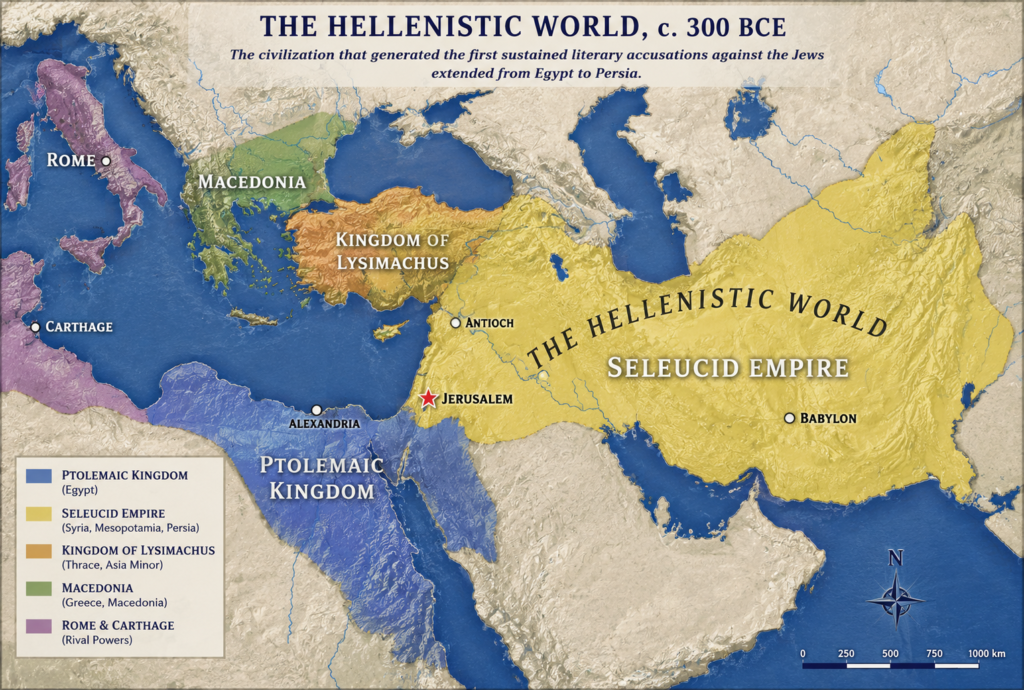
Antiochus IV Epiphanes came to the Seleucid throne in 175 BCE. His coins bore his portrait and the inscription Theos Epiphanes—G-d manifest. The man who declared himself divine would find, in the Jewish refusal to acknowledge that declaration, the misanthropia charge converted from literary accusation into the justification for state violence.
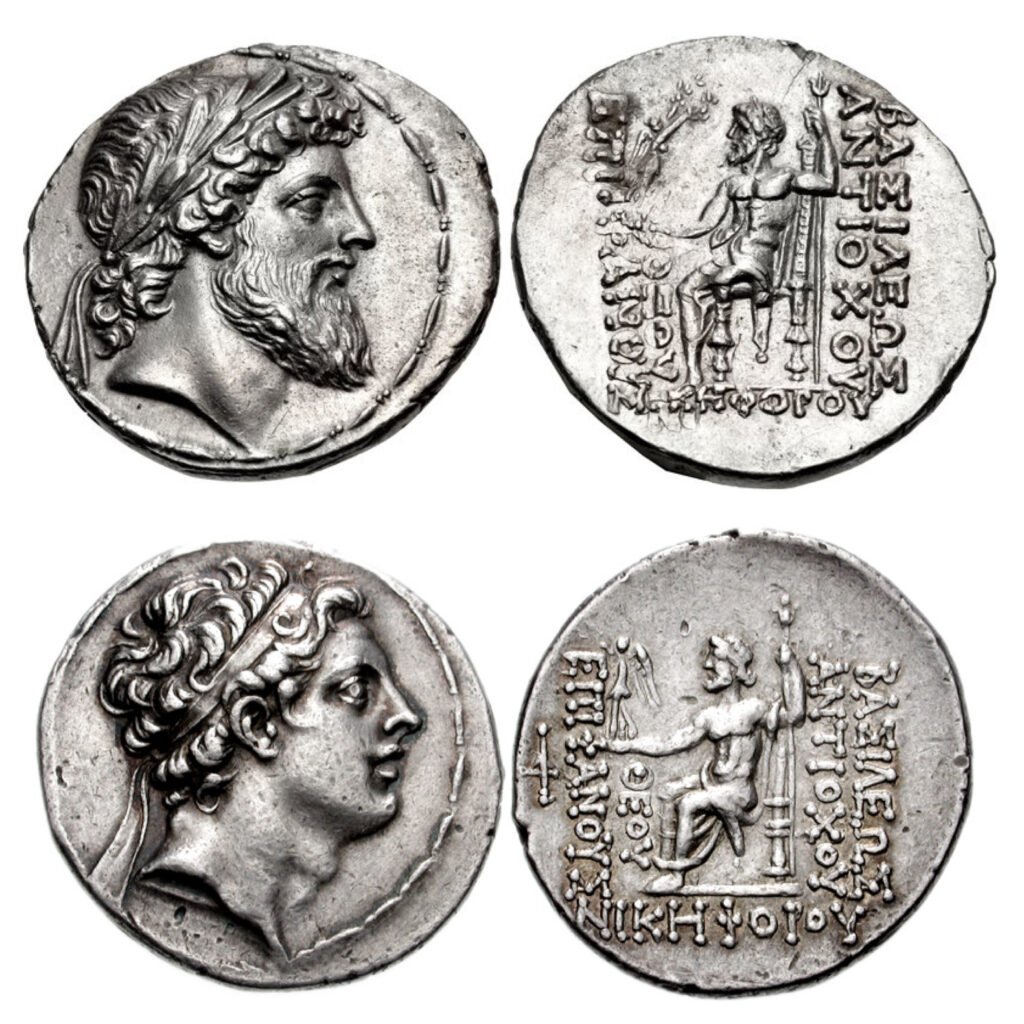
His desecration of the Temple in Jerusalem in 167 BCE was not arbitrary. He installed a Greek altar on the site of the altar of burnt offering. He sacrificed pigs on it. He prohibited circumcision, Sabbath observance, and Torah study under penalty of death. He commanded Jews to eat forbidden foods, to worship Greek gods, to participate in the sacrificial economy of Hellenistic civic religion. The prohibition was total: what made Jews Jewish was exactly what was to be destroyed.
The coins are the argument in miniature. Every transaction in his realm passed through currency bearing the image of a man who claimed to be a god. Under the pressure of his radical Hellenization campaign, what had once been a daily tension—navigating the demands of a Hellenistic empire while maintaining Jewish practice—became something different: an enforced declaration of submission. The coin was no longer incidental. It was the test.
The Maccabean revolt succeeded in driving Antiochus from the Temple. The story is told in the books of Maccabees, and the festival of Hanukkah commemorates its culmination. But military defeat did not remove the charges from circulation. They had already entered the Hellenistic literary bloodstream. The misanthropia accusation did not require Antiochus to survive it.
The difference between Antiochus and his literary predecessors is one of register, not of argument. Hecataeus and Manetho wrote contempt. Antiochus enacted it. He demonstrated that the charges which Hellenistic writers had been refining across generations could be translated into policy—that the accusation against being Jewish could be made operational, backed by the authority of the state, enforced by its soldiers. What begins as a literary posture can become, when institutional power claims it, a blueprint.
Apion and the Refutation That Preserved the Charges
Apion of Alexandria was a Greek grammarian and public intellectual of the first century CE—sufficiently prominent that the emperor Caligula appointed him to lead an Alexandrian delegation to Rome. He was also the most systematic compiler of anti-Jewish charges in the ancient world, and he is known to us almost entirely because Josephus considered him worth a book.
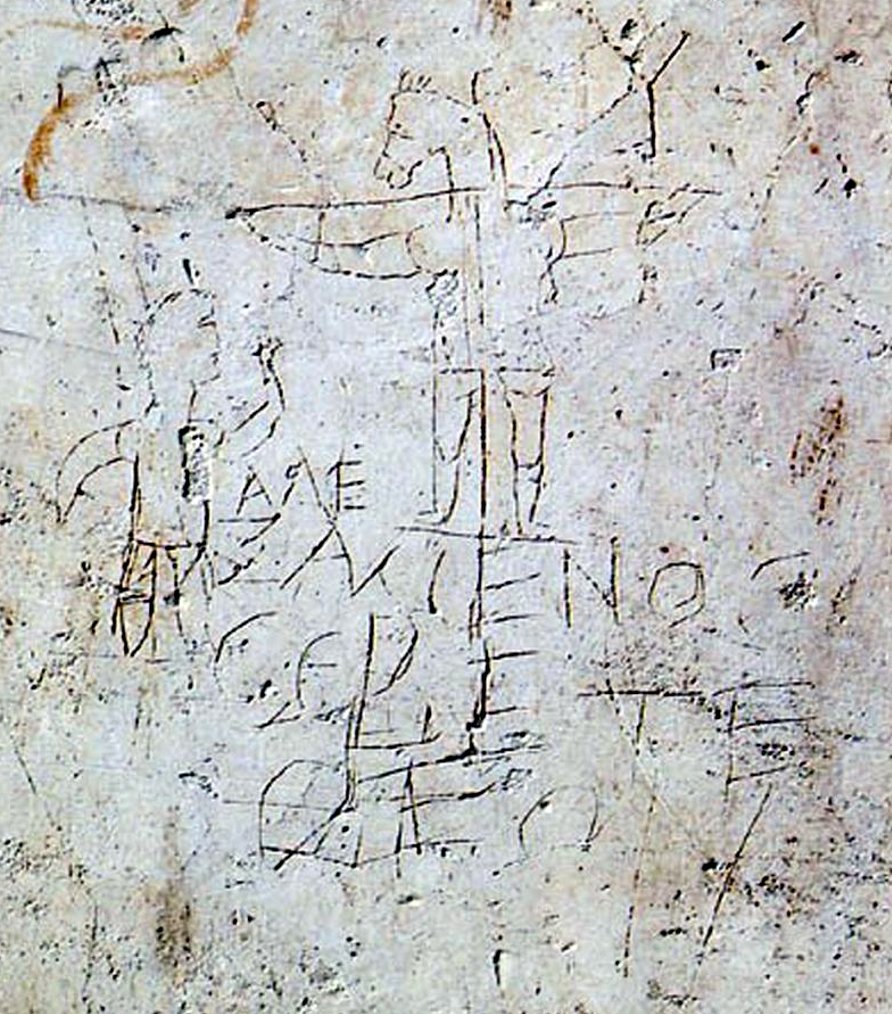
Josephus’s Contra Apionem—available on Sefaria—is the most sustained Jewish response to pagan anti-Jewish literature that survives from antiquity. In it, Josephus quotes Apion’s charges before dismantling them. The donkey-head worship in the Temple’s inner sanctuary—the claim that Jews kept a golden ass’s head as their most sacred object. The annual ritual murder of a Greek captive, whose flesh was consumed in a ceremony of hatred for all Gentiles. The claim that the Sabbath took its name from a disease—the Egyptian word for a groin inflammation—carried by the expelled lepers whom Manetho had identified as the ancestors of the Jews.
None of this was true. All of it circulated widely in Rome.
The mechanism matters more than the content. Falsehoods often survive precisely because serious people consider them worth answering. The more thoroughly a charge is refuted, the more thoroughly it is preserved—copied into the refutation, transmitted with the refutation, available to every future reader who encounters the text. The Contra Apionem is, among other things, a detailed record of what Rome’s educated classes believed about Jews. Josephus answered the slanders. The answer kept them alive.

Tacitus and the Weight of Rome
The difference between Apion and Tacitus is the difference between a polemicist and Rome speaking. Apion argued. Tacitus wrote as Rome’s historian—a man whose authority derived from his reputation for cutting through official narratives to find what had actually happened. When Tacitus described Jews, he was not advancing a case. He was recording what, in his judgment, was simply the case.
Histories Book 5, written around 100 CE, contains the most rhetorically sophisticated expression of the misanthropia charge in ancient literature. Tacitus traces Jewish origins, examines Jewish customs, and offers his assessments. The Sabbath, he argues, was adopted out of sloth. The dietary laws are separatism codified into habit, a daily practice of treating the foods of other peoples as unclean. The refusal of intermarriage is social aggression—a systematic decision to exclude the rest of humanity. Jewish monotheism is not piety but arrogance: a refusal to acknowledge the gods of other peoples that amounts to a declaration that other peoples are wrong about everything that matters.
Toward non-Jews, Tacitus writes, Jews feel hostility and hatred. They will not share meals. They will not worship together. The whole of Jewish practice is a sustained inversion of civilized norms—as though Jews had taken everything Roman and Greek civilization values about civic life and deliberately done the opposite.
This is the misanthropia charge at its most authoritative. It carries the weight of Rome’s greatest historian. It is not fringe opinion.
Then there is Annales XV.44.
Writing about Nero’s persecution of Christians in the aftermath of the great fire of Rome, Tacitus identifies the new sect’s founder as one executed under Pontius Pilate in Judaea—the province he has already established, in the Histories, as a source of moral contagion extending outward into Rome itself. He calls their faith a destructive superstition—exitiabilis superstitio—which had been temporarily suppressed but had broken out again and spread through the city.
The same author. The same vocabulary. The same evaluative framework.
The charge does not need to be reinvented for a new target. It needs only to be reassigned. What Tacitus has written about Jews—their separatism, their contempt for others, their stubborn refusal of civilized norms—he applies, almost as a matter of course, to the movement that had grown from within Judaism. The hostility migrates because the template is already in place.
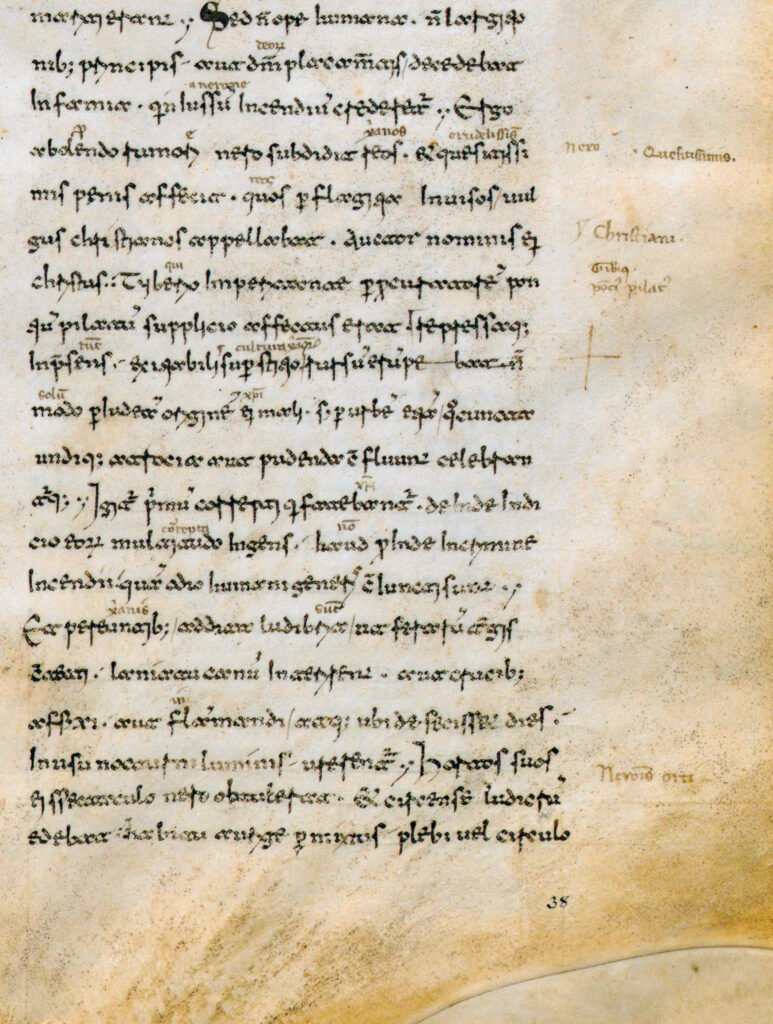
An eleventh-century monk copying this folio in a Florentine scriptorium marked the margin: Christiani. He was flagging the passage for future readers—the reference to the followers of Christ was what he was looking for. What the surrounding text contained—Tacitus’s characterization of Judaea as a province of moral contagion, his vocabulary of exitiabilis superstitio, the evaluative framework he had built in the Histories—passed through the monk’s hand into the manuscript without, apparently, requiring comment.
The transmission mechanism does not require anyone to notice what they are carrying.
What Was Already in the Water
The accusations predate Christianity. By the time the first Christians were writing their letters and gospels, the charges were already three centuries old. Already refined. Already embedded in the most authoritative historical prose of the ancient world. Already available to any educated Roman who had read his Tacitus, his Diodorus, his predecessors in the Hellenistic literary tradition.
What is consistent across Manetho, Apion, Antiochus, and Tacitus is not simply the hostility. It is the target. The accusation attaches itself not to particular Jewish individuals or to specific Jewish crimes. It attaches itself to Jewish practice—to circumcision, to the Sabbath, to dietary law, to endogamy, to the refusal of other gods. To the things that make Jews Jewish.
Being Jewish is itself the offense.
The register changes. The charge does not.
Through the theological architecture that would be built on top of this foundation, through its legal codification in imperial law, through its encoding in stone and glass and illuminated manuscript, through its secularization in the language of race and nation—the accusation runs unbroken. What Christianity inherited was not a vague cultural hostility. It was a fully formed vocabulary of contempt, refined across three centuries by Hellenistic and Roman writers, available and ready for new architecture.

Discover more from Many Lamps, One Flame
Subscribe to get the latest posts sent to your email.