
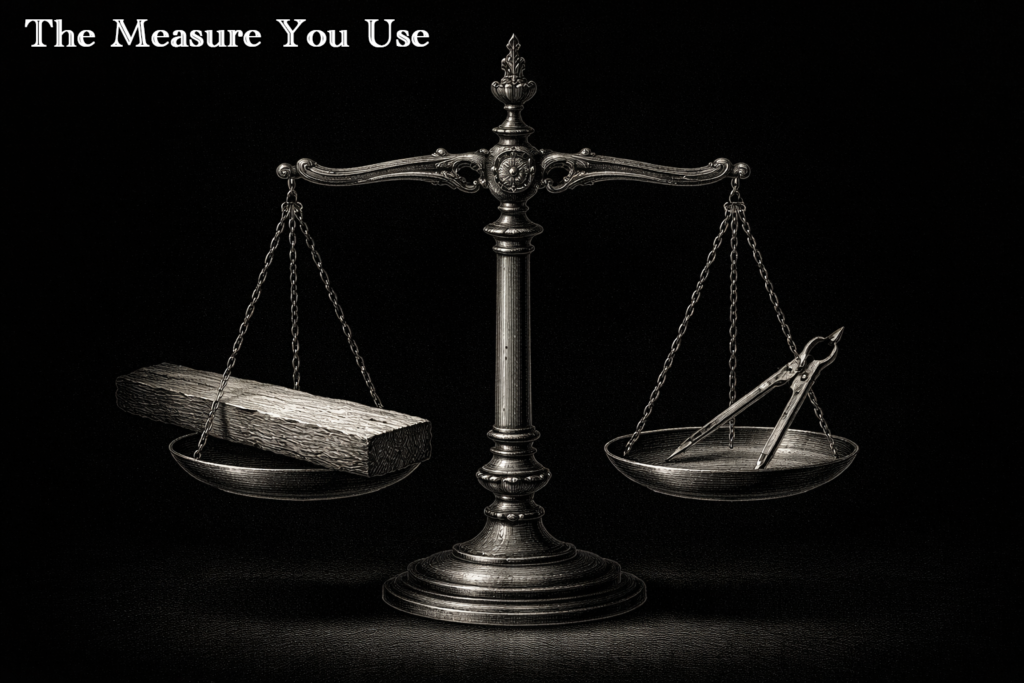
“Judge not, that you be not judged. For with what judgment you judge, you will be judged; and with the measure you use, it will be measured back to you. And why do you look at the speck in your brother’s eye, but do not consider the plank in your own eye? Or how can you say to your brother, ‘Let me remove the speck from your eye’; and look, a plank is in your own eye? Hypocrite! First remove the plank from your own eye, and then you will see clearly to remove the speck from your brother’s eye. Do not give what is holy to the dogs; nor cast your pearls before swine, lest they trample them under their feet, and turn and tear you in pieces.”
(Matthew 7:1–6)
“Judge not, lest ye be judged.” Six words. Perhaps the most quoted moral instruction in Western civilization. They have been deployed to silence prophets, immunize power from scrutiny, and end conversations that urgently needed to continue. They appear on social media as a conversation-stopper, in political discourse as a shield for the powerful, in church life as a tool for enforcing silence. What was once a precise, demanding, and philosophically rich teaching has been compressed into a sound bite—and in that compression, something has been lost. Not only the depth of the instruction, but its plain simplicity as well. Jesus was not speaking in abstractions. He was speaking to Galilean fishermen and farmers under Roman occupation, and what he said was specific, sharp, and grounded in those listening to Him. To recover what he actually said, we have to dismantle what has been built on top of it.
What the Word Actually Means
The Greek is krinō (κρίνω)—to sift, to separate, to distinguish, to assess, to declare what is true and binding. The command Jesus gives is mē krinete: do not judge, second person plural, addressed to a crowd. But the word carries far more weight than the English suggests. The classical Greek sense of krinō is rooted in discernment: the capacity to separate one thing from another, to recognize what something is, to declare its value. Embedded in the act of judgment is an act of valuation. When you judge, you are not merely expressing an opinion or registering a feeling. You are declaring what something is worth and what it deserves.
The Latin root confirms this weight. Iudicare—from ius (law) and dicere (to speak, to declare)—means to speak the law, to declare what is binding. Judgment is not a disposition or an attitude. It is a binding declaration, an act that puts its author on the hook. The one who judges is accountable for the judgment rendered, because that judgment claims authority: it says, this is what this person, this action, this situation is worth. That claim will be tested by the same standard it invokes. The accountability is built into the word itself.
In the Septuagint—the Greek translation of the Hebrew scriptures that both Jesus and those before Him would have known—krinō consistently translates the Hebrew mishpat (מִשְּפָּט—justice, legal ordinance, the declaration of what is right). Three civilizations—Hebrew, Greek, Latin—converge on the same concept: judgment is not casual. It is a faculty with demands, and those demands begin with the one who judges.
The Tradition Jesus Stood In
The Jewish legal tradition does not regard judgment as optional. The concept of tochecha—the obligation of rebuke—makes this explicit. Leviticus 19:17 commands: “you shall not hate your brother in your heart; you shall surely rebuke your neighbor.” The rabbis read that surely rebuke as an obligation, not a permission. Silence in the face of wrongdoing is itself a violation. The Talmud’s extended treatment in Arachin 16b explores the limits of this obligation—when rebuke is required, when it becomes futile, how far the duty extends—but it never questions the obligation itself. A tradition that built the beit din (court of law), the entire apparatus of communal accountability, and the command of tochecha into the fabric of daily life is not a tradition allergic to judgment. Judgment is a mitzvah. A blanket prohibition on judging would have been incoherent to Jesus’s audience. That is not what he said.
The frame for what judgment is for is given in Psalm 1:4: the wicked are like chaff that the wind drives away. Separating wheat from chaff is not a hostile act. It is a necessary one, performed in service of the wheat. The chaff is not condemned by the act of separation—it is recognized for what it is so that what has value can be preserved. Genuine judgment, in this tradition, is an act of care for what deserves to endure. This is the tradition within which Jesus is speaking.
Middah K’neged Middah
The rabbinic principle operating beneath verse 2 is middah k’neged middah (מִדָּה כְּנֶגֶד מִדָּה)—measure for measure. This is not a threat. It is a structural description of how judgment functions in the moral universe. The measure you deploy becomes the measure applied to you—not as punishment, but as logical consequence. When you claim the authority to declare what is true and binding, that claim will be tested by the same standard you invoked. You have established the criterion; you will be assessed by it.
One of the classical illustrations is the ten plagues in Egypt: each plague corresponded precisely to the harm Egypt had inflicted on Israel. Not arbitrary punishment, but moral architecture—the measure returned in kind. The principle runs throughout the rabbinic tradition as a description of how justice works at the level of creation itself. When Jesus invokes it in Matthew 7:2, His audience recognized it immediately. They did not need it explained. What they may not have expected was what he would do with it next.
Plato, Aristotle, and the Greek Inheritance
By the Second Temple period, Hellenistic philosophy had been absorbed into Jewish intellectual life. Figures like Philo of Alexandria were already synthesizing krinō with mishpat, Platonic epistemology with Torah. The philosophical vocabulary was not foreign to the tradition; it had been argued over, sometimes resisted, sometimes illuminated, and woven in. Jesus speaks in Galilee—adjacent to the Decapolis, saturated with Greek-speaking culture since Alexander—in a world where these streams had long since collided.
Plato’s account of judgment in the dialogues frames it as a cognitive act requiring the proper ordering of the soul toward truth. A soul disordered by appetite or passion cannot judge correctly—not for lack of information, but because the faculty of discernment is compromised. The plank, in Platonic terms, is not a moral failure. It is a disorder of the soul’s capacity to see clearly. That is almost word-for-word the claim of Matthew 7.
Aristotle’s phronēsis (φρόνησις)—practical wisdom—is the cultivated capacity to judge rightly in particular circumstances. It is not a rule you apply; it is a virtue you develop through experience, self-knowledge, and habituation. A person without phronēsis rendering judgment is performing something that looks like judgment but structurally is not, because the faculty is not yet formed. The cheshbon hanefesh (the honest accounting of one’s own soul) Jesus requires before approaching the speck is, in Aristotelian terms, the prerequisite cultivation of the faculty itself.
Neither Plato nor Aristotle would have endorsed the flat reading. A disordered soul cannot judge value rightly, because it cannot see clearly. The domesticated sound bite is indefensible even on the church’s own Greek philosophical terms.
The Plank, the Speck, and the Hypocrite
The image is deliberately absurd. A person with a beam of wood protruding from their eye attempting the delicate work of removing a splinter from someone else’s. This is rabbinic hyperbole in its most recognizable form—almost slapstick, and intentionally so. The comedy is the point. The exaggeration is calibrated to make the listener laugh before they realize they are the target.
But the argument is surgical. The claim is not: you are imperfect, therefore do not judge. The claim is: you cannot execute judgment you are not qualified to render. The plank is not a moral disqualification. It is an epistemological one. It is not that you are bad. It is that you cannot see clearly. And what is judgment if not an act that requires clear sight? The Greek krinō—to sift, to assess, to separate—requires functioning eyes. A plank in the eye is a precise description of compromised discernment.
Notice what Jesus does not say. He does not say: never judge. He says: first remove the plank, then you will see clearly to remove the speck from your brother’s eye. The capacity for judgment is recoverable. The disqualification is not permanent. It requires prior work—cheshbon hanefesh, the kind of self-examination that clears the eye before presuming to assess another’s.
The word Jesus uses is hypokritēs (ὑποκριτής)—in the Greek theatrical tradition, the actor behind the mask. The hypocrite is not simply a liar. They are a performer of judgment: someone executing the gestures of discernment without the faculty behind them. Rendered without the prior work of self-examination, judgment is not judgment at all. It is projection wearing judgment’s clothes.
Pearls, Dogs, and the Completion of the Argument
The passage closes with a demand that looks, at first glance, like a non sequitur: do not give what is holy to the dogs; do not cast your pearls before swine. But this is not a change of subject. It is the full circle of the argument.
If judgment is a declaration of value—an assessment of what merits protection, what must be kept from what cannot receive it—then the pearl and the holy thing require a discerning eye to recognize them as such. The dogs and swine are not moral condemnations of those people. They are descriptions of a condition: of someone not yet capable of receiving what is being offered. Casting pearls before swine is not generosity. It is a failure of discernment—a failure, ironically, of judgment. You cannot protect what is valuable without the capacity to recognize value. That capacity is precisely what the plank removes.
The passage that opens with a prohibition on careless judgment closes with a demand for careful discernment. That is not contradiction. It is the architecture of the argument made visible: krinō is not forbidden. Careless krinō—the pretense of judgment by someone whose eye is full of plank—is what is forbidden. Because it is not judgment at all. It is power wearing judgment’s mask.
Paul, Augustine, and Aquinas—What They Preserved
Paul, writing to the Romans, stays close to the middah k’neged middah logic: “You, therefore, have no excuse, you who pass judgment on someone else, for at whatever point you judge another, you are condemning yourself, because you who pass judgment do the same things” (Romans 2:1). This is a faithful extension of the teaching into a Gentile context—not a distortion. The measure-for-measure structure is intact. The accountability of the one who judges is intact. What Paul carries forward is the original precision.
Augustine, in City of G‑d, distinguishes between carnal judgment—judgment by appearances, ordered toward self-justification—and judgment ordered toward truth. The prohibition, for Augustine, falls on the former. The soul that judges by appearances rather than by truth has not yet removed its own plank; it is not qualified to render the verdict it is attempting. That is a reading with real depth, and it honors the original.
Aquinas is precise in the way that serves this argument best. In Summa Theologica II-II, Q.60, he distinguishes rash judgment—judging without sufficient grounds, without the proper exercise of the faculty—from judgment as such. The prohibition is against the former. Judgment exercised with right order, sufficient evidence, and proper authority is not only permitted but required. Both Augustine and Aquinas understood what the tradition actually said. What neither of them could prevent was what came next.
Nicaea and the Imperial Inversion
The Council of Nicaea, 325 CE. Constantine does not attend as a theologian. He attends as a political architect. The creed that emerges is not merely a theological document; it is a loyalty test, a mechanism for defining orthodoxy in terms that serve imperial unity. And in that context, “judge not” undergoes its decisive inversion.
What had begun with Jesus as a precise rabbinic prohibition—protecting the vulnerable from the casual deployment of judgment by the powerful, demanding self-examination before any verdict is rendered—becomes, in the hands of imperial Christianity, a tool for protecting the powerful from the accountability of the governed. The mechanism is not subtle. When the church holds temporal power, dissent becomes heresy. Questioning the council’s decisions becomes an act of rebellion. Examining the orthodoxy handed down from above becomes itself a form of pride. “Judge not” stops being a demand for self-examination and becomes a prohibition on scrutiny directed upward.
This is the mechanism by which the sound bite is born. Not through theological carelessness, but through political utility. Three civilizations’ worth of thinking about what judgment actually is—Greek krinō, Hebrew mishpat, Roman iudicare—compressed into four words and deployed as a silencing mechanism. The wheat-and-chaff image, which had always described judgment as an act of care for what is valuable, gets flattened into a prohibition on discernment itself. And the institution that benefits from that flattening has every incentive to preserve it.
The domestication of “judge not” is not a theological accident. It is an imperial artifact. And it has persisted because the political structure that produced it has never fully dismantled.
The teaching, restored to its full weight, is not a prohibition on judgment. It is a demand for the kind of judgment that earns its authority. The wheat still needs separating from the chaff. The pearl still needs protecting. The holy still needs to be kept from what cannot receive it. That work requires a clear eye—an eye that has done the prior labor of self-examination, that has cultivated the faculty Aristotle called phronesis, that has weighed its own condition before presuming to declare another’s. The Sermon on the Mount does not relieve you of the obligation to judge. It tells you what judgment actually costs—and who must pay that cost before the verdict is rendered. The measure you use will be the measure returned to you. That is not a warning. That is a description of how the moral universe is built.

Discover more from Many Lamps, One Flame
Subscribe to get the latest posts sent to your email.