
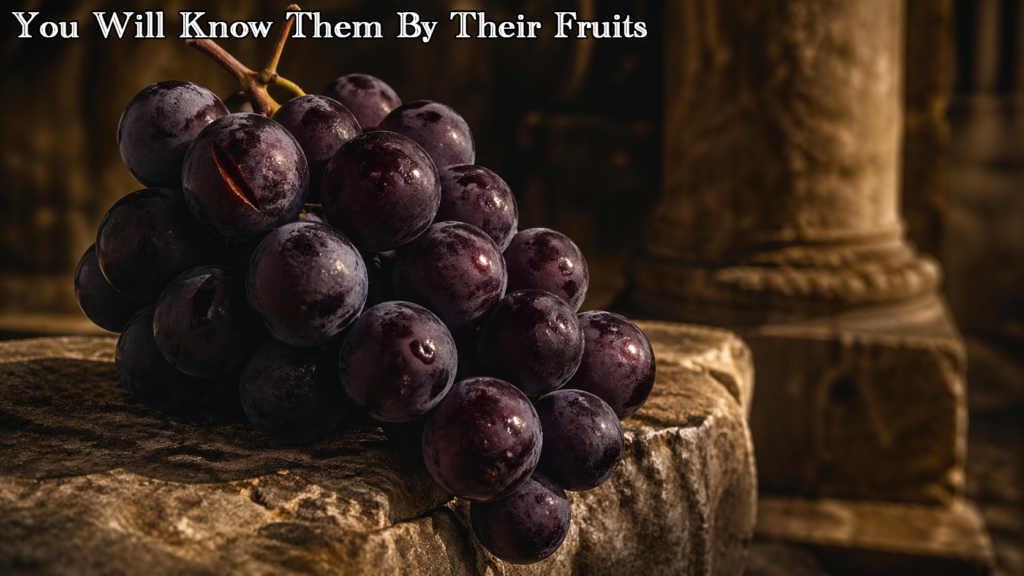
Beware of false prophets, who come to you in sheep’s clothing, but inwardly they are ravenous wolves. You will know them by their fruits. Do men gather grapes from thornbushes or figs from thistles? Even so, every good tree bears good fruit, but a bad tree bears bad fruit. A good tree cannot bear bad fruit, nor can a bad tree bear good fruit. Every tree that does not bear good fruit is cut down and thrown into the fire. Therefore by their fruits you will know them. —Matthew 7:15–20, NKJV
The Sermon on the Mount has been building a person. Anger disciplined. Desire ordered. Speech made precise. Prayer without performance. Giving without audience. Anxiety surrendered. Judgment turned inward. The narrow gate entered. Now Jesus turns outward—not to the world in general, but to what grows on the other side of that gate, and specifically to what claims to have come through it.
Beware. Present tense. Continuous. Not a historical warning about a past category of person but an ongoing posture the formed soul is required to maintain. The formation the Sermon has been producing is incomplete without the discernment it demands. You cannot navigate what you cannot recognize.
The Sheep’s Clothing
The wolf does not announce himself. The false prophet does not wear a sign. The warning is specific: they come in sheep’s clothing—wearing the forms, speaking the language, occupying the role. The clothing is not always a deliberate disguise. Often it grew naturally, learned from the flock, indistinguishable from the real thing because it was assembled from the real thing’s materials.
The erev rav principle—the mixed multitude that left Egypt with Israel—is the tradition’s acknowledgment that the false prophet is not always an outsider. He emerges from within the community, using its vocabulary, standing in its lineage, carrying its forms without its substance. The Golden Calf was not built by Egyptians who had followed from a distance. It was built by people who had crossed the sea.
The Zohar’s Yanuka makes this precise: the Other Side imitates holiness as a monkey apes humans. Structurally perfect imitation—same gestures, same sounds, same surface—but the interiority is absent. Netsach without Chokhmah: the capacity to articulate revelation without having genuinely received it from above. The channel is open but running from the wrong source. Torah’s warnings against false prophets—Deuteronomy 13, Deuteronomy 18, Jeremiah 23—all describe this same anatomy: words that sound like prophecy, signs that look like divine confirmation, communities that form around them. And the question the tradition always returns to: from which side does the transmission actually come?
The Fruit Test and What It Requires
You will know them by their fruits. Not by their intentions. Not by their sincerity. Not by their credentials or their fluency or the size of their following. By what they produce—in the community around them, and specifically in you.
The biology is deterministic: a thorn bush cannot produce grapes. Applied to persons, however, the test requires something the thornbush does not: discernment. Binah—understanding, the capacity to receive, process, and evaluate what has been received. Aquinas, in Summa Theologica II-II, Q.172, notes that the false prophet may not know he is false—the disordered imagination produces experiences indistinguishable, from the inside, from genuine prophetic illumination. The true prophet receives from the lumen propheticum, the illumination from above. The false prophet receives from a disordered interior or from the left side’s imitation of it. Subjective certainty is not verification. The fruit test is necessary precisely because the prophet’s own experience cannot be trusted to distinguish the source.
This requires of the one applying the test something the modern world has largely abandoned as a spiritual discipline: critical thinking. Not cynicism. Not reflexive suspicion. The deliberate, ongoing evaluation of what is actually being produced by the tree you are sitting under. Not what it promises. Not what it produced in early seasons. What it is producing now—in you, around you, in the community that follows it. The soul that does not perform this evaluation regularly will find itself, eventually, having consumed fruit that felt nourishing and is now propagating something it did not choose to carry.
The Fruit That Breeds
The fruit may look good—bright, free of blemish. When you bite into it, it is filled with maggots. The distinction from rot is theological, not merely visceral. Rot is an endpoint—the fruit consumed itself and is finished. Maggots are a reproductive mechanism. They do not stay in the fruit. They spread. The false prophet’s fruit doesn’t merely fail to nourish—it actively propagates the condition that produced it. You consume it and become the next host. The next tree that looks good from the outside.
The Sermon has already addressed this mechanism from the other direction. The one who gives for recognition, prays for visibility, fasts for admiration—Francis of Assisi, whose Admonitions return to this pattern throughout, names it precisely: the servant of G‑d who is not disturbed when praised or blamed, because he knows what he actually is. What you perform for an audience produces fruit that feeds the performance. The tree that grows from amor proprio—Catherine of Siena’s term, in The Dialogue, for the self-love at the root of the false prophet’s entire operation—produces fruit that circles back to the self. Everything it generates feeds back into its own reputation, its own security, its own need for confirmation. Even its generosity is self-serving.
The fruit test reveals the root. And the root is what the Sermon has been addressing all along.
When the Shepherd Becomes the Destination
John of the Cross, in the Ascent of Mount Carmel, warns against spiritual directors who make themselves the destination rather than the path. The soul that arrives not at union with the divine but at dependency on the teacher has been led into a klipah—a vessel that receives but cannot transmit, that accumulates around itself rather than opening toward the source. The bad tree produces dependency. Souls that cannot function without the director’s approval. Souls that have transferred their ultimate orientation to the human teacher rather than toward the divine.
Here the yetzer ha-ra reveals its most dangerous capacity. It is not experienced as evil from the inside. The person in its grip does not feel corrupted—he feels called. He feels justified. He feels that what he is doing serves a higher purpose that others cannot yet see. The yetzer ha-ra does not announce itself. It presents itself as the voice of conviction, of mission, of righteous anger, of necessary action. It wears the clothing of the yetzer ha-tov because that is the only way it gains traction in a soul that retains any moral awareness at all. The road to the worst evils in human history is not paved by people who thought they were doing evil. It is paved by people who were absolutely certain they were doing good. That certainty—the unshakeable conviction that one’s cause is righteous, that opposition is itself corrupt, that the escalating means are justified by the end—is one of the most reliable fruits of the yetzer ha-ra operating at full strength in a spiritually articulate person.
The twentieth century provided the fruit test with abundant material. Jim Jones, who began with genuine civil rights ministry and ended in Jonestown. David Koresh, whose biblical fluency was real and whose fruit was catastrophic. Marshall Applewhite, Charles Manson, Shoko Asahara—each built communities that looked, initially, like genuine belonging: purpose, mission, the sense of being chosen for something significant. Each produced fruit that did not rot but bred. The survivors of Peoples Temple carried the damage into decades of subsequent life. Manson’s followers murdered for him—they became the reproductive mechanism of his poison. Asahara’s disciples manufactured sarin.
John’s diagnosis of every case would be identical: the leader had made himself the destination. Netsachwithout Chokhmah—the capacity to articulate, organize, transmit—operating without genuine wisdom from above. And crucially: not one of them knew what they were. Jones believed he was building the Kingdom. Koresh believed he was the Lamb of Revelation. Applewhite genuinely believed he was guiding his followers to the Next Level. This is precisely what Aquinas warned: the false prophet may not know he is false. Which is why Jesus does not say you will know them by their intentions. He says by their fruits.
The Discipline That Does Not End
The fruit test is not a one-time evaluation applied at the moment of first encounter and then set aside. It is the permanent condition of the soul that has come through the narrow gate—the ongoing discipline of the person the Sermon has been forming.
You left Egypt. You crossed the sea. The erev rav crossed with you. And the question of which trees you are sitting under, what fruit you are consuming, and what you are now producing does not resolve itself at any point in the journey. The false prophet does not always arrive from outside. He grows from within the community, from within the tradition, sometimes from within the self—the voice that has learned to speak the language of yetzer ha-tov while serving the yetzer ha-ra, the channel running from the left side in the vocabulary of the right.
Augustine, in The City of God, frames the fruit test as the only reliable diagnostic precisely because everything else can be counterfeited: the miracle, the eloquence, the apparent holiness. What cannot be sustained indefinitely is the fruit. Over time, under pressure, in the private life that no performance can fully cover, the tree reveals what it actually is. The community that follows it reveals what it has been consuming. And the person who has applied the test rigorously—who has developed the Binah to evaluate what they receive, the Chokhmah to recognize transmission from above, the courage to act on what the evaluation reveals—that person has completed something the Sermon has been building toward since the first Beatitude.
Not safety. Not certainty. The ongoing, costly, irreplaceable discipline of discernment.
By their fruits you will know them.

Discover more from Many Lamps, One Flame
Subscribe to get the latest posts sent to your email.
I really enjoyed this article and totally agree with it. I personally have experienced the difference of individuals that are not living what they claim to be yet profess to do so. Very good reminder to us to keep working on our spiritual life and focused on Torah and Kabbalah to avoid those pitfalls!