
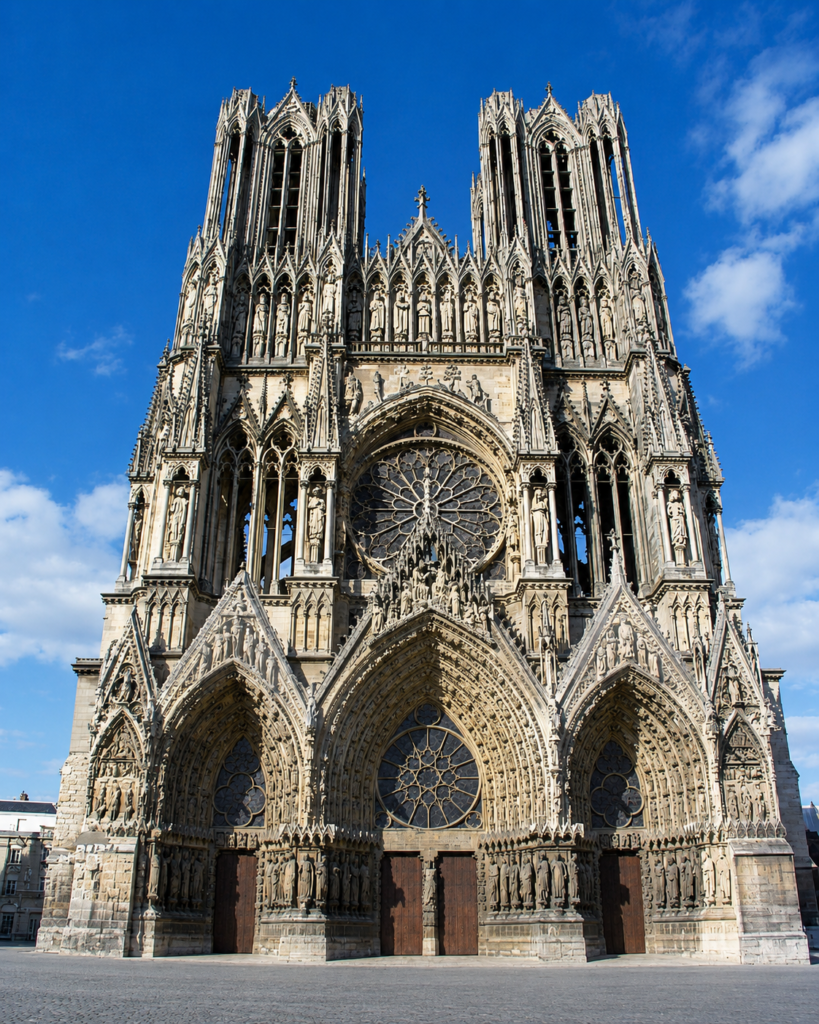
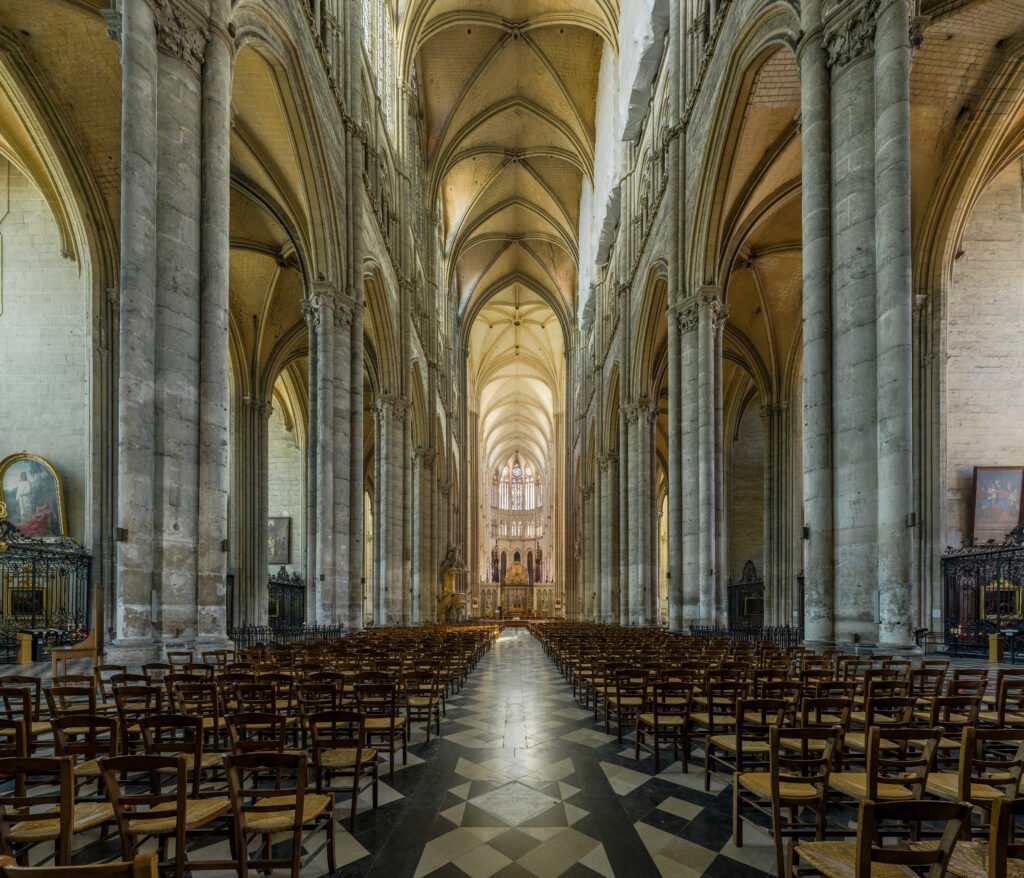
You cross the threshold. Before you have heard a word of the sermon, before you have opened a text, before anyone has said anything to you, the argument has already been made.
It is in the stone above the door you just walked through. It is in the glass that filters the light you are praying by. It is in the wood beneath the seat where the monks sing the hours. It is in the carved capital above the column you are leaning against.
The contempt is the building.
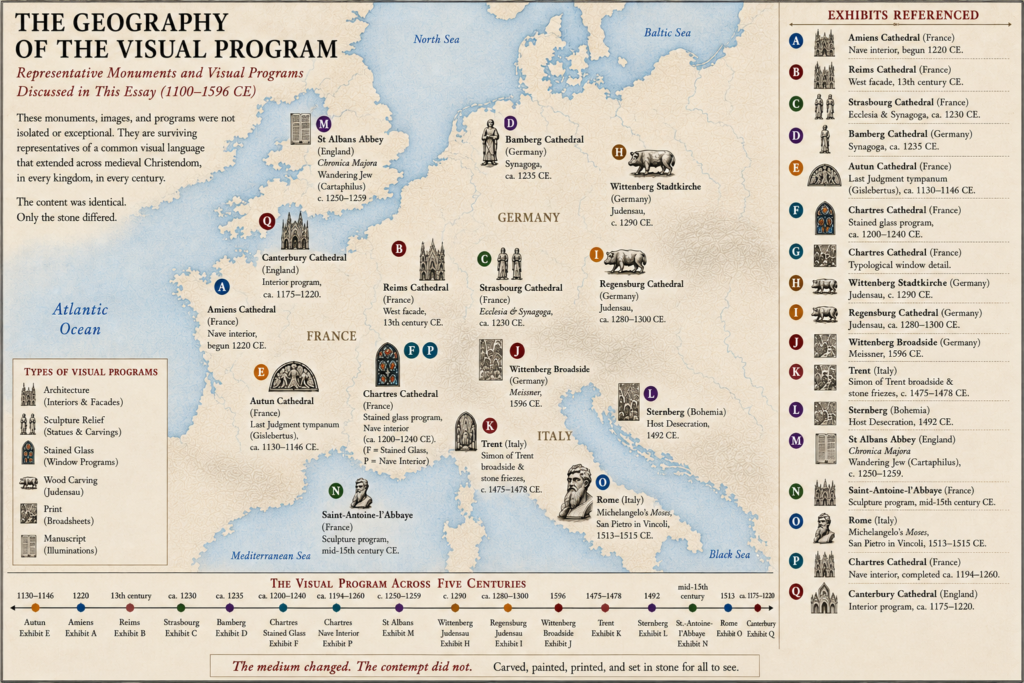
Every other mechanism traced through this series required a vehicle—a text, a law, a sermon, a financial instrument, a courtroom. The medieval church building requires none of these. It simply is. A peasant who never heard a sermon, never read a word, never attended a trial, absorbed the theological argument about Jews every time he entered his parish church—absorbed it through his eyes, through the architecture that organized his worship, through the images that surrounded the sacraments he received. The building taught him. And it taught him the same lesson in every parish in Christendom, in every language, across every century of the Middle Ages. The content was identical. Only the stone differed.
These were not marginal images in obscure manuscripts consulted by scholars. They were the walls of the buildings in which an entire civilization was baptized, married, shriven, and buried. They were the environment of formation—the visual world that organized every other visual world. You did not go to them. You lived inside them.
The Door You Pass Through
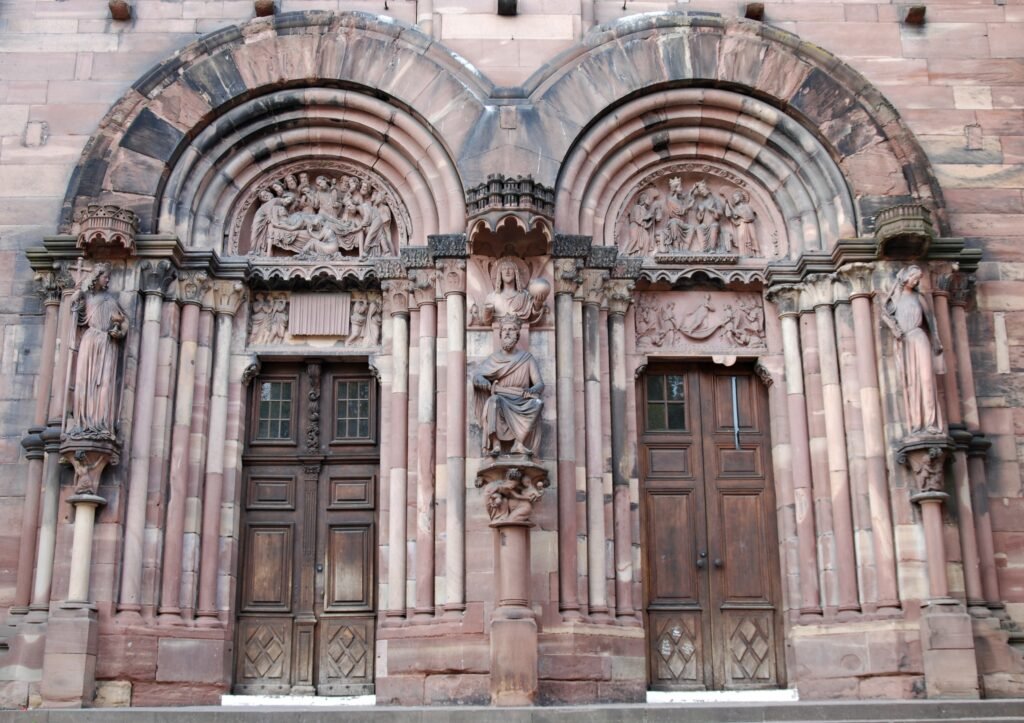
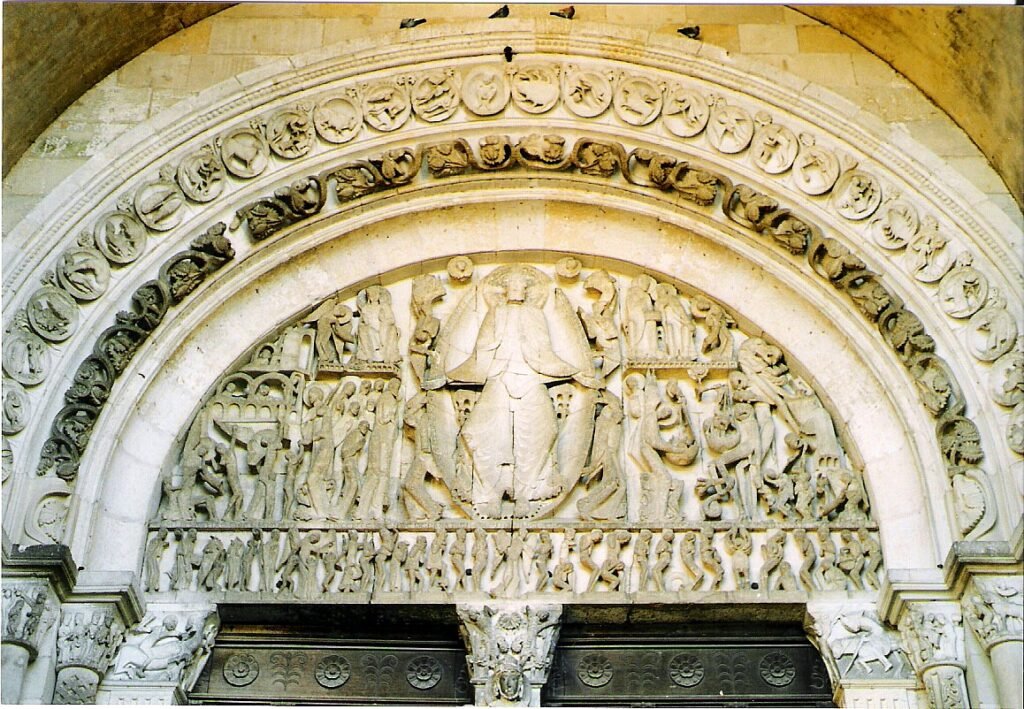
The portal is the most prominent position in the entire cathedral building program. Above the door: the tympanum, carved with the Last Judgment. The saved rise on one side, the damned descend on the other. In many programs, the damned include identifiable Jewish figures—the pointed Judenhut makes them legible to anyone who knows the visual code, which every medieval Christian did. You looked up before you entered. The verdict was already visible.
But the more precise argument is in what flanks the door itself. At Strasbourg, at Bamberg, at Reims, at Notre-Dame de Paris, and at dozens of other cathedrals across Europe: two female figures, carved at eye level, placed where every congregant passes. Ecclesia on the right—crowned, triumphant, holding the chalice and the staff of authority. Synagoga on the left—crown fallen at her feet, staff broken twice, eyes wrapped in a serpent.
The crown has fallen off Synagoga’s head—it lies at her feet, midair in some versions, because the moment of its falling was located at the crucifixion. The staff is broken twice, not once: broken at the wrist, broken again at the shoulder. Early Christian theologians interpreted the Temple’s destruction in 70 CE as the second breaking—the first being the crucifixion itself. The broken staff encodes a compressed timeline of the theological argument in three feet of carved stone.
And then there is what some versions of Synagoga holds in her right hand: the decapitated head of a goat. The goat imagery—deriving from Jesus’s statement that at the Second Coming he will separate the sheep from the goats, sheep to heaven, goats to hell—links Synagoga directly to Satan and the damned. Not merely defeated. In league with evil.
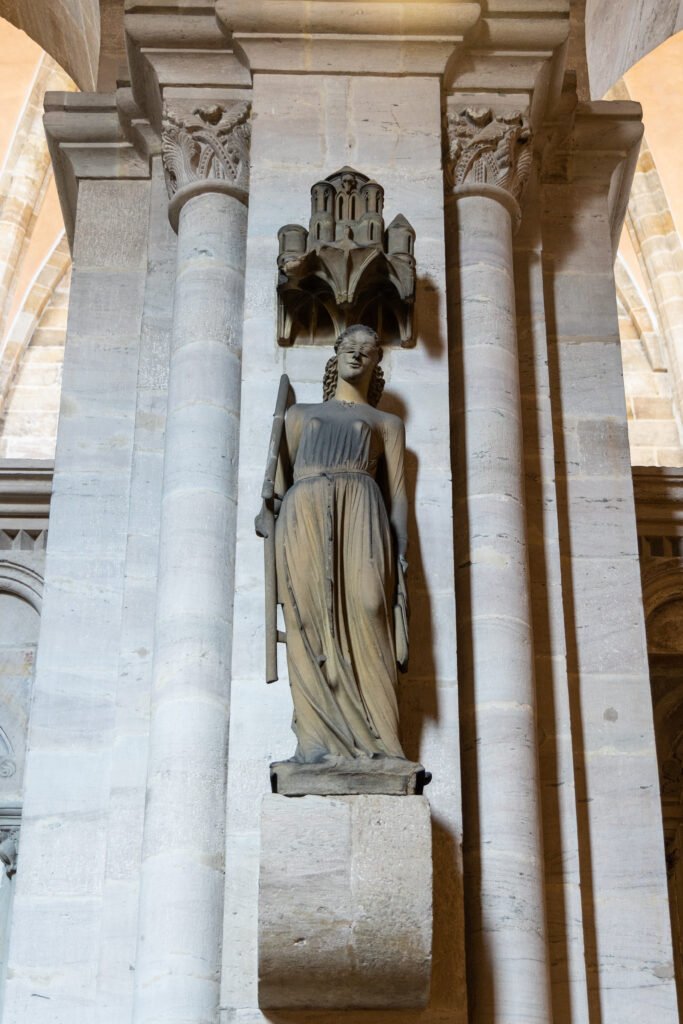
These figures were brought down to eye level. They flank the central entrance. This is not peripheral decoration. This is the central argument of the building—placed where no congregant could miss it, where every act of entry required passing between the crowned and the defeated, between the covenant kept and the covenant broken.
The Light That Teaches
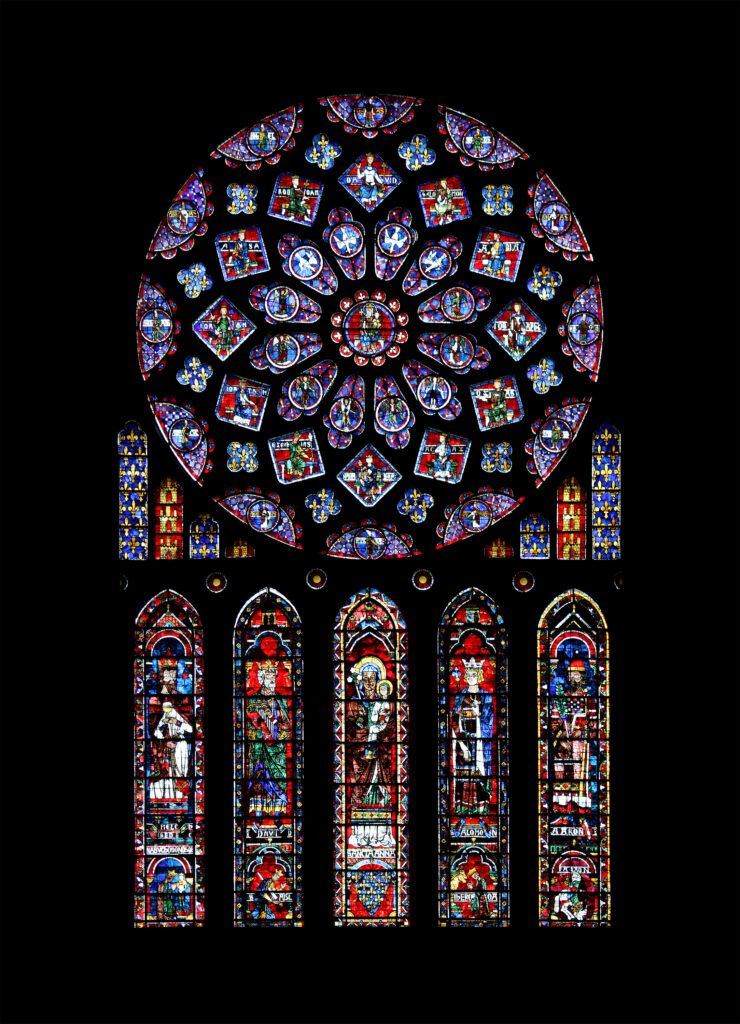
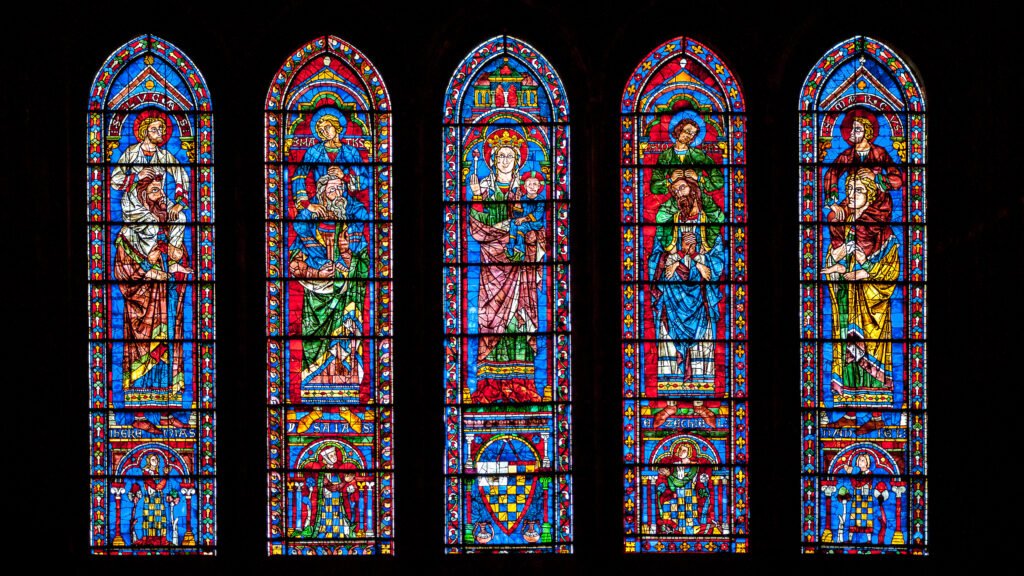
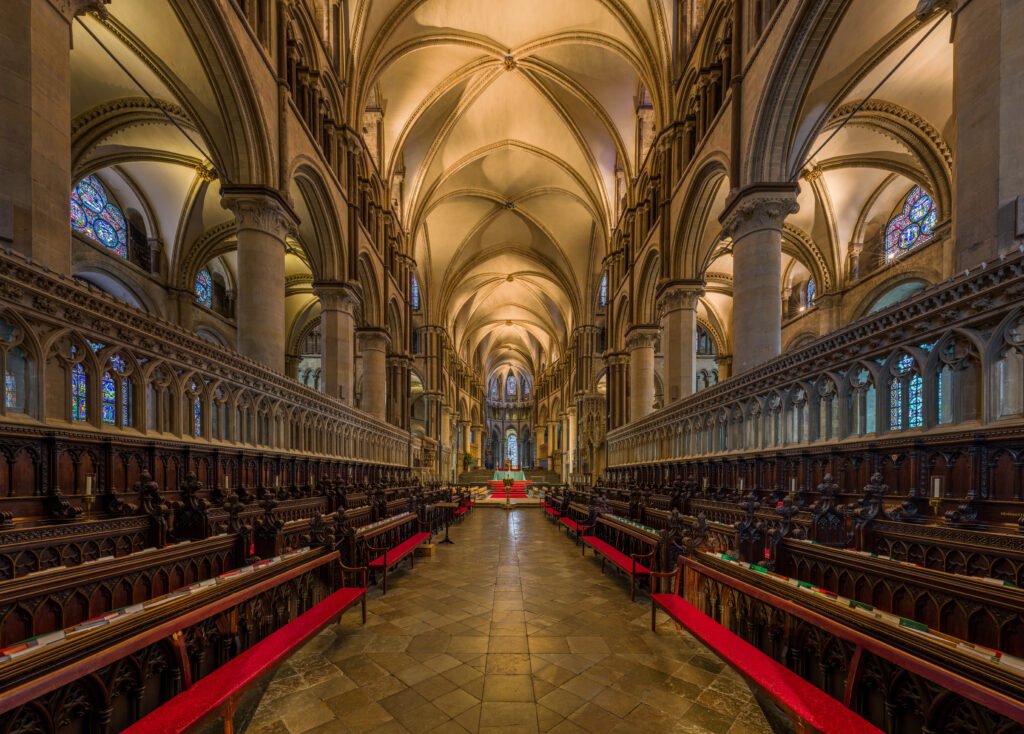
The stained glass windows are the building’s second lecture, delivered in light. The great typological window programs at Chartres, Canterbury, and elsewhere pair Old Testament scenes with New Testament fulfillments—a visual argument that every Jewish text, every Jewish practice, every Jewish figure was a prefiguration of what Christianity had completed and surpassed. Abraham’s near-sacrifice of Isaac prefigures the crucifixion. The brazen serpent in the wilderness prefigures Christ on the cross. Moses striking water from the rock prefigures baptism.
The Jews in these windows are often depicted neutrally or even sympathetically—the argument is not that they are evil but that they are incomplete. Preliminary. The preparation for something greater that has now arrived and rendered the original obsolete. This is supersessionism in its subtler and in some ways more insidious register. The Judensau dehumanizes. The typological window claims—it takes the Jewish inheritance and reframes it as preparation for something beyond itself. Both are contempt. They are structurally different forms of contempt, operating at different emotional registers, distributed through different elements of the same building.
You cannot choose not to be bathed in this light. You worship inside it. The colored glass falls across you during the Mass, during the prayers, during the sacraments. The argument reaches you not through the eyes looking at a page but through the skin receiving the light.
The Seat You Sit In
Below the great theological programs of portal and window lies the most vernacular level of medieval church art: the misericords—the small ledge beneath the hinged seat of the choir stall that monks and clergy could lean against during the long hours of the Divine Office. When the seat was raised, the misericord was visible. Carved into these surfaces, often in grotesque and obscene detail, were images that would never have appeared in the official iconographic program of the building but that circulated freely in this more private, less supervised space.
A Judensau belongs here in the fullest sense: carved into the underside of a choir-stall seat at Cologne Cathedral, 1308–1311, invisible except to the canon who raised the seat to sit. It predates the public exterior carvings at Wittenberg and Regensburg by nearly two centuries—a private statement, made in a space no congregant would ever see, expressing in wood what the institution would not yet carve into its walls.
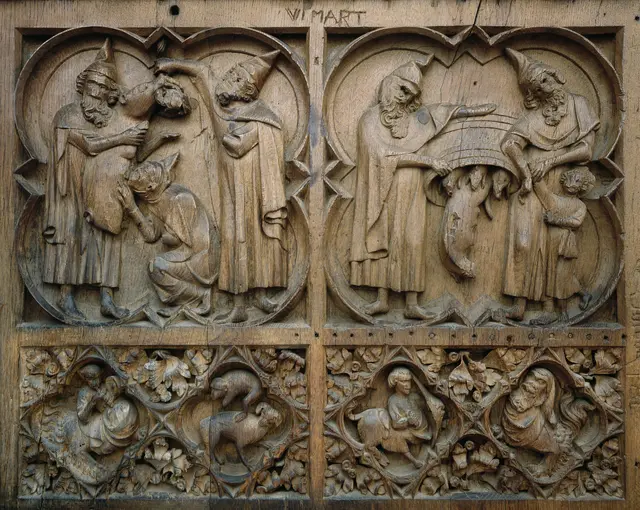
But the image did not stay hidden.
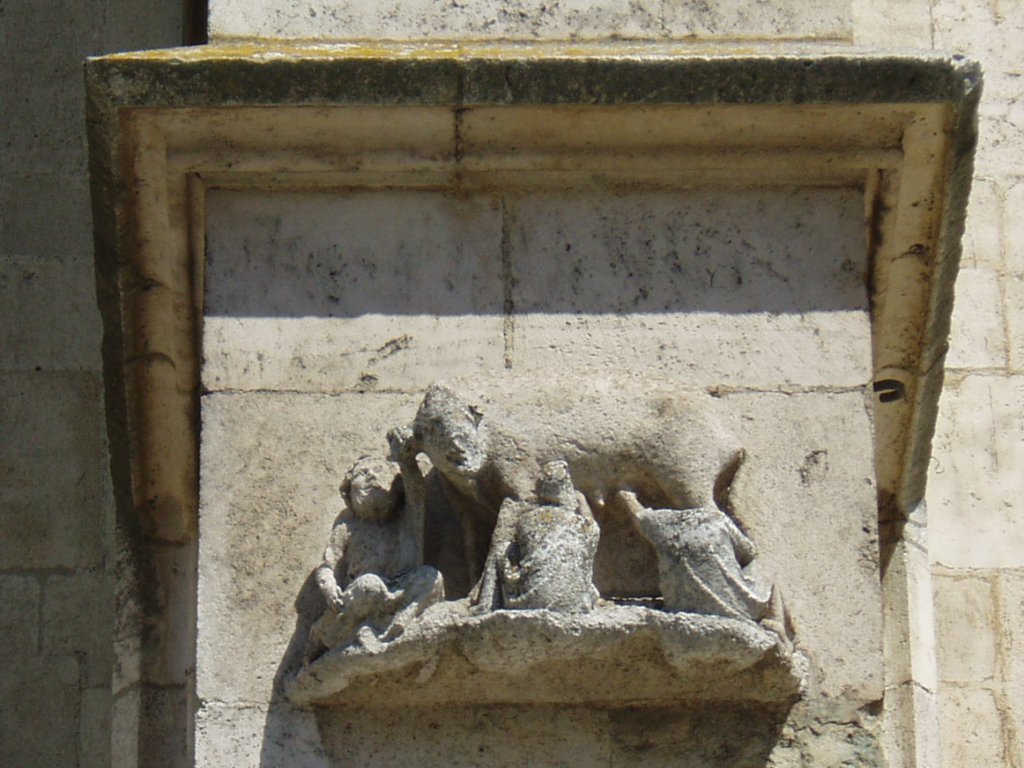
Within a century it had moved off the underside of the furniture and onto the outside of the building—carved not for the clergy who used the choir stalls but for the entire town passing beneath it in the street. A sow depicted nursing piglets. Jewish figures nursing alongside them, or eating the pig’s excrement, or sitting astride the pig, or lifting its tail to read the Talmud from beneath it. The image recurs on the Brandenburg Cathedral, the Regensburg Cathedral, and dozens of churches across the German-speaking world—no longer confined to what a monk alone could see, but set where anyone could see it. It is not theological argument in any sophisticated sense. It is dehumanization—the most visceral and least abstract form of contempt, and by the time it reached the church exterior, it no longer needed privacy to survive.
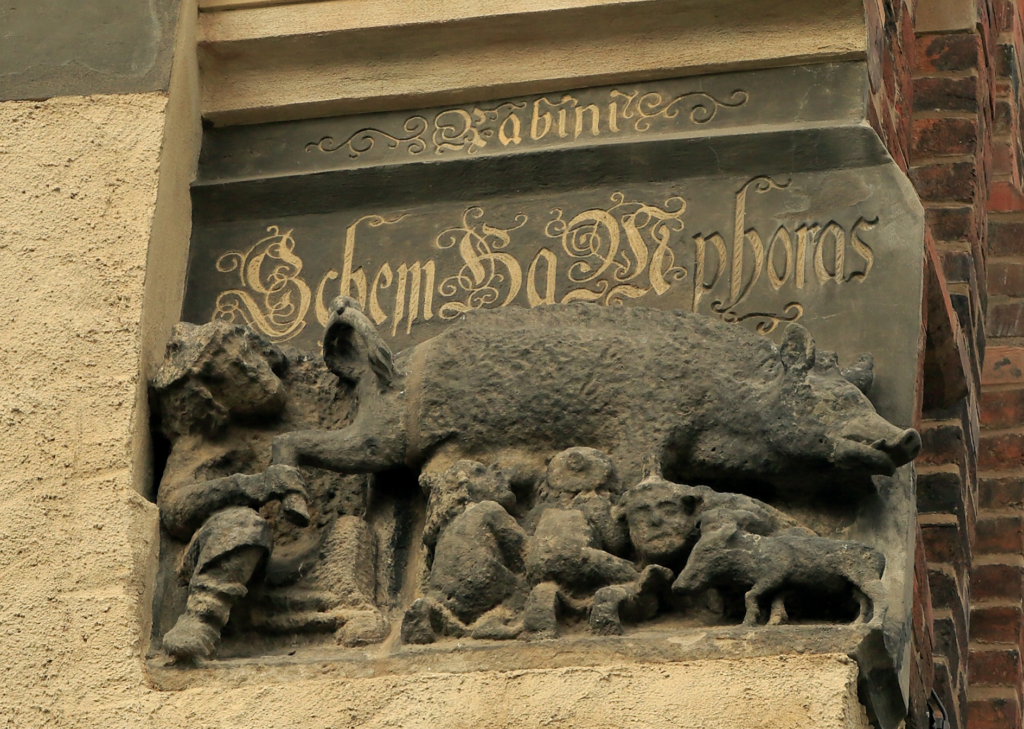
Luther knew the Judensau at St. Marien Church in Wittenberg well. He said Mass there every day. He wrote about it in his journal: “Here on our church in Wittenberg, a sow is split in stone. Young pigs and Jews lie suckling under her. Behind the sow, Rabbi is bent over lifting up her right leg, holding her tail high, looking intensely under her tail and into her Talmud, as though he were reading something extraordinary, which is certainly where they find their G-d.” Luther’s description is almost fond. The image confirmed what he already believed. He found it a satisfying expression of contempt.
By the time Luther wrote those words in the 16th century, the Judensau had been carved into church buildings for centuries. He did not need to argue for the image’s validity. He simply recognized it. The building had been making the argument since before he was born. (In June 2022, Germany’s highest court ruled that the Wittenberg Judensau could remain in place on the church façade.)
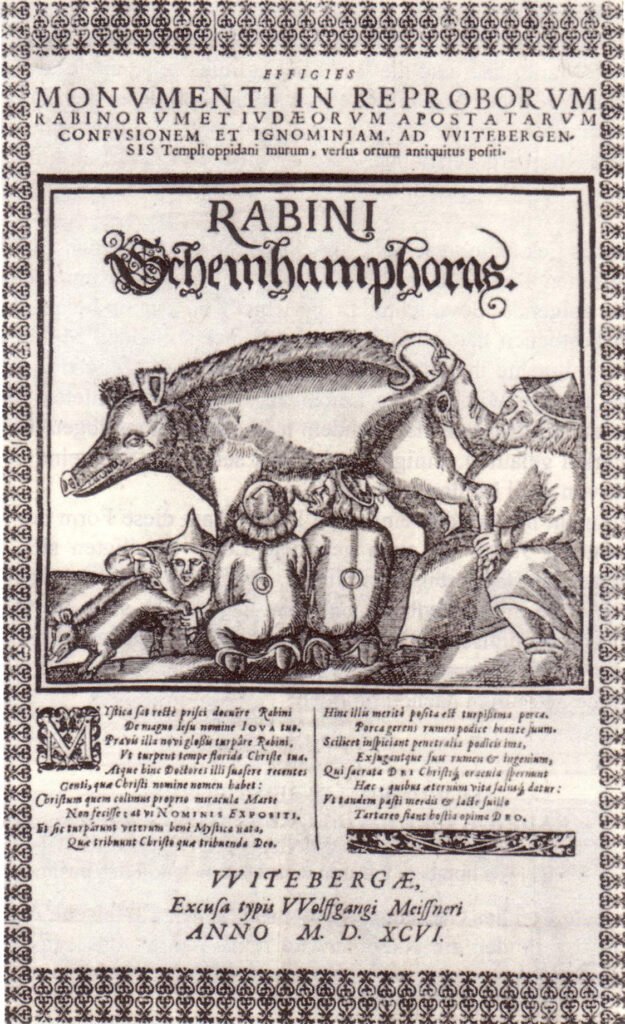
The Judensau did not remain confined to the church wall. Once printing made images portable, the same visual language escaped the building and entered the page. The stone became a woodcut. The congregation became a readership.
The medium changed. The contempt did not.
The Lie That Built a Shrine
Two distinct accusations generated visual traditions so extensive that they became architectural—built into the fabric of church buildings and the built environment of Christian communities across Europe.
The blood libel—the accusation that Jews kidnapped and murdered Christian children to use their blood in the Passover ritual—first emerged in documented form in Norwich in 1144, where a boy named William was found murdered and the Jewish community was blamed. The Jewish community of Norwich at the time numbered approximately seven families. The retribution was medieval. But the accusation traveled with extraordinary speed across Europe, each new case generating its own visual documentation: illuminated accounts of the ritual murder, broadsheets distributed by the newly invented printing press, carved friezes on buildings, altarpiece paintings in parish churches. The boy became a martyr. The martyr was venerated. The shrine attracted pilgrims. Communities where Jews had never lived developed visual traditions of blood libel in their parish churches.
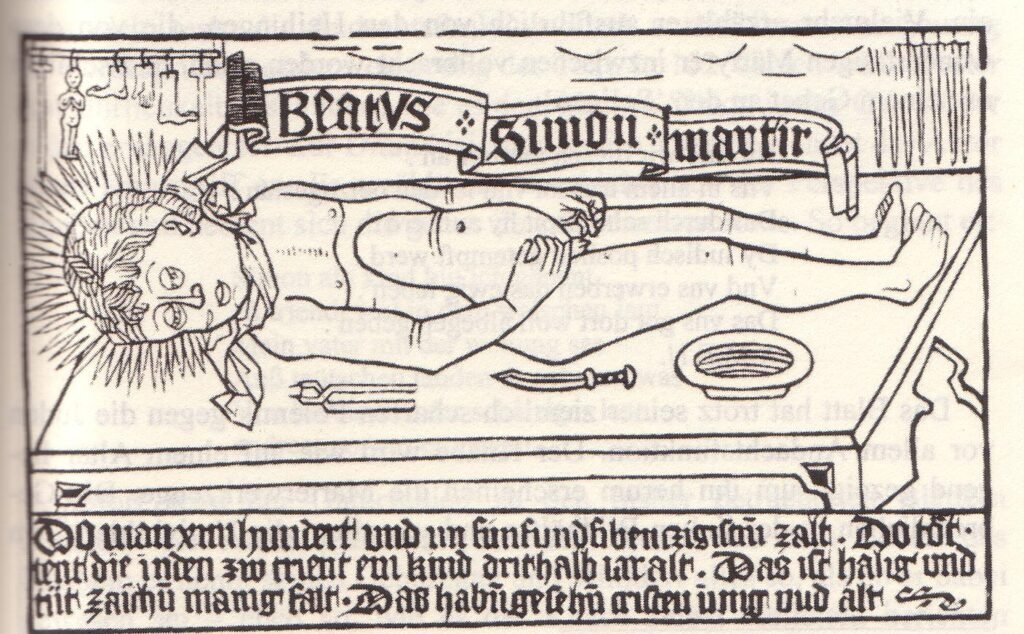
In Trent in the 15th century, a boy named Simon disappeared. His body was found, the Jewish community was accused, its leaders were executed, the community was expelled, the synagogue was destroyed, and on its ruins a Renaissance building was constructed. Two stone friezes on its exterior told the story of the ritual murder for every passerby on the Via del Simonino. The building still stands there today. Simon was canonized. Christian pilgrims traveled to Trent to venerate his bones. The visual tradition the accusation generated—Jews as child murderers, Jewish ritual as requiring Christian blood, the Jewish quarter as a place of danger—circulated in images across Christendom, in places where no Jew would ever be seen.
The host desecration accusation is more specifically theological and emerges later—and its emergence date is not accidental. It did not appear until after the Fourth Lateran Council of 1215, because the Council’s proclamation of the doctrine of transubstantiation—that the bread at Mass sacramentally becomes the body of Christ—created the theological precondition for the accusation. Once Christ was held to be present in the consecrated host, the accusation followed: that Jews would seek to obtain the host and desecrate it, re-enacting the crucifixion against the body of Christ now made available in bread.
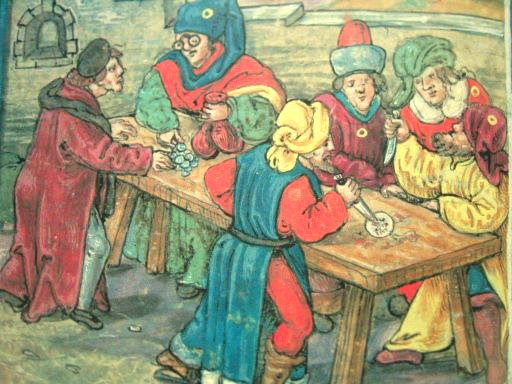
The visual tradition of host desecration is consistent across German churches of the 15th century. In some versions, the transaction is explicitly financial—a money bag changes hands between the Christian who steals the host and the Jews who purchase it. The bridge between the economic mythology and the theological accusation is made visible in the image itself: Jews pay Christians to betray Christ, because money and betrayal are what Jews do. The accusation does not exist in isolation. It is woven into a visual ecosystem in which every element reinforces every other.
The Legend That Walked the Roads
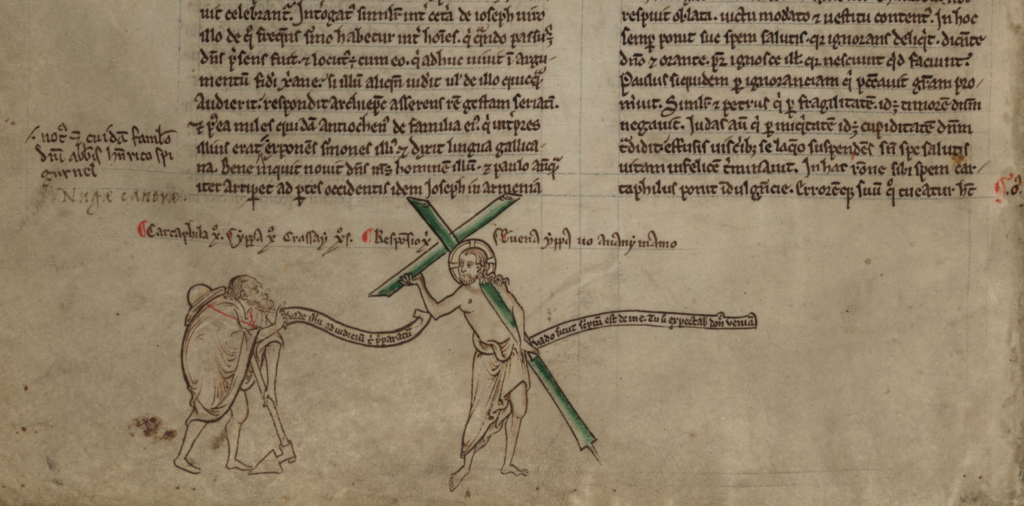
The theology of Jewish punishment encoded in Synagoga’s broken staff and fallen crown had a narrative counterpart that moved beyond the cathedral walls—into chronicles, into pilgrim culture, onto the roads of Christendom. The Wandering Jew: the legend of Cartaphilus, the doorkeeper who struck Jesus on the way to the crucifixion and was condemned to wander the earth, neither living nor dying, until the Second Coming. Matthew Paris recorded the legend in his Chronica Majora in the 1250s, providing one of its earliest visual representations—a robed, staff-bearing figure in perpetual motion, marked and untethered, moving through the world without belonging to it.
The legend did precisely what the cathedral sculptures did, but without requiring a building. It gave the theology of Jewish punishment a face, a story, and a pair of walking feet. Wherever it traveled—and it traveled everywhere, appearing in chronicles, sermons, and eventually in printed form across all of Europe—it carried the same argument Synagoga made in stone: the Jewish people are condemned. Their wandering is not displacement. It is sentence. The theology of the portal had become ambulatory. It moved through the world the way the Church itself moved—finding new vessels, requiring no fixed location to transmit what it carried.
The Error That Horned a Tradition
In the late 4th century CE, Jerome produced the Vulgate—the Latin translation of the Hebrew Bible that became the standard scriptural text of Western Christianity for more than a millennium. In translating Exodus 34:29, where Moses descends from Sinai after receiving the Torah and his face shone with divine light, Jerome rendered the Hebrew karan—which means radiated or shone—as cornuta: horned. Moses descended from the mountain, and his face was horned.
The mistranslation entered the visual imagination of Western Christianity almost immediately. Moses acquired horns. And because Moses was read as a representative figure of the Jewish people and the Jewish tradition—the lawgiver, the founder, the one through whom the covenant was given—the horns migrated. Medieval representations of Jews in church art frequently include the pointed horn, sometimes subtly integrated into the Judenhut, sometimes unmistakably explicit.
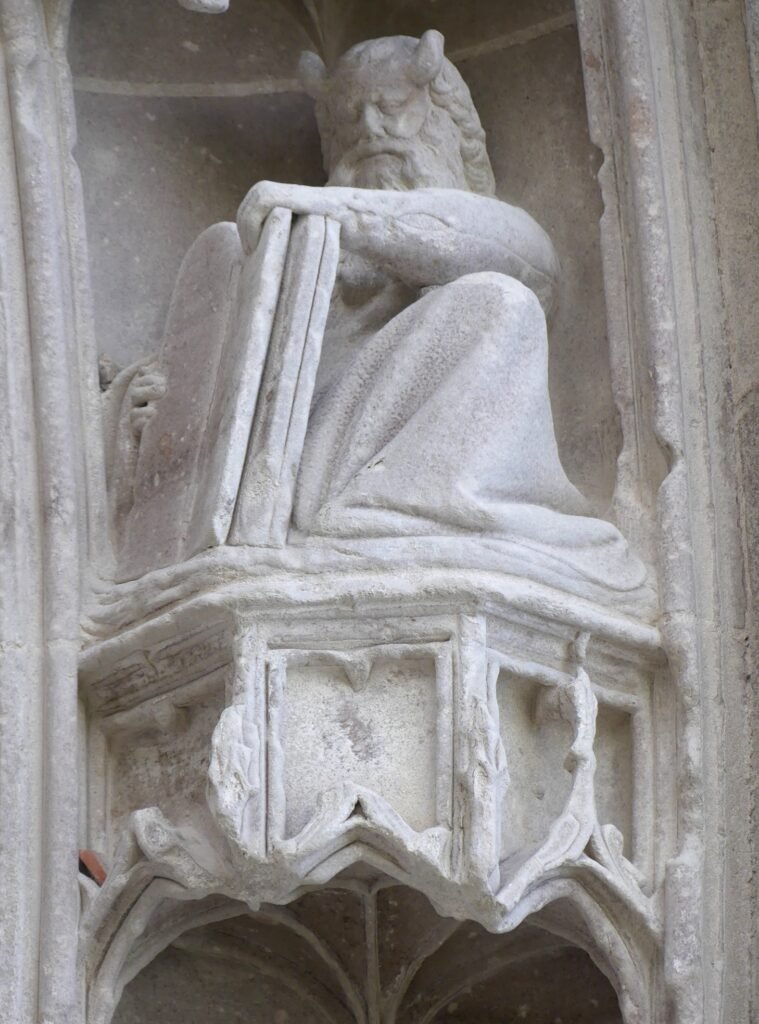
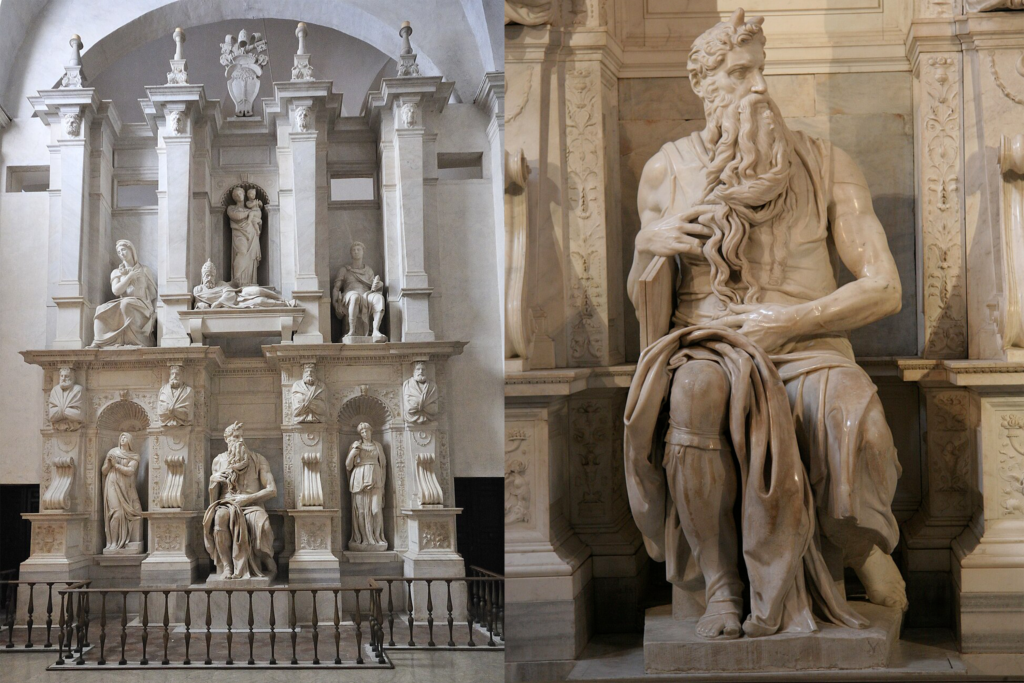
The visual code became so thoroughly established that by the time Michelangelo carved his Moses for the tomb of Pope Julius II in 1513–1515, the horned Moses was not a controversial interpretive choice. It was the tradition. The greatest sculptor of the Renaissance produced what many consider his masterpiece—a figure of incomparable power, authority, and psychological intensity—with horns on his head, because a 4th-century translator misread a Hebrew verb.
The horn is not contempt in the way the Judensau is contempt. It emerged from a translation error, not from malice. But it encoded itself into the visual tradition of Western Christianity with the same durability as any deliberate act of contempt, and it functioned in the same way: as a visual marker that distinguished the Jewish figure, made the Jewish body legible as different, and connected that difference to a tradition of devilish association that the surrounding iconography had been building for centuries.
What the Building Left Behind
The Reformation altered the buildings. The Enlightenment emptied some of them. The 19th century restored and reinterpreted others. The Second Vatican Council repudiated the theology that had commissioned the sculptures. Some of the most offensive images were eventually removed or relocated. The Judensau at Wittenberg remains, accompanied now by a memorial plaque acknowledging its history. The Simon of Trent friezes remain on the building on the Via del Simonino. The horned Moses remains in San Pietro in Vincoli, drawing millions of visitors each year.
But the deeper question is not whether the buildings were altered. It is what happened to what they had taught for six, seven, eight centuries before they were. The answer is not comfortable. Contempt that is the air of a civilization’s sacred space for eight centuries does not require its architectural expression to persist in order to persist. It has already been transmitted. It has already been encoded in the emotional register of generations who learned what Jews are—defeated, demonic, murderous, horned, blind—not from a text they read or a sermon they heard but from the building they worshipped in every week of their lives from birth to burial.
The Reformation produced Luther. Luther had worshipped under the Judensau since childhood. The Enlightenment produced secular versions of the contempt the church had theologized. The 19th century produced racial science that translated theological categories into biological ones. The 20th century produced the administrative machinery of extermination. The thread runs from the carved stone at the cathedral door to the bureaucratic ledger of the death camp not as a single unbroken causation but as a continuous transmission—contempt handed from one vessel to the next, always finding new architecture, always recognizing itself in what it receives.
The buildings did not cause what followed. But they prepared the eye to see. They organized the visual field of an entire civilization for eight centuries. And what you see from childhood, what is simply the world—the crowned Ecclesia, the blindfolded Synagoga, the Judensau in the church corner, the horned figures in the margins—becomes, in time, the frame through which all subsequent information about Jews is received and processed.
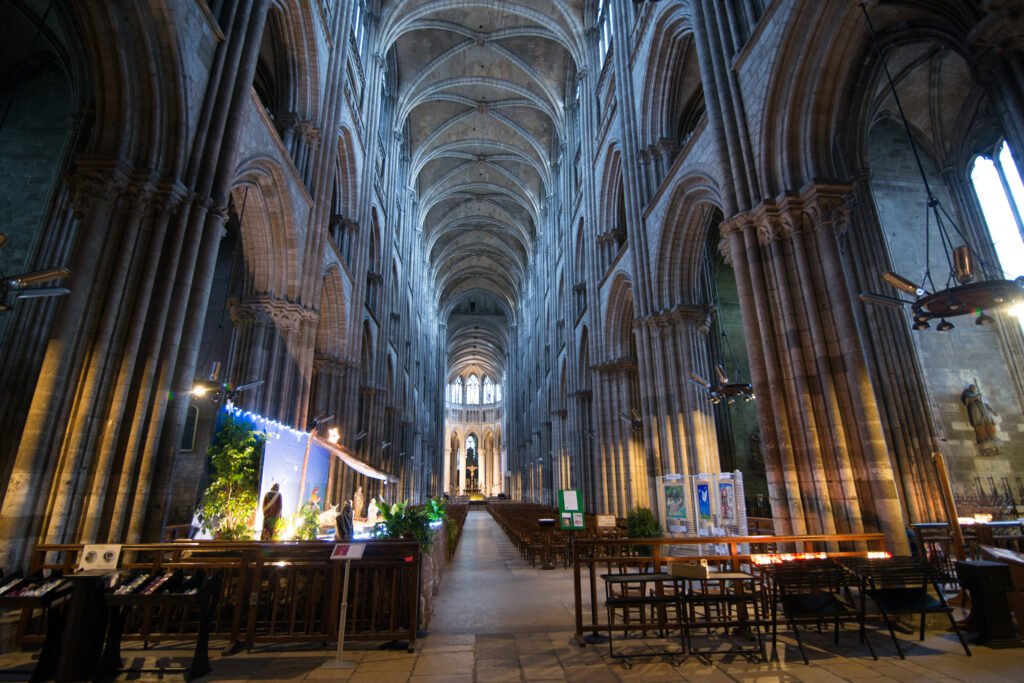
Doctrine travels through books. Contempt travels through bodies. The medieval church building was the most efficient body that contempt ever found—because it was the body that organized all other bodies, the space that held every other space, the structure that gave the civilization its sense of what was sacred and what was damned.
What it left behind outlasted every reform that was applied to it. The serpent around Synagoga’s eyes is still there. So is what it taught.

Discover more from Many Lamps, One Flame
Subscribe to get the latest posts sent to your email.