
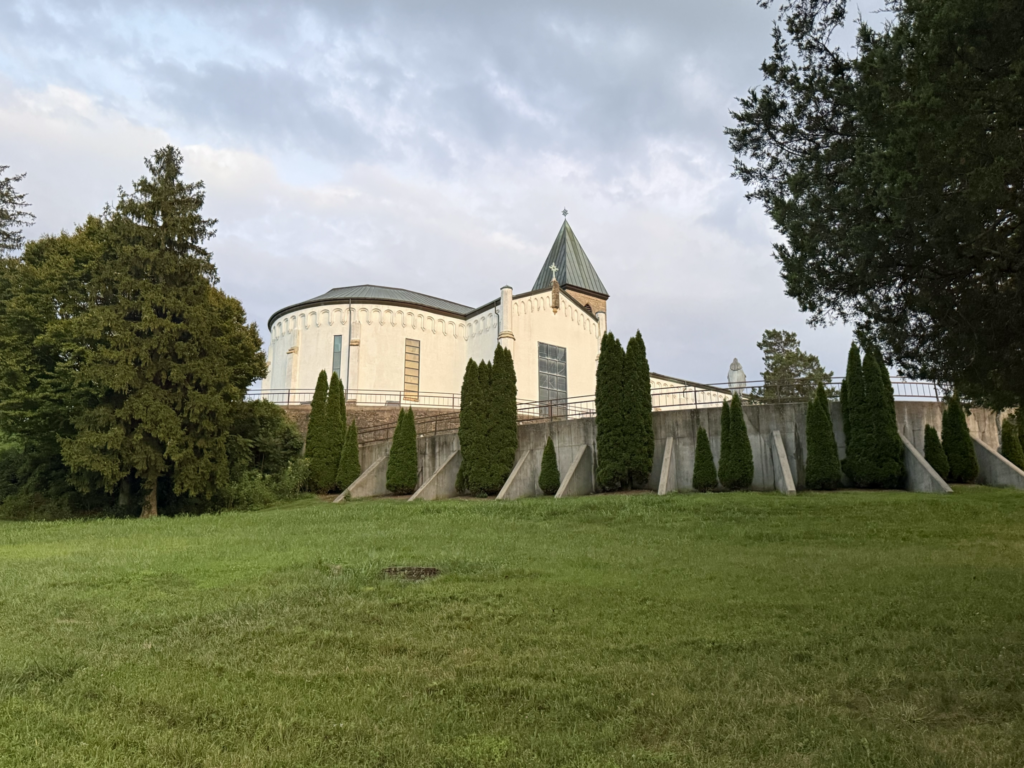
I am at the Abbey of Gethsemani, a Trappist monastery in the Kentucky hill country. I arrived yesterday afternoon with no itinerary beyond the days themselves—mostly because I needed to be somewhere that was not anywhere I had already been. I’ve attended several of the services since arriving; the monks gather seven times a day, plus Mass, in a rhythm that predates anyone currently living.
Vigils comes first, in full darkness, the longest and starkest of the hours—psalms and long readings, watching while the rest of the world sleeps. Lauds follows near dawn, turned toward thanksgiving and the beginning of the day. Terce, Sext, and None are shorter, scattered through the working hours like a hand placed briefly on the shoulder—a few minutes each, just enough to interrupt whatever was being attended to and point it somewhere else. Vespers gathers the day’s work into evening. Compline closes it, quiet and unhurried, before the whole house goes silent until Vigils comes again.
It’s the morning after, and I’d meant to visit the gift shop for something new to sit with. It wasn’t open yet, so I found a spot beneath a grove of maples to wait.
The air is calm, cool as it still is this early, with a slight breeze. It’s quieting. And then the cicadas erupt—a cacophony of breeding frenzy, indifferent to whoever happens to be sitting beneath the trees. Every so often the song and chirp of birds cuts through it, the chatter of a squirrel, the chuck of some small animal I still can’t identify. If I didn’t know better, I’d say there were monkeys nearby. There are, of course, no monkeys in Kentucky. Then the cooing of a dove. A crow, cawing its way across the sky and gone.
That said—it is quiet here. And that’s the whole idea.
I am outside the monastery’s actual silence zone, but the grounds carry a sense of silence regardless, wildlife and tower bells notwithstanding. Even the occasional airplane overhead, the rare car on the road beyond the property, seem muted, as if the place itself absorbs them before they can fully arrive.
The green space is a mix of Kentucky bluegrass, clover, chickweed—here and there a bit of crabgrass, a broadleaf weed making its stand. It’s kept trimmed. But there’s less concern here for the lawn than for other matters. As it should be.
It’s into this that the thought first arrives, unbidden, without ceremony:
What if I just stayed here?
By the second day I had begun doing the math. How long the water would last. What provisions I’d need before I’d have to leave the grounds for anything. Whether a person could simply stay—not forever, but longer than planned—without anyone needing to be told why.
I want to be honest about what that was. It wasn’t a fantasy about becoming a monk. I had no interest in the habit or the vows. It was something narrower and, I think, more honest: an arithmetic of not-leaving. I was not dreaming about Trappist life. I was calculating how long I could go on being nowhere in particular, answerable to no one.
That the impulse arrived as logistics rather than longing is, I suspect, the whole point.
The Masks
I have worn a number of names in this life. Husband. Father. Son. Friend. Employee. Boss. Each one real, each one demanding, none of them false in the sense of being untrue—I have in fact been all of these things, and tried to be them well. But none of them is the self. They are the roles the self performs, the postures it holds in relation to other people’s needs and expectations, the shape it takes so the world knows where to find it.
I have understood this for some time, in the way one understands a doctrine before it becomes a felt thing. What the last day here has done is strip the doctrine down to something closer to sensation: I can feel the weight of the roles set down, even briefly, even only because there is no one on these grounds asking anything of me. And in the space that opens when the weight lifts, a question follows that I did not expect to take seriously: which one of these was ever actually me, and which one was simply what I agreed to wear so the world would have somewhere to address its letters?
Solitude, and Something Else
I told a friend I was seeking solitude here. That was true, but incomplete. Solitude is the absence of demand—no phone, no schedule but the bells, no one requiring anything of me for a few days. I could find that almost anywhere with enough discipline.
What I am actually seeking is separation. Not from people. From the self that exists only in relation to what pulls at it—the self that tracks the unresolved things, rehearses the unfinished conversations, keeps a kind of continuous watch over a life that does not, in fact, require constant watching in order to keep existing. That self does not go quiet just because the phone is in a drawer. It has to be set down deliberately, and it does not want to be set down, because it has convinced itself that its vigilance is a form of love, or responsibility, or usefulness. Sometimes it is. Often it is simply motion mistaken for care.
Separation, then, is not escape from my life. My life is not the thing I am fleeing. It is distance from the version of myself that can only exist by continuously managing it.
The Cloth
There is an image I keep reaching for when trying to describe this: a cloth draped over the ordinary business of living—masks, management, motion—draped so seamlessly it stops looking like something draped at all and starts looking like the furniture itself.
I have known the cloth was there for some time. This is not a discovery. I gave up mistaking the cloth for the room years ago. But here it is different—more defined, easier to see, draped with an almost startling clarity over everything I have built and worn and managed. I could always have told you it existed. Here I can nearly trace its seams.
That clarity is not the same as seeing beneath it. I know what the cloth is. I know, with the same certainty, that something lies underneath it. What I do not have—what even this place has not given me yet—is the lifting itself. The temptation, sitting with a legal pad and nowhere to be, is to write my way to a glimpse the fabric hasn’t actually offered. I would rather report the cloth in unusually sharp focus than manufacture a look beneath it that hasn’t been earned.
Not Understanding, But Being
I did not come expecting an answer. I expected, if anything, more questions—that much has held, and held true to form. What I had quietly hoped for was a glimpse of understanding: some formulation sturdy enough to carry home and test against the years of Scripture and Talmud and argument I’ve already put into these questions.
That hasn’t come. What has come instead is stranger, and I trust it more for being stranger.
Understanding is not the goal. I have started to suspect it never was—that it is, in fact, a kind of superficial mistress to being itself, a facade with its own seductions. Understanding wants to conclude. It wants a sentence that holds. What is happening here does not want to conclude.
The tradition I actually live inside has language sharp enough to hold the distinction. Chokhmah is insight—the flash, the intuition before it has form. Binah is understanding—the flash given structure, worked out, built into something one can explain to another person. Da’at sits differently again: not insight, not structured understanding, but knowledge as transformation, knowing that changes the knower in the act of knowing. I have spent a fair amount of ink arguing that Da’at is closer to presence than to information—that the same root gives us the word Genesis reaches for at the most intimate human union there is. Adam knew Eve. Biblical Hebrew had other words available for this—lying with, coming in to—and did not choose them here. It chose knowing. Not a euphemism doing modest work. A deliberate word, for a deliberate kind of intimacy that changes the knower in the encounter.
What I am touching here, as best I can tell, does not belong to any of the three, precisely because all three are still forms of knowing, however refined, and what I am touching resists form entirely. Da’at comes closest, and still falls short. I cannot explain it, and I do not think the failure is mine. I think explanation was never going to reach it, by design, the way you cannot hold water by closing your hand around it tighter.
Merton knew this too, writing from this same ground: that the deepest contemplative encounter is not something the intellect can process into a proposition and hand back to itself as a possession. The moment you can fully explain what you touched, you are no longer touching it—you are handling its description instead.
That may be the entire point.
Not the First Time
This is not the first time the pull toward disappearing has surfaced. It has surfaced before, more sharply than an afternoon under maple trees—the wish not merely to withdraw for a while but to sever, completely, and not come back. People who love me have told me, more than once, that I am not permitted that option. That the world needs me here in ways I don’t get to override. I understand why they say it, and it moves me. But I hold no particular sense of my own importance in hearing it. It is not certainty about my significance that has kept me from choosing the sharper kind of leaving. It is something closer to an unfinished sentence.
Two years ago I was visited by something that looked very much like death, and later handed an option—a transplant—that most people never have to weigh. Both times, the decision to continue was not built on having found the thing I was for. It was built on the conviction that something remained undone, something I had not yet done, whatever it might turn out to be. I still do not know what that something is. I only know I have not finished not-knowing it yet.
I suspect Merton understood a version of this too—not the exact shape of what I have experienced, of course, but the underlying tension within his own experiences. He was granted a hermitage on these same grounds later in his life, sought more solitude across his years here, and by his own writing never fully resolved the pull toward greater withdrawal. And yet he never fully severed. He kept writing. Kept corresponding. Kept, famously, standing on a street corner in Louisville and discovering, to his own apparent surprise, that he belonged to every person walking past him whether he had withdrawn from them or not. Distance sharpened the connection. It did not replace it.
The Question I’m Bringing Home
Which means the question this piece has been circling was never quite the one I started with. I do not, in the end, want to stay at Gethsemani, wonderful though it may be. There is a sentence in me still unfinished, and I did not come here to finish it. What I want to stay in is not a place at all. It is this—the posture, the quality of attention, the distance from the self that manages everything—carried home rather than left behind at the gate.
I do not know if what has stirred here will survive the drive out. I suspect it will not survive in the form it currently has—the particular quiet of this place, the bells, the ground Merton is buried under, none of that travels. In a week the language I am using right now to describe it may already feel borrowed, the way yesterday’s insight so often calcifies into a phrase you repeat without quite remembering what it once felt like to mean it.
But a felt knowing does not die the way a sentence dies. It leaves something behind even when the words for it are gone—not a conclusion to defend, but a residue that can be recognized later, on some ordinary Tuesday, in the middle of an argument about nothing, or in the silence just before falling asleep. I do not know yet whether I will be able to find my way back to it once I am no longer here to be reminded by the trees and the bell and the ground. That is the honest question this place has actually put before me, and I am not going to pretend the retreat has answered it simply because the question feels good to hold.
Whether a knowing made of no words at all can survive a return to a life made entirely of them—that is the question sitting with me here, still unresolved, and it may be the only honest thing I eventually carry out.

Discover more from Many Lamps, One Flame
Subscribe to get the latest posts sent to your email.