Most people who have heard of the Omer think of it as a countdown. Forty-nine days between Passover and Shavuot, ticked off one by one until the calendar moves on. That framing is not wrong, exactly—but it misses almost everything that matters. A countdown measures distance to an event. What the Omer measures is something else entirely: the distance between who you are and who you need to become in order to receive what is waiting at the end.
That is a different kind of counting.
What It Is and Where It Comes From
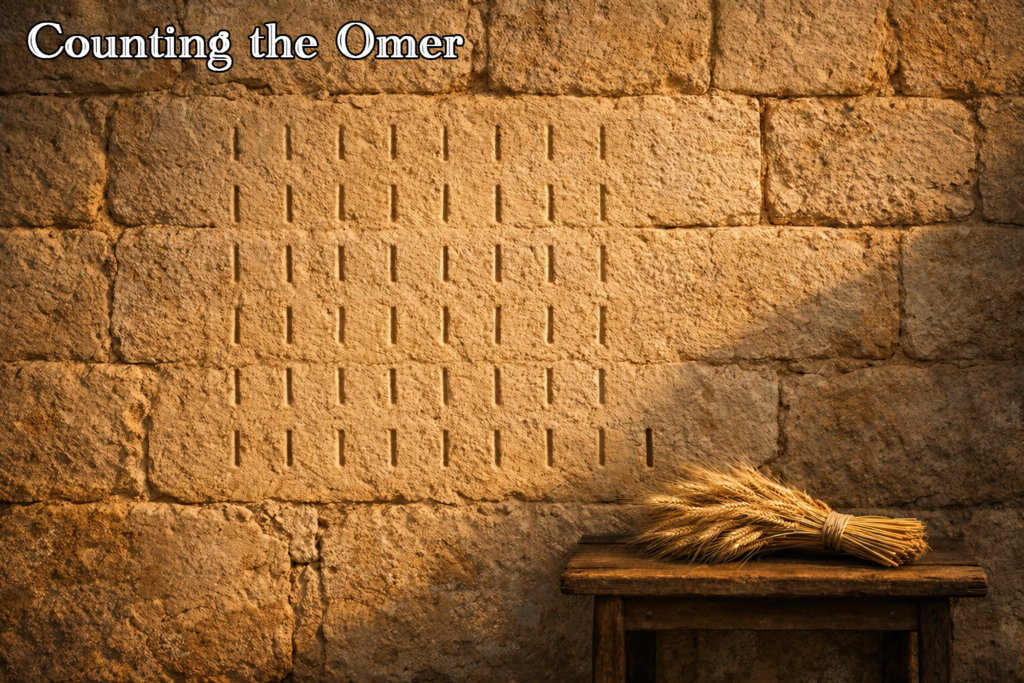
The commandment appears in Leviticus 23:15–16: beginning on the sixteenth of Nisan—the day after the first festival day of Passover—count seven complete weeks—forty-nine days—and on the fiftieth day bring a new grain offering to G‑d. In its original agricultural context, the count ran from the barley harvest to the wheat harvest. The omer of the title is the sheaf of barley brought as a wave offering on the second day of Passover—a measure of grain, humble and specific, that gives the entire practice its name.
But even in the Torah’s own telling, the agricultural frame is secondary to something larger. Shavuot—the fiftieth day—is the anniversary of the giving of Torah at Sinai. And so the count became something more than crop tracking. It became the structure of preparation.
The Sefer HaChinuch, Mitzvah 306, puts it in language that should stop you:
Since the acceptance of the Torah was the goal of our redemption and serves as the foundation of the Jewish people, and through it we achieved our greatness, we were commanded to count from the day after Pesach until the day that the Torah was given. This manifests our great desire for that awesome day which our hearts yearn for—just as a servant yearns for shade. We count constantly: when will the day come that we yearn for? Because counting toward a certain date shows a person that all his desire and longing is to reach that time.
The Rambam, in Moreh Nevuchim 3:43, adds the image of someone awaiting a loved one—counting not by days but by hours. That is the emotional register the tradition assigns to this period. Not patience. Anticipation.
This is the first layer of meaning: the Omer is desire given a discipline. You do not simply feel the longing for Sinai—you count it. Every night, you mark exactly where you are in the waiting.
How It Works
The mechanics are simple. After nightfall—once three stars are visible—you recite a blessing and declare the day.
The blessing: Baruch atah Adonai Eloheinu melech ha’olam asher kid’shanu b’mitzvotav v’tzivanu al sefirat ha’omer—Blessed are You, G‑d, Ruler of the universe, who sanctifies us with mitzvot and commands us concerning the counting of the Omer.
Then the declaration. During the first six days, the count is days only: Today is one day of the Omer. Today is two days of the Omer. On day seven, the week enters: Today is seven days, which is one week of the Omer.From day eight onward, both scales are named together: Today is eight days, which is one week and one day of the Omer. The pattern continues through all forty-nine combinations of weeks and days until the count reaches its completion: Today is forty-nine days, which is seven weeks of the Omer.
The Rambam similarly frames the count: days and weeks together constitute a single unified commandment—not two separate obligations. You hold both at once: where you are in the immediate day, and where you are in the larger arc. That dual awareness is itself part of the practice.
Then, in the kabbalistic tradition, you sit with the quality of the day—but more on that shortly.
If you want a companion for the count, the app Forty Nine Days was built exactly for this: the blessing in Hebrew, transliteration, and English; the daily declaration; nightfall-calculated notifications based on your GPS coordinates so the reminder arrives at the halachically correct moment for your location; and a kabbalistic reflection for each of the forty-nine days, rotating across a three-year cycle. It is currently available on iOS and Android.
The Weight of the Season
If the Omer is a period of preparation and longing, the tradition encodes that seriousness in restriction. The seven weeks carry a semi-mourning character—no weddings, no live music, no haircuts. These are not arbitrary discomforts. They are the tradition’s way of marking this as time set apart, time that is not ordinary.
The historical anchor for the mourning is a catastrophe recorded in the Talmud. Rabbi Akiva had twelve thousand pairs of students—twenty-four thousand in total—spread across a region stretching from Gevat to Antipatris in Judea. During the Omer period, a plague swept through them. The Talmud in Yevamot 62brecords the reason with devastating directness:
They all died in one period of time, because they did not treat each other with respect.
Twenty-four thousand people devoted to the study of a tradition whose animating commandment is to love your neighbor—destroyed by their failure to honor one another. The mourning the tradition observes during the Omer is, in part, mourning for that failure. And the lesson is not subtle: you cannot receive Torah if you cannot honor the person standing next to you. Preparation for Sinai is not only internal refinement. It is ethical practice in community.
The mourning lifts—partially—on the thirty-third day: Lag B’Omer, from the Hebrew letters lamed and gimelwhich together equal thirty-three. The plague, tradition holds, ceased on that day. Weddings are celebrated, haircuts taken, music played. Bonfires are lit across the Jewish world—in Israel, entire hillsides glow orange on Lag B’Omer night.
The bonfires point to the second layer of the day’s meaning. Lag B’Omer is the yahrzeit—the anniversary of death—of Rabbi Shimon bar Yochai, known as Rashbi, the central figure of the Zohar. Rashbi spent thirteen years hiding in a cave with his son to escape Roman persecution, emerging with a Torah that had been driven so deep by necessity that it surfaced as mystical fire. A tradition preserved in the Zohar holds that during his lifetime no rainbow appeared—because his merit alone was sufficient protection for the world, making the rainbow’s covenantal function redundant. The bonfires of Lag B’Omer are the light of the Zohar—his Torah—made visible. The archery play common among children on this day carries its own resonance: the bow shape of the rainbow, conspicuously absent during Rashbi’s life, playfully reclaimed.
That Rashbi—the man whose mystical legacy gives the Omer its kabbalistic architecture—died on the holiday within the Omer is not a coincidence the tradition passes over lightly.
As for the mourning customs themselves: practice varies, and if you encounter different communities observing different days, that is why. Some observe restrictions through the thirty-second day and celebrate freely from Lag B’Omer onward. Some observe from Rosh Chodesh Iyar through Shavuot, skipping the first two weeks of the count entirely. Some maintain the full forty-nine days with Lag B’Omer as an interruption. The variation reflects different halakhic rulings on the same underlying reality: this is a season the tradition takes seriously, even when communities have calibrated exactly where the weight falls differently.
The Kabbalistic Heart
Here is where most treatments of the Omer stop short—and where the practice actually begins.
The kabbalistic tradition maps the forty-nine days onto the seven lower sefirot—the divine qualities that form the active, relational dimension of the Tree of Life. If the sefirot are unfamiliar territory, the Kabbalah: An Orientation essay provides the foundation. Briefly: the seven lower sefirot are Chesed (lovingkindness), Gevurah (strength/judgment), Tiferet (beauty/harmony), Netzach (endurance/eternity), Hod(splendor/humility), Yesod (foundation), and Malchut (kingdom/sovereignty). Each governs one week of the Omer. And each day within that week is considered through the lens of each sefirah in turn.
This produces the forty-nine combinations. The notation is X she’b’Y—the quality named first, within or as expressed through the quality named second. Day one is Chesed she’b’Chesed: pure lovingkindness examined within itself. Day eight—the first day of the week of Gevurah—is Chesed she’b’Gevurah: where is the lovingkindness inside your discipline? Is your restraint animated by care, or is it simply control? Day seventeen is Tiferet she’b’Tiferet: is the harmony you cultivate genuine balance, or is it avoidance of necessary conflict dressed as peace?
Each of the forty-nine days offers a different angle on the same fundamental inquiry: what are you actually made of, and what needs repair? The Omer does not traffic in abstract virtue. It exposes concrete character—the specific texture of your own character—the places where Chesed collapses into permissiveness, where Gevurah hardens into cruelty, where Tiferet’s harmony papers over fractures that need addressing. The count is a forty-nine-day diagnostic.
This is also why the tradition insists that you count every day. According to many halakhic authorities, missing a full day interrupts the continuity, and the count continues thereafter without a blessing. The requirement of continuity is not arbitrary strictness—it encodes something true about inner work. Transformation is not achieved by the days you remember. It is undermined by the days you skip.
Forty Nine Days carries a reflection for each day of the cycle, written in this spirit and accessible to readers of any background, rotating across a three-year cycle so the practice stays fresh year after year.
A Living Structure
The forty-nine-day framework is not a museum piece. It is a living architecture, and teachers are finding new expressions of it in other seasons of the year.
Rav Aubrey Glazer has written about counting the Omer in reverse—running from Tisha B’Av to Rosh Hashanah, the forty-nine days between the deepest grief on the Jewish calendar and its threshold of renewal. Where the spring count moves from liberation (Passover) toward revelation (Shavuot), this summer count moves from brokenness toward teshuvah. The same seven sefirot, traversed in reverse order—beginning with Malchut and ascending back toward Chesed—as the community moves from the ruins of destruction toward the opening of a new year.
A parallel practice applies the same framework to the descent from Sinai itself. The fifty-day arc does not end at Shavuot—it continues. The forty-nine days following the fiftieth examine what revelation actually produced when it passed through ordinary life: where Chesed held under pressure, where Gevurah became rigidity, where the clarity of Sinai survived contact with the world and where it did not. This is not a formal mitzvah. It is the tradition’s implicit question made explicit: what did receiving Torah actually change?
A future version of Forty Nine Days will support the Tisha B’Av-to-Rosh Hashanah practice—because if the structure is true in spring, it is true in summer too.
The Fiftieth Day
On the fiftieth day, the count stops.
Shavuot—the Feast of Weeks—arrives. Unlike virtually every other major Jewish holiday, it arrives almost ritually bare: no seder, no sukkah, no shofar, no specific food. What it has is study. The tradition of tikkun leil Shavuot—an all-night learning vigil—fills the night before with Torah. The Ten Commandments are read in the morning service, the congregation standing. The absence of elaborate ritual is itself the statement: you cannot receive what you have not prepared to receive. The forty-nine days are not preamble. They are the condition.
And Shavuot carries weight beyond the Jewish tradition—weight that most who observe it do not know they are standing under.
The Christian feast of Pentecost falls on the same fiftieth day. Its name is simply the Greek word for fifty—Pentēkostē—the same concept rendered in another language. Acts 2 places the descent of the Holy Spirit on the disciples explicitly on this day, in Jerusalem, among people gathered for the pilgrimage festival. The disciples were Jewish. The crowd that heard them was Jewish diaspora, assembled for Shavuot. The rushing wind and tongues of fire that descended upon them arrived while people were already assembled to commemorate the fire and thunder of Sinai.
What the early followers of Jesus experienced on that day—whatever one makes of it theologically—they experienced as covenant renewed and internalized. This is precisely the language of Jeremiah 31:31: I will put my law within them, and I will write it on their hearts. Not a different law. The same Torah, arriving at a new depth of interiority. As explored at length in The Blood and the Cup, the “new covenant” of Christian theology is not the abolition of the old—it is the old covenant arriving at its fullness, written now on hearts rather than stone.
Shavuot is the day G‑d writes covenant into human beings. That inscription happened at Sinai for Israel. Those first followers of Jesus, counting the Omer as Jews, experienced something they understood as that same inscription renewed—immediate, interior, transforming. Two traditions standing on the same fiftieth day, shaped by the same fire.
Most Christians have no idea they are standing in a Jewish count when they observe Pentecost. Most have never heard of the Omer. But the structure was there before either tradition named it—and it remains there still, waiting to be recognized.
What the Count Is For
The liberation from Egypt was something that happened to Israel. The revelation at Sinai was something they had to become ready for. The Omer is the distance between those two things—between being freed and being formed.
Freedom without formation is not yet wholeness. It is potential, restless and unfinished. The forty-nine days are the tradition’s insistence that the gap between liberation and covenant cannot be skipped—that you must cross it deliberately, day by day, quality by quality, watching what you are made of as you go.
The count ends. The fiftieth day arrives.
Whether anything has changed depends entirely on whether you were paying attention.

Discover more from Many Lamps, One Flame
Subscribe to get the latest posts sent to your email.