A Special Pascha Essay—Part One of Five
The room is close and warm. Twelve men have gathered in Jerusalem—a city swollen beyond its seams with pilgrims, the air thick with smoke from the Temple courts, the sounds of an ancient festival pressing through every wall. Their teacher rises from the table. He removes his outer garment. He ties a towel around his waist, pours water into a basin, and begins—one by one—to wash his disciples’ feet.
No one in that room misreads the gesture. A master does not wash the feet of his students. A teacher does not kneel before those he has formed. What is unfolding at this table, before a single word of the supper has been spoken, is an inversion so deliberate it amounts to a theological statement: the one who serves is the one who will feed you. The one who kneels before you is the one you will call Lord.
Let us begin.
The Festival and the City
To understand what happens in that room, you must first understand what is happening outside it.
Flavius Josephus, writing in Jewish War VI.9.3, preserves a census figure—almost certainly inflated but indicative of scale—suggesting that the population of Jerusalem during Passover swelled to extraordinary numbers. Pilgrims came from across the Diaspora: from Alexandria, from Babylon, from Rome itself. The Temple courts ran with the blood of the korban Pesach, the Passover sacrifice, as each household brought its lamb to be slaughtered by the priests. Philo of Alexandria, in De Specialibus Legibus II.145–149, describes Passover as a feast in which each layman acts as priest—every household a temple, every table an altar.
The korban Pesach was not incidental to the observance. It was the observance. The lamb slaughtered at twilight on the 14th of Nisan, its blood collected, its flesh roasted and consumed before morning—this was the original act that the entire festival commemorated. And behind it stood the memory recorded in Exodus 12:
The blood shall be a sign for you on the houses where you live. When I see the blood, I will pass over you.
The blood on the doorposts was the mark of a covenant sealed in sacrifice. Every Passover lamb thereafter was a re-enactment of that original night.
Rome was not unaware of what the festival meant. Pontius Pilate, the praefectus of Judaea, did not remain in his administrative seat at Caesarea Maritima during Passover. He relocated to Jerusalem specifically for the festival—not out of respect, but out of calculation. A city full of Jews celebrating liberation from foreign oppression, under the heel of a foreign occupation, was a city capable of riots. Pilate would not have come to Jerusalem without troops. The message was clear: Rome suspends its procedures for no one’s festival.
This is the political context that shapes everything that follows. And it requires getting the factions right. It has become habitual in Christian retelling to cast the Pharisees as the primary antagonists of the Passion story—a caricature that distorts both history and theology. The Pharisees were not the Temple establishment. They were the synagogue movement, the Torah teachers, the ones whose practice was portable and did not depend on the sacrificial cult. They had far less institutional stake in removing Jesus than those who did: the Sadducees, the priestly aristocracy, whose authority was entirely bound up with Temple operations and whose survival depended on maintaining a working relationship with Rome.
The Gospels’ hostility toward the Pharisees is, in large part, a post-70 CE artifact. By the time the Gospels reach their final written form, the Temple has fallen. The Pharisees and the Jesus movement are competing for the same surviving Jewish population—and the rhetorical stakes of that competition show up in the text. To read the Gospel Pharisees as historical documentary is to mistake a polemical portrait for a photograph. E.P. Sanders, in Jesus and Judaism, has argued this case influentially, and an important line of scholarship has followed.
David Flusser of the Hebrew University, a significant Israeli scholar of early Christianity and Second Temple Judaism, argued in Jesus that Jesus is recoverable as a historically plausible first-century Jewish teacher whose life and teaching make complete sense within the Judaism of his time—requiring no later theological overlay to make him coherent. Flusser read the Gospels as Jewish documents. What he found in them was not the founder of a new religion, but a Jewish teacher speaking to Jews, in Jewish categories, with Jewish urgency. That reading belongs at the foundation of any serious engagement with the Last Supper.
The Table Before the Table
Here is where both traditions have spent centuries being wrong in opposite directions—and for entirely self-serving reasons.
Those on the Jewish side who wish to maximize the distance between the tradition and Christianity do not merely argue that the Last Supper lacked a formal seder structure. They go further, insisting the meal had no Passover character whatsoever—sometimes reaching for evidence so thin it collapses under examination. One recent example: a commentator zooming in on Michelangelo’s Last Supper to identify what appeared to be a loaf of leavened bread on the table, offered as proof that the meal was not a Passover observance. Michelangelo completed that work in 1498—nearly fifteen centuries after the event, working within Western Christian iconographic convention that never once claimed historical documentary status. Using his compositional choices as evidence about a first-century Jerusalem table is not scholarship. It is motivated reasoning in search of a conclusion it has already decided upon.
Those on the Christian side who wish to root Jesus firmly in his Jewish context have argued the opposite with equal conviction: that the Last Supper was a Passover seder—citing the Synoptic Gospels’ placement of the meal on the evening of the 15th of Nisan and reading the ritual elements backward through the later Haggadah.
Both are wrong. And here is what both have missed: there was not yet a rabbinically codified seder in the later sense. Not at the Last Supper, and not anywhere else in the first century—because the seder as a formal, ordered ritual did not yet exist. The Haggadah—the ordered text, the precisely structured sequence of maggid(the telling), maror, Hallel in two movements, the four cups with their appointed liturgical functions—is a rabbinic construction, codified in the period following the destruction of the Second Temple in 70 CE. When the Temple fell and the sacrificial cult ended overnight, the Rabbis undertook an extraordinary act of creative preservation: they transformed a living, embodied, Temple-centered practice into a portable codified ritual that could survive in any dining room in the Diaspora. Tractate Pesachim in the Mishnah encodes what that reconstruction looked like. It is one of the most consequential acts of religious engineering in human history. But it happened after the upper room, not before it.
Rabbi David Zaslow and Joseph Lieberman, in Jesus: First-Century Rabbi, make the same point from an explicitly rabbinic perspective: Jesus is intelligible as a Jewish teacher who never left Judaism, whose practice was rooted in the living observance of his time rather than in a later codified ritual that did not yet exist. Their work is not a concession to Christian claims. It is a reclamation—an insistence that the Jewish tradition has more to say about this figure than two thousand years of enforced distance have allowed.
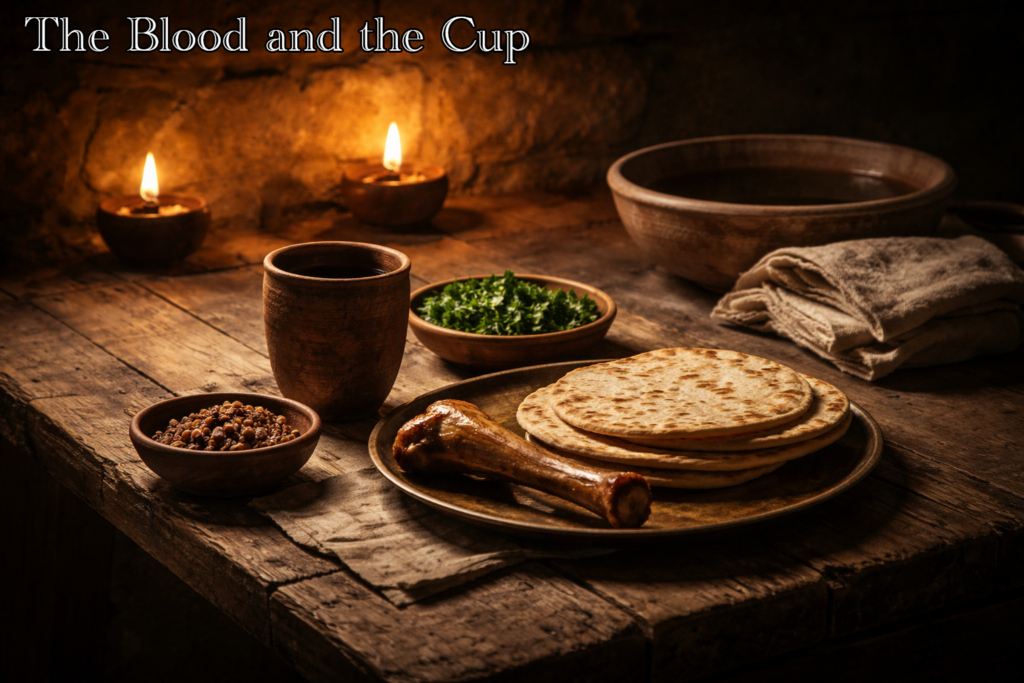
What existed on the night of the Last Supper was something older and in some ways richer than the seder that would come after—because it had not yet been reduced to a codified ritual. It was a living Passover observance in full, unhurried practice: a meal that lasted two to three hours, structured around the korban Pesach that had been slaughtered that afternoon in the Temple courts. The households and gathered groups of Jerusalem ate the lamb with maror—bitter herbs—and charoset, the sweet paste of fruit and nuts that recalls the mortar of Egyptian bondage. They drank the wine in cups that carried the memory of the four divine promises recorded in Exodus 6:6–7: I will bring you out. I will deliver you. I will redeem you. I will take you as my people. They reclined at table—a gesture of freedom, the posture of the liberated rather than the slave who eats standing, in haste. They sang the Hallel psalms in two movements, one before the meal and one after. They told the story of the Exodus—not as history but as living memory, inhabited rather than merely recalled.
Philo of Alexandria, in De Specialibus Legibus, allegorizes these elements with philosophical precision: the chametz—leaven—as the corruption of the soul, the pride-swollen self that must be expelled before liberation is possible. The search for and removal of chametz before Passover is not merely a dietary discipline; it is an interior reckoning, a clearing of the self so that what is about to happen can happen in clean space. The unleavened bread is purity, and the haste of those who left Egypt without time to let their bread rise. The bitter herbs are the memory of suffering that must not be sweetened into sentiment.
This is what was happening at tables across Jerusalem on that night. Not a seder. Not a liturgical vacuum. Something alive, ancient, and deeply particular—richer precisely because it had not yet been codified.
The berakah structure of Jewish table practice was already in place: blessings over bread and wine at the beginning and close of the meal, the fundamental grammar of Jewish eating. The third cup, the cup of redemption—I will redeem you—is the cup that matters for what follows.
The afikomen—bread broken, hidden, and recovered—would be formalized in its ritual structure after the Temple fell. But the typological weight it would carry was latent in what was already on the table: bread broken, concealed, brought back.
Let Us Begin
What Jesus does at that table, he does inside this world. He does not import a foreign ritual. He does not invent from nothing. He takes the living practice of the korban Pesach—the lamb, the blood, the bread, the cup of redemption—and he transforms it from within.
When he takes the bread, breaks it, and says this is my body, given for you; do this in memory of me, the word that the Gospel tradition reaches for is the Greek anamnesis—remembrance, re-enactment, making-present. But this is not a Greek concept wearing a Greek name. It is zachor, the Hebrew imperative that runs through every Passover observance: not merely to recall the Exodus but to inhabit it, to make it present, to be yourself the one who went out from Egypt. Deuteronomy 16:3 commands that the unleavened bread be eaten so that you may remember the day of your departure from Egypt all the days of your life. Memory in this tradition is not archival. It is participatory.
When he takes the third cup—the cup of redemption—and speaks over it, the Synoptic accounts record the words in Greek as τοῦτο τὸ ποτήριον ἡ καινὴ διαθήκη ἐν τῷ αἵματί μου: this cup is the new covenant in my blood. The Catholic Eucharistic tradition renders this as the blood of the new and everlasting covenant—language that has echoed through the Mass for two millennia. Two words in that sentence carry the full theological weight of everything that follows.
The first is diathēkē—covenant, but more precisely a testament, a disposition of relationship, a binding of one party to another. Not a contract between equals but a gift from the greater to the lesser, sealed in the blood of sacrifice. This is brit—the Hebrew covenant that runs from Abraham through Sinai through the Prophets to this cup.
The second is kainos. It is the word translated as new—and it has been catastrophically misread for two thousand years. Greek distinguishes between two kinds of newness: neos, meaning new in time, a replacement for something that preceded it, and kainos, meaning new in quality, renewed, restored, brought to fullness—the newness of something that was always latent becoming visible. Kainos is what you say when you are not replacing the old thing. It is what you say when you are revealing what the old thing was always pointing toward. Jeremiah 31:31, which Jesus is invoking, speaks of a brit chadasha—a new covenant—and then immediately clarifies: I will put my law within them, and I will write it on their hearts. Not a different law. The same Torah, internalized rather than external, written on the heart rather than on stone. The new covenant is not the abolition of the old. It is the old covenant arriving at its fullness.
The Church’s long habit of reading kainos as neos—of hearing new covenant as replacement covenant—is the root of supersessionism. It is the theological error that produced the teaching of contempt, the charge of deicide, the blood libel, and two thousand years of Christian anti-Judaism. One of the fault lines opens at a misread word at the cup of redemption. Jesus is not replacing the covenant at that table. He is standing inside it, holding it up to the light, and showing those twelve men what it has always contained.
The lamb is the hinge on which the entire evening turns—and on which the entire claim about what happens three days later depends. In the Temple courts that same afternoon, the korban Pesach was being slaughtered—the 14th of Nisan, the eve of Passover, the hour appointed in Exodus 12. The Gospel of John—alone among the four—places the crucifixion not on the 15th, after the Passover meal, but on the 14th, precisely during the hours of sacrifice. This is not a historical discrepancy to be harmonized. It is a deliberate theological statement: the lamb dies when the lambs die. John’s Jesus is not presiding at the Passover. John’s Jesus is the Passover. He is the korban Pesach whose blood marks the threshold and turns death aside.
The blood on the doorposts in Egypt. The blood in the Temple basin on the 14th of Nisan. The blood in the cup of the third covenant. These are fifteen centuries of Jewish memory carried forward in a single image—transformed at each moment, recognizable throughout. What comes after the upper room is a different kind of memory: a Christian tradition carrying a Jewish image it would spend centuries struggling to recognize as such.
And before any of it: the foot washing. Do you know what I have done for you? The same structural question the Passover Haggadah would later place on the lips of the youngest child—why is this night different from all other nights?—is already present in another form. He has shown them what it means to be a servant. He has told them: do as I have done for you. The Eucharistic command and the foot-washing command are the same command, given twice in the same evening. Feed one another. Kneel before one another. The one who serves is the one who redeems.
The Long Drift
It would not stay that simple.
The earliest written record of what the supper meant comes not from the Gospels but from Paul’s first letter to the Corinthians, composed in the 50s CE—before any of the Gospels reached written form. Christ our Passover is sacrificed for us, Paul writes in 1 Corinthians 5:7, deploying the korban Pesach identification without explanation, as though it requires none. His audience already knows. The Jewish frame is still intact.
But the movement was spreading into a world that thought in different categories. The prologue to John’s Gospel—In the beginning was the Word (Logos)—is already a philosophical translation. Any educated Greek reader in the first century would recognize the Logos as the mediating principle between the transcendent divine and material existence, a concept developed through Platonic and Stoic philosophy. What is striking is that this translation had already been made inside Judaism before Jesus. Philo of Alexandria, a Jewish philosopher writing in Greek in the decades before the crucifixion, had already developed an elaborate Logostheology as a synthesis of Torah and Platonism. The early Christian theological project did not import Greek philosophy into a previously pure Hebrew tradition. It extended a synthesis that Hellenistic Judaism had already begun.
This matters because it means the so-called “Hellenization” of Christianity—often narrated as a betrayal of Jewish origins—is more complicated than that story allows. The tools were already in the room. What changed was the institutional context in which they were deployed.
That context changed decisively in 325 CE, when the Emperor Constantine convened the Council of Nicaea. The council’s primary business was the Arian controversy—a dispute about the ontological status of the Son. Was the Logos homoousios with the Father, of the same substance, co-eternal and co-equal? Or was he homoiousios—of similar, but not identical, substance, the first and greatest of created beings? One letter. One iota of difference in the Greek. And the entire structure of Trinitarian theology hangs on it.
That the argument required an empire to settle it tells you everything about how genuinely difficult the monotheism-with-Trinity position was to stabilize. The apostles at that upper room table had not been asked to affirm a creed. They had been given bread and wine, a basin and a towel. What emerged from Nicaea was an imperial document as much as a confessional one—the Creed not merely as theological statement but as political instrument, designed to unify a fractious movement across a vast and restless empire.
Augustine of Hippo, writing in the late fourth and early fifth century, applied the Neoplatonic framework to the interior life with precision—the soul’s restlessness until it rests in G-d, the memory of G-d buried beneath the weight of the fallen will. His reading of the Eucharist drew on this framework: the outward sign bearing the inward reality through sacramental participation. The Jewish table practice is still present in Augustine—the typology of the Passover lamb, the blood of the first covenant foreshadowing the blood of the new—but it is now being carried in Platonic vessels.
Thomas Aquinas, writing in the thirteenth century in Summa Theologica III, Q.75, brought Aristotelian metaphysics to bear with characteristic rigor. The doctrine of transubstantiation—the substance of the bread and wine transformed into the body and blood while the accidents (appearance, taste, texture) remain unchanged—is Aristotelian philosophy in theological dress. Substance and accident are categories from the Metaphysics, not from Exodus. What Aquinas accomplishes is a philosophical stabilization of the sacrament. What he does not accomplish, because it is not his aim, is to return to the upper room table and the cup of redemption.
The distance between that table and the Tridentine Mass is real and should not be minimized. But neither should it be read as simple betrayal. The intellectual tools of Platonism and Aristotelianism were what made the movement’s claims coherent to a Greek-educated world that was not going to be converted by a theology with no answer to its philosophical questions. The synthesis was, in a profound sense, necessary. What was lost in the process was proximity to the Jewish matrix—the living Passover practice, the zachor, the korban, the blood on the doorposts—which became increasingly typological, a figure pointing forward rather than a root still drawing water.
One observation that neither tradition has spent much time sitting with: Pascha—the Greek name for the Christian feast—is simply the Greek rendering of Pesach. The name was never changed. Two traditions insisting on their separateness from each other have been calling the feast by the same name for two millennia, without noticing.
One Table, Many Memories
The spring has always known this. Before the Exodus, before the Temple, before the upper room, before Nicaea—the season of lengthening light and returning life carried the recognition that something dies in the dark and something returns in the morning. The lamb, the new grain, the blood poured out and the people passed over: these are not borrowings from older spring observances. They are one expression of a human recognition older than any of its institutions—that the world moves through death and does not stay there.
What moved through that room on the night of the 14th of Nisan was the accumulated weight of that recognition: the blood on the Egyptian doorposts, the lamb in the Temple court, the bread broken and the cup poured, the servant kneeling with a basin. Two traditions would spend the next two millennia building walls between themselves—each insisting on its distance from the other, each claiming the image for itself alone. The Jewish tradition would codify the seder in the aftermath of catastrophe, transforming the Passover into a portable, enduring text that could survive without a Temple. The Christian tradition would translate the supper into the philosophical language of substance and accident, carrying it into an empire that needed doctrine more than memory.
Neither tradition seems to have noticed that they are still, in their distinct ways, performing the same act—zachor, the making-present of a saving event—that was commanded at that table long before either of them existed in their current form.
The blood on the doorposts. The cup of redemption. The body broken and given. The servant kneeling before those he will feed.
One image. Carried forward in two vessels. From the same source.
Chag Pesach Sameach. Blessed Pascha.

Discover more from Many Lamps, One Flame
Subscribe to get the latest posts sent to your email.