
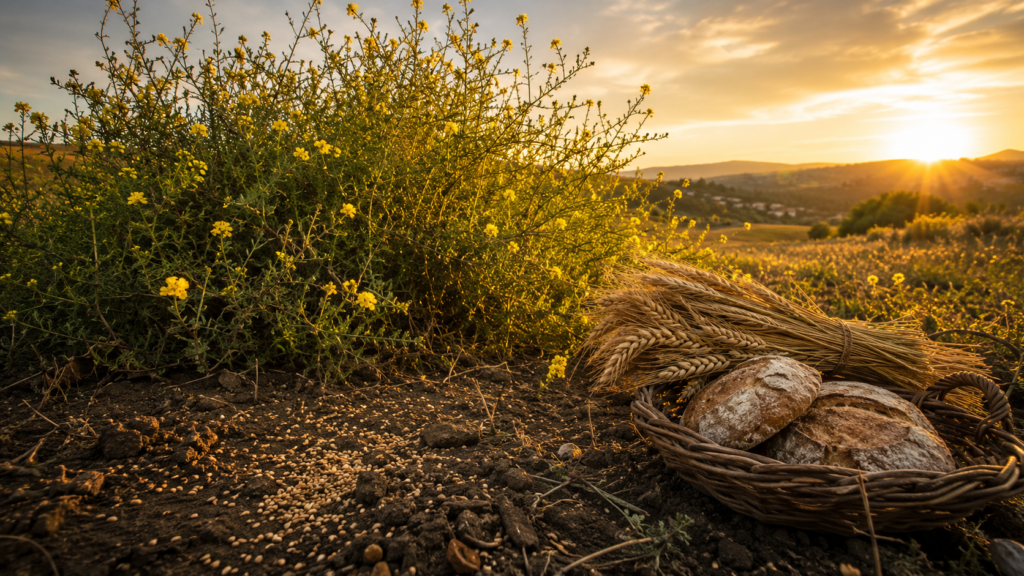
| The Growing Seed He also said, ‘The kingdom of God is as if someone would scatter seed on the ground, and would sleep and rise night and day, and the seed would sprout and grow, he does not know how. The earth produces of itself, first the stalk, then the head, then the full grain in the head. But when the grain is ripe, at once he goes in with his sickle, because the harvest has come.’ — Mark 4:26–29 (NKJV) | The Leaven He told them another parable: ‘The kingdom of heaven is like yeast that a woman took and mixed in with three measures of flour until all of it was leavened.’ — Matthew 13:33 (NKJV) | The Mustard Seed He put before them another parable: ‘The kingdom of heaven is like a mustard seed that someone took and sowed in his field; it is the smallest of all the seeds, but when it has grown it is the greatest of shrubs and becomes a tree, so that the birds of the air come and make nests in its branches.’ — Matthew 13:31–32 (NKJV) |
Three parables. One teaching session by the sea. One argument delivered from three angles—and in each case, the argument is not the one the audience is expecting.
They are waiting for the cedar. They are going to get something considerably smaller, considerably more subversive, and considerably more alive. The Kingdom of heaven, Jesus tells them, is like a mustard seed. Like leaven working through flour. Like seed scattered on ground while the farmer sleeps, growing in ways he cannot see and does not govern. Three images of hiddenness, of transformation beyond observation, of a greatness that arrives without announcing itself in the register of power.
The decisive work, in all three cases, occurs entirely beyond the range of ordinary sight.
The Cedar They Were Waiting For
To hear the mustard seed parable as Jesus’s audience heard it, you need to know what they were expecting. The prophetic tradition had given them an image of the coming Kingdom, and it was not small.
In Ezekiel 17:22–23, G‑d plants a tender sprig from the top of a cedar on the mountain heights of Israel: and it shall bring forth boughs and bear fruit and become a majestic cedar. And under it will dwell all kinds of beasts; in the shade of its branches birds of every sort will nest. The cedar is the image of messianic Kingdom—enormous, permanent, unmistakably imperial in its proportions. In Ezekiel 31:3–6, the same imagery describes the great empires of the world: cedars so vast that all the birds of the air nest in their branches, all the nations rest in their shade. That is what power looks like. That is what greatness looks like. That is the form the Kingdom is supposed to take when it arrives.
Jesus gives them a mustard seed.
Not the cedar of imperial imagination, but an ordinary field seed—small, forgettable, easily overlooked. And then, pointedly, he puts the birds in it anyway. The nations find shelter in it. The endpoint of the Ezekiel promise is fulfilled. The vehicle is a weed that got out of hand.
This is not an accident and it is not modesty. It is a precise theological argument delivered in parabolic form: the Kingdom’s greatness is not measured by cedar standards. It provides everything the cedar was supposed to provide—shelter, abundance, a gathering place for all—without the imperial proportions, without the visible apparatus of power, without the form that makes greatness legible to eyes trained on empires. The mustard shrub that shelters every bird is greater than the cedar that impresses every eye. Greatness has been redefined from the inside out.
The audience’s entire framework for recognizing the Kingdom when it arrives has been quietly dismantled. They are still waiting for the cedar. The birds have already found the mustard shrub.
The Woman in the Kitchen
The Leaven follows immediately in Matthew and Luke, and the pairing is deliberate. If the mustard seed dismantles mistaken categories of power, the leaven dismantles mistaken categories of purity.
A woman takes yeast and hides it—the Greek is enkrypto, to conceal, to bury within—in three measures of flour until the whole batch is leavened. Three seahs of flour: roughly fifty pounds, enough bread to feed a hundred people. This is not a domestic baking scene. This is a feast produced by an unnamed woman working quietly, invisibly, in a kitchen, through an agent whose work cannot be observed in progress. You put the yeast in. Something entirely different comes out the other end. The transformation is internal, hidden, and complete.
The woman is unremarkable. The leaven is invisible in the dough. The result is abundance at a scale the visible action gives no indication of producing.
What the tradition would come to name as the Shekhinah—the indwelling divine presence, the feminine face of G‑d that works within material reality rather than descending dramatically upon it from without—resonates powerfully through this image. The Shekhinah does not announce herself. She inhabits. She works from within the substance of the world, transforming it according to a logic that operates beneath the threshold of ordinary observation, producing nourishment and sustenance that the surface of things gives no sign of containing.
The Kingdom of G‑d does not arrive from outside the flour. It is already working within it—hidden, active, transforming the whole from the inside—and an unnamed woman in a kitchen is the instrument through whom something that can feed a multitude comes into being. The question the parable puts to its audience is the same question the Shekhinah has always put to those who look for the divine only in the dramatic and the visible: what if it has been here all along, working in the ordinary, and you simply did not know where to look?
He Does Not Know How
The Growing Seed appears only in Mark. No Synoptic parallel carries it forward, which makes its survival in the tradition all the more significant. Mark preserves something the other evangelists did not—and the detail that makes it irreplaceable is a single phrase in the Greek: he does not know how.
The farmer scatters seed on the ground. Then he sleeps and rises, sleeps and rises, going about his life while something he cannot observe is happening in the dark beneath his feet. The earth produces of itself—the Greek is automatē, automatically, by its own agency, from within its own nature. First the stalk, then the head, then the full grain. The farmer’s next active role is the harvest—he shows up when the grain is ready. What happens between scattering and harvest belongs to a process he cannot see, does not govern, and does not understand.
This is the theological center of the three parables, and the one most consistently overlooked by a tradition that has spent two millennia turning the Kingdom into a human management project. The Kingdom is not built by human effort. It is not sustained by institutional maintenance. It is not advanced by the right strategy, the right leaders, the right organizational structures. It grows by divine agency already embedded within creation—working in the ground, working in the dough, working in the mustard shrub—according to a logic that operates entirely outside human comprehension or control.
What resonates here with what the kabbalistic tradition would later articulate as tzimtzum—the divine contraction that creates space for creation to unfold by its own nature—is not coincidence but structural continuity. The insight that G‑d works by creating conditions and then permitting the process to unfold through agency already embedded within the created order runs through the tradition from its earliest layers. The farmer’s role is real: scatter the seed, show up at the harvest. The growing is not his.
Scatter. Wait. Harvest. The growing is not yours.
What You Will Miss
Three parables. Three iterations of a single argument. The decisive work—in every case—occurs beyond the range of ordinary observation. The seed underground. The leaven invisible in the dough. The mustard shrub growing unnoticed in the field until the birds have already arrived. The Kingdom is present, active, and transforming—and it consistently fails human recognition because human categories are malformed.
The category of power tells you to look for the cedar. The Kingdom gives you the mustard shrub, and the birds are already nesting in it before you have decided whether it qualifies.
The category of the visible tells you the divine presence arrives with announcement, with drama, with the kind of event you cannot miss. The Kingdom hides itself in fifty pounds of flour and feeds a hundred people through a woman whose name is never recorded.
The category of agency tells you that the Kingdom is something human beings build, sustain, and advance through properly organized effort. The Kingdom grows in the dark while the farmer sleeps, by a process he does not understand, and presents him with a harvest he did not produce.
The ‘mashal’ is asking its audience—then and now—a question it will not answer on their behalf: what would it mean to have eyes trained to see the mustard shrub rather than waiting for the cedar? To recognize the Shekhinah working in the kitchen? To trust the seed to grow in the dark, and to understand that the growing is not yours to govern?
These are not comfortable questions. They were not meant to be. The ‘mashal’ does not offer answers; it engineers the conditions under which the listener must produce one.
Lesser is Greater
Standing by the sea, Jesus offered no cedar at all. He gave his audience a weed growing in the field, bread rising quietly in a kitchen, and a farmer asleep while life emerged beyond his understanding. Three images of a Kingdom already present, already active, already transforming—none of them legible to eyes trained on the forms power takes.
The mustard shrub does not announce itself. The leaven does not ask permission. The seed does not wait for the farmer to understand what is happening before it grows. The Kingdom moves by its own agency, through the hidden and the ordinary, producing abundance that the visible action gives no sign of containing.
The question the ‘mashal’ leaves with every reader is the same one it left with the crowd on the shore: what would it mean to have eyes trained to see this? To recognize the Kingdom not in the forms greatness taught us to expect, but in the weed, the kitchen, and the dark ground where something is already growing—whether we are watching or not.

Discover more from Many Lamps, One Flame
Subscribe to get the latest posts sent to your email.