
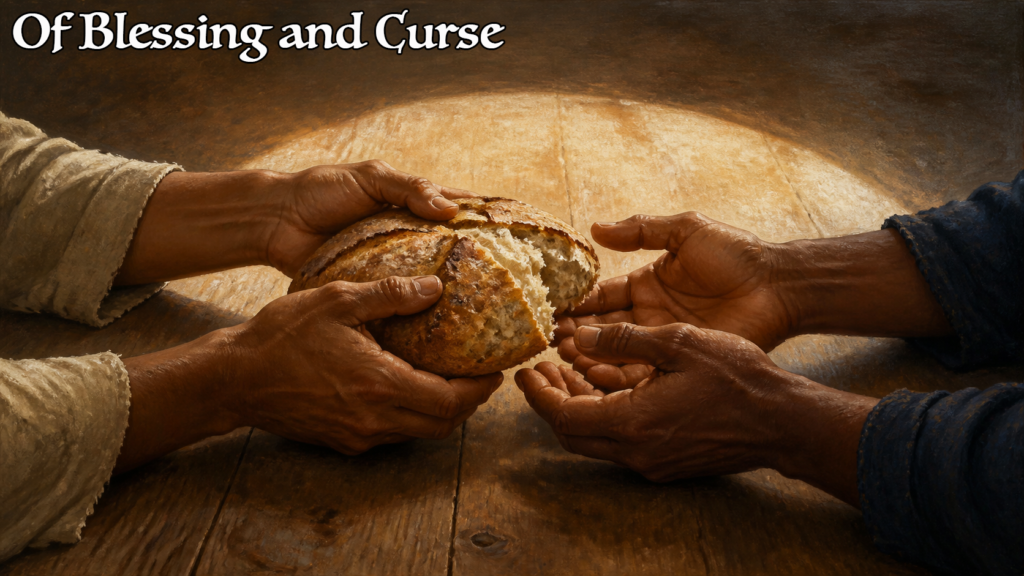
Behold, I set before you today a blessing and a curse.
— Deuteronomy 11:26
The imperative is singular. Re’eh—see, one person, singular—addressed to lifneichem, before you, plural. Moses is speaking to a nation and demanding something of each member of it individually, in the same breath. That grammatical seam is not incidental. It is the argument of the entire book compressed into one word, and by the end of this parashah, it will be tested in the movement from one organ to another: in what the eye beholds and the hand subsequently does with it.
What Moses Is Actually Doing
Devarim functions as a covenant renewal—historical review and exhortation, then stipulation, with blessing and curse giving the covenant its stakes. Deuteronomy 11:26 stands at the threshold between the first movement and the second, though not as the final verse before the laws: verses 26–32 form the closing unit that carries the blessing and curse forward to Gerizim and Eival; the stipulations begin at 12:1.
What makes that threshold necessary is the audience’s uneven relationship to the past. Moses can insist that the covenant at Horeb was made “with us—us, who are all of us here alive today” (Deuteronomy 5:3), then distinguish his hearers from their children, who did not witness the wilderness acts he names (11:2–7). Witness and inheritance already overlap.
Devarim is not another Sinai. It is Sinai re-addressed, restated, and extended into laws suited to a settled life the wilderness setting had not yet required. Re’eh is therefore not merely a request for memory. It asks what inherited memory will make a person see—and do—now.
Two Targums, One Word
The word Moses actually uses is Hebrew: kelalah, curse. Not Aramaic—the confusion belongs to the reception history, not the text. Two Aramaic translation traditions render this fixed Hebrew word differently, though not from the same era. Onkelos, generally regarded as the earlier tradition, gives it literally: curse. A second, composite Aramaic tradition—long printed under the name Targum Yonatan ben Uziel, though the Talmud credits that sage only with a translation of the Prophets, never the Torah—renders it chilufah. Scholars call this second work Targum Pseudo-Jonathan for exactly this reason. Its received form is later—possibly much later—than Onkelos, whatever older material it may carry inside it. One common explanation for the attribution is an abbreviation, ת”י for Targum Yerushalmi, misread over time and expanded into a name the work was never given.
Chilufah’s primary sense, in the standard lexicons, is opposite or reverse, not exchange—the richer reading belongs to later interpretation, not to the word on its own. But the Aramaic still does something the Hebrew does not: where kelalah stands beside blessing as its own separate noun, chilufah defines the second term through the first—not curse, but the blessing’s opposite, grammatically dependent on the thing it negates. That dependence is modest. It is also exactly what later Hasidic thought will press into a claim about concealment.
Sforno, reading the same verse, is not offering an alternative to Moses’s binary. He is explaining why Moses insists on one: re’eh, Sforno writes, warns against the instinct—which he attributes to “the nations of the world”—to search for a comfortable middle ground between the two paths (Sforno on Deuteronomy 11:26). Moses forecloses the middle rhetorically, in the same verse where a later Aramaic tradition will find something folded inside the second term. The two moves do not compete. They occupy different altitudes of the same insistence: choose, knowing later tradition will find in the second term more than a mirror of the first.
What the Eye Does
“No evil descends from Above” is not a Hasidic coinage. It appears in Bereishit Rabbah 51:3, and is elaborated at length in later Hasidic thought, including the Alter Rebbe’s Tanya. A later Chabad reading of Re’eh, building on that inherited line, takes chilufah’s grammatical dependence further and reads it as concealment: what looks like curse is blessing not yet recognized as such. That reading should be named for what it is—a Hasidic exposition working from a traditional, pre-critical attribution of its source targum—not narrated as settled history about who wrote what while the Temple still stood.
Maimonides reads the same verse and asks a different question. In Hilchot Teshuvah, he cites Deuteronomy 11:26 directly, alongside 30:15, as his proof that free will is not a philosophical nicety but the pillar on which Torah and its commandments rest: the choice, he writes, is in your hands (Mishneh Torah, Repentance 5:3). The Hasidic reading asks what descends from Above. Maimonides asks what a person does below, and refuses to let the first question answer the second. Whatever is or is not concealed in the curse is not what he is interested in adjudicating. What remains, regardless, is the freedom Viktor Frankl would later call the last of the human freedoms: not the freedom to determine what happens, but the freedom to choose one’s response to it. That is what prepares the literal hand this parashah will ask something of before it ends.
Kabbalah supplies a structural analogue here rather than another translation. Chesed and Gevurah name expansion and restraint, two distinct divine modes meant to be held in balance on the Tree’s outer columns. Gevurah is not evil, and it is not simply Chesed gone unrecognized; its danger appears specifically when judgment is severed from the whole and left to operate as if it answered to nothing else. The analogy is not that severity is secretly kindness in disguise. It is that no attribute, on the Tree or off it, is safe to treat as autonomous.
And this is where the letters matter, though carefully. The Hebrew word before both targums remains kelalah—unchanged, unaltered, identical in each. That stability is a literary echo of Va’etchanan’s insistence on guarding the word, though not the specific legal claim of lo tosifu, which governs the commandments rather than promising scribal permanence. The wording can hold perfectly still while what is asked of it moves considerably. Fidelity to the letter does not settle what the letter will be asked to mean.
What the Eye Can Become
Later in the same parashah, the organ Moses commanded into use reappears—not through the same verb, but through the same organ. Beware, Moses says, lest you harbor the thought that the year of release is near, and וְרָעָה עֵינְךָ, ve-ra’ah einecha—your eye become evil—against your poor brother, and you give him nothing (Deuteronomy 15:9). Re’eh (רְאֵה), “see,” and ve-ra‘ah (וְרָעָה), “and [your eye] become evil,” derive from different Hebrew roots; the resemblance is phonetic, not etymological. But the eye itself is the same eye, asked in chapter eleven to see rightly and shown, four chapters later, exactly what it looks like when it doesn’t. Re’eh was never asking for a single correct vision, delivered once and held forever. It was asking what the seeing would go on to produce, verse after verse, in a body still capable of getting it wrong.
One kabbalistic mapping, attributed to the Arizal, places giver and recipient along the channel of Yesod and the sphere of Malchut—the conduit and the point of reception, the latter also the sefirah associated with exile, with waxing and waning rather than generating its own light. In that symbolic system, tzedakah is not merely an example of blessing correctly perceived. It restores flow to exactly the kind of concealment this reading has been tracing. The open hand is not a footnote to the argument. It is where the argument was always headed.
What the Hand Discloses
Re’eh, singular, addressed to lifneichem, plural: the blessing and its opposite are placed before the nation together, all at once, as a body. But by the fifteenth chapter, the grammar has narrowed. It is no longer the nation’s eye. It is your eye, singular, and your hand, singular, closing or opening in front of one particular brother who is not an abstraction. The choice Moses sets before Israel collectively in chapter eleven is not adjudicated collectively. It is adjudicated one hand at a time, in private, where no assembly at Gerizim or Eival is watching.
The fire at Horeb went out. Responsibility did not. After Horeb, one indispensable evidence of what a person has seen is what that seeing makes them do with the person standing in front of them, asking for something they remain entirely free to refuse.

Discover more from Many Lamps, One Flame
Subscribe to get the latest posts sent to your email.