

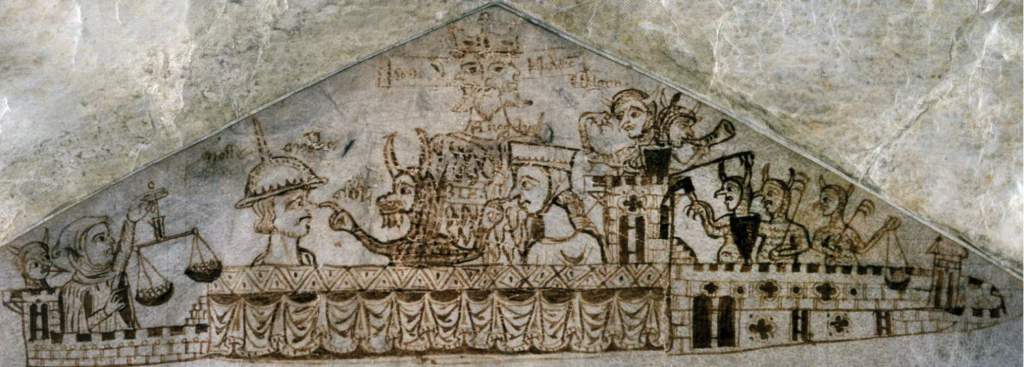
A politician speaks of globalists manipulating the world’s financial systems. A celebrity warns that a small, coordinated group controls the banks, the media, and the government. A social-media graphic circulates widely, depicting puppet strings attached to a recognizable Jewish name. The language feels contemporary. The accusation is not.
Its essential structure—a small, foreign, financially capable group manipulating the host society from within, their loyalty never fully to the nation they inhabit—is structurally similar to what a Venetian audience understood about Shylock in 1596, which is structurally similar to what a Crusader preacher said about a Jewish creditor in 1096, which echoes what an Egyptian official said about a foreign administrator three thousand years before either. The specific anxieties differ. The shape does not.
To understand where that sentence came from, it is necessary to go back — not to the Rothschilds, not to Shakespeare, not even to the Middle Ages. It is necessary to go back to a granary in ancient Egypt, and a young man named Joseph who could read the future in dreams.
Joseph and the Shape of the Accusation
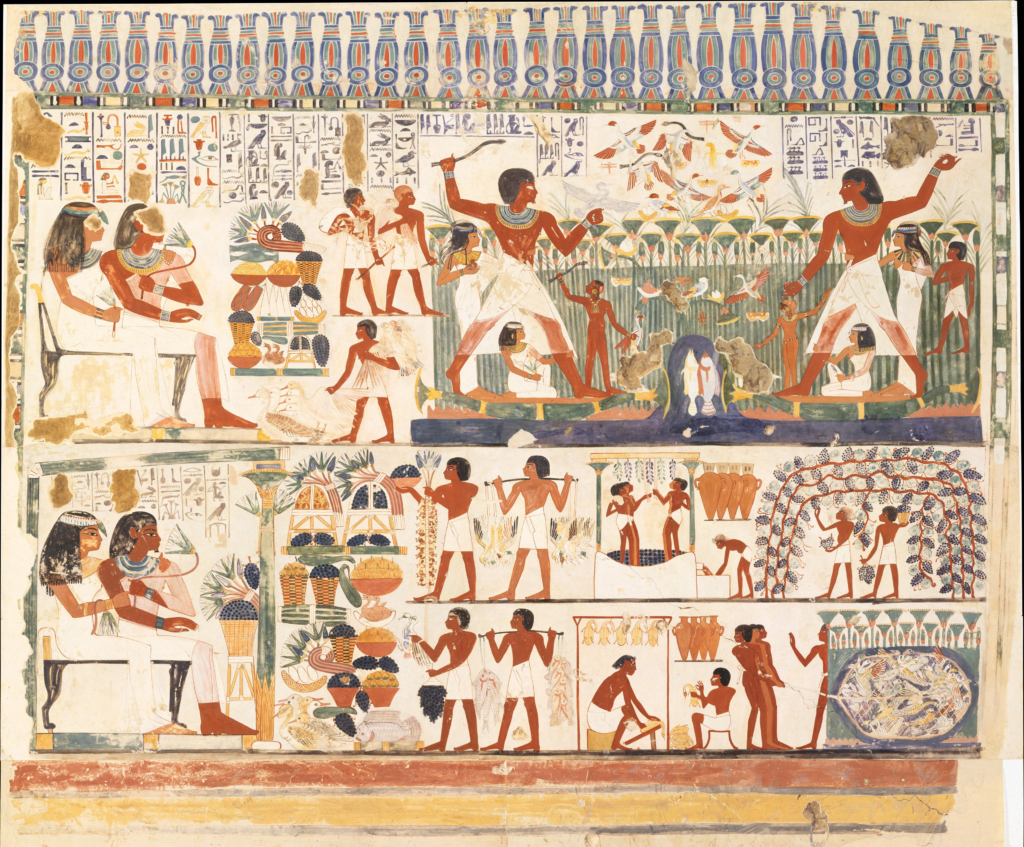
The Joseph narrative in Genesis is not the origin of the economic mythology of anti-Jewish contempt. What it contains is something older and more structural: the pattern by which indispensable service becomes suspicious visibility once the service is forgotten.
Joseph is sold into slavery by his brothers, brought to Egypt, imprisoned unjustly, and then elevated to the second highest office in the land because he can do something no one else can — read the meaning of Pharaoh’s dreams and administer the economy accordingly. He saves Egypt from famine. He saves the surrounding nations. He saves his own family, the brothers who sold him. He is, by any measure, indispensable.
Then a Pharaoh arises who knew not Joseph. What he sees is not the man who saved Egypt. What he sees is a community that has grown numerous and capable — a foreign people whose visible competence has made them threatening. His fear is not primarily financial. It is political and demographic: if war breaks out, he says, they will join our enemies. This is the old misanthropia charge — separatism read as disloyalty — not yet the later accusation of financial manipulation. But beneath it lies the same structural logic: utility recognized, utility exploited, utility forgotten, capability reframed as threat.
Joseph is not the origin of the Jewish financial stereotype. He is evidence of a deeper narrative grammar — the grammar of conditional belonging. The community is welcome when its capabilities serve the host society’s needs. It becomes suspect when those needs are met and the capability remains visible. The medieval economic mythology will fit this shape precisely. But it will require the specific machinery of medieval Christian law to construct the cage from which the mythology grows.
The Construction of the Cage
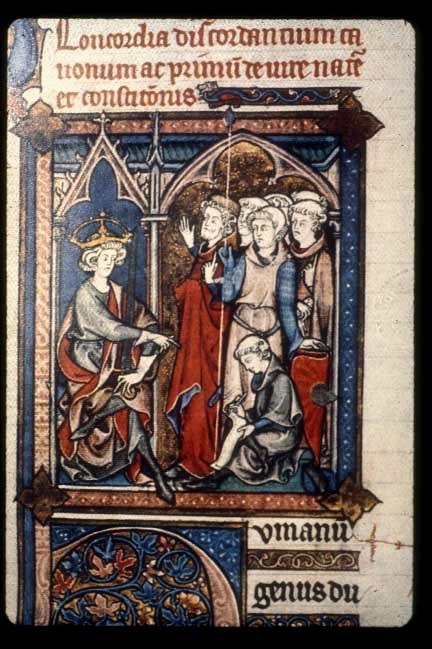
No single law placed European Jews into finance. What produced the conditions for the economic mythology was a convergence — of restrictions, exclusions, royal policy, credit demand, and cultural habit — that made Jewish participation in certain financial roles unusually visible, and then erased the conditions that had created that visibility.
The subordinate legal status that late Roman law had established — through the Codex Theodosianus and its exclusions from public office, military service, guild membership, and Christian slave ownership — was not a single blueprint mechanically enforced for a millennium. Medieval authorities adapted those exclusions to local economic life across centuries and regions, producing varying conditions in different places and periods. But the underlying direction was consistent: Jewish communities were excluded from the widest range of economic roles, confined to movable property because their tenure on land was insecure, and made dependent on royal protection that could be withdrawn at any moment.
Into this context came the Christian prohibition on usury. The Council of Nicaea in 325 CE had already forbidden clergy from lending money at interest. By the twelfth century, the prohibition had been extended to Christian laity — usury, defined as lending at any interest, was a sin against the natural order, a charge for time itself, which belonged to G-d. Christian lenders never disappeared entirely. Lombards, Cahorsins, monasteries, merchants, and pawnbrokers operated in the credit economy through legal and contractual workarounds. But the stigma was real, the canonical prohibition was real, and the social pressure against visible Christian lending was real.
The result was not that every Jew became a moneylender. It was that Jewish lenders became unusually visible — and visibility became identity. Christian culture learned to see the Jewish community through the creditor standing at its point of greatest financial anxiety. The physician, the scholar, the merchant, the craftsman — these Jewish figures were less visible in the imagination than the creditor, because the creditor stood at the point where Christian anxiety about money intersected with Christian anxiety about Jews.
The distinction between compulsion and character was deliberately erased. The community forced into certain financial roles by legal exclusion became, in the cultural imagination, a community that had chosen them — that was constitutionally oriented toward financial exploitation, that was by nature what the law had by design made it by necessity. What the host society had engineered became evidence of what the Jewish community intrinsically was. The cage was built. Then the mythology formed around the cage. And then the builders forgot they had built it.
The Utility Cycle

The pattern that runs through the medieval and early modern period is consistent enough to constitute a structural argument. A Jewish community is tolerated — or invited, or readmitted after a prior expulsion — because it provides something the host society needs and cannot or will not provide itself. Financial services, trade networks, medical expertise, administrative capability. The community builds, lends, facilitates, serves. Then the need is met, or the debt becomes inconvenient, or a crisis requires a target. The expulsion follows. The debt is cancelled. The community is gone, and so is what the host society owed them.
The mechanisms were not identical in every case, and the differences matter.
In England, the expulsion of 1290 emerged from a convergence of royal finance, parliamentary politics, and religious hostility. Edward I had already extracted everything he could from the Jewish community through taxation and arbitrary seizure, had restricted and then effectively nationalized Jewish lending, and had made the community economically peripheral well before the expulsion. The expulsion was part of the price he paid to obtain taxation from Parliament for his wars — a political transaction in which Jewish expulsion was currency. The debt-cancellation logic was present but not simple.
In France, the cycle was clearest. Jewish communities were expelled and readmitted repeatedly across the thirteenth and fourteenth centuries, each cycle following the same pattern: invite when the financial networks are needed, extract through escalating taxation, expel when the debts become politically inconvenient, readmit when the networks are needed again. The French crown treated its Jewish communities as renewable fiscal resources — to be harvested, expelled, and eventually replanted.
In Spain, the confessional logic was primary. The Reconquista was complete in 1492, the same year as the expulsion, and Ferdinand and Isabella were engaged in a project of religious unification that the presence of a large, visible Jewish community complicated. The influence of practicing Jews on conversos — Jewish converts to Christianity — was the stated justification. Economic opportunism was present: property seizure, the transfer of assets, the absorption of commercial networks. But to reduce the Alhambra Decree to a financial transaction understates the decisive religious logic. A community that had served Iberian commercial, intellectual, and administrative life for centuries — physicians, astronomers, philosophers, poets, financiers — was given four months to convert or leave. The Ottoman Empire, recognizing precisely what Spain had discarded, welcomed them.
In each case, the structural outcome was the same: a society extracted Jewish service and then converted Jewish visibility into evidence against Jewish belonging. The utility was real. The mythology that replaced it in the cultural memory was not.
The Myth Enters the Bloodstream
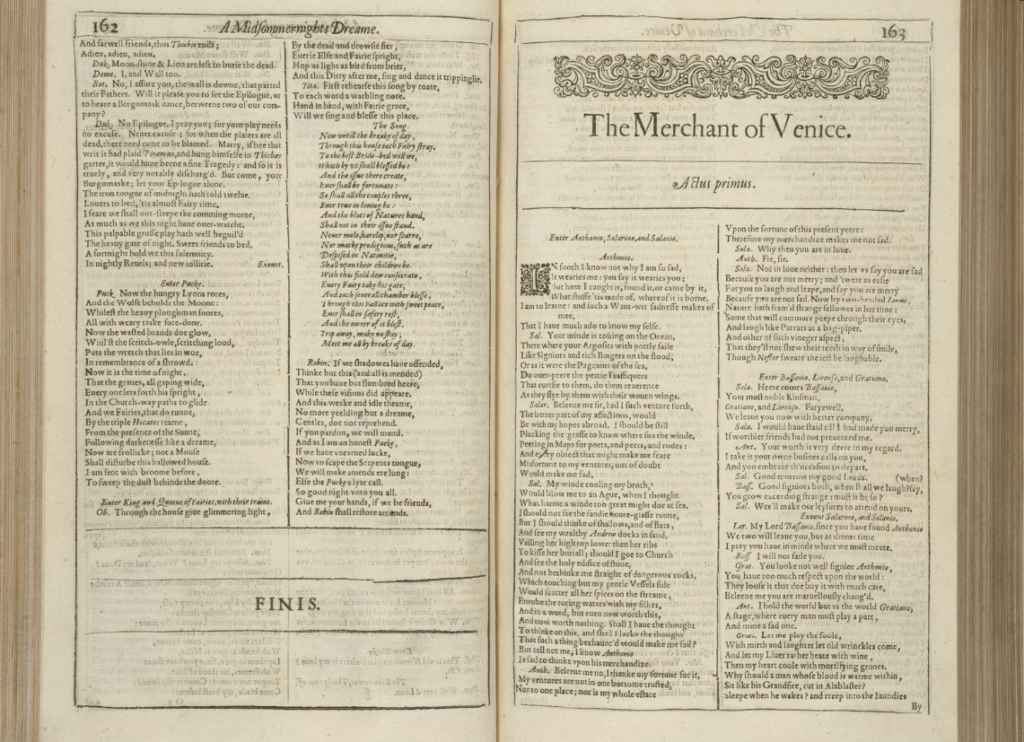
1596. The Merchant of Venice. Shylock.
Shakespeare did not invent the figure of the Jewish moneylender. He inherited a dramatic type that had been accumulating in European literature and theater for centuries — in mystery plays, in fabliaux, in the theological imagination of a culture that had been encoding the economic mythology into narrative since the Crusades. What Shakespeare did was give that accumulated tradition its most memorable and most widely disseminated form.
The play is more complicated than propaganda. Shakespeare gives Shylock humanity — he is wounded, intelligent, humiliated, recognizably human. His famous speech — hath not a Jew eyes? — is a genuine claim on common humanity, and generations of readers have felt its force. But Shylock is also still the Jew whose bond demands Christian flesh. Shakespeare complicates the type without dismantling it. The stereotype survives the sympathy.
This is the mechanism of transmission through transformation. The economic mythology does not survive because it is simple. It survives because it is flexible—because it can absorb critique, accommodate complexity, wear the clothing of humanism, and still deliver the essential accusation. Shylock can be humanized and still be Shylock. The creditor can be sympathetically portrayed and still be the creditor. The type outlasts the playwright’s evident ambivalence.
By 1623, when the First Folio fixed the play in print, the Shylock figure had entered the cultural bloodstream of the English-speaking world in a form that would persist for four centuries. The medieval economic mythology — constructed from legal exclusion, amplified by the utility cycle, encoded into the cultural imagination through narrative — had found its most durable literary form. The cage was invisible. Only the creature inside it remained.
What the Myth Cannot Explain
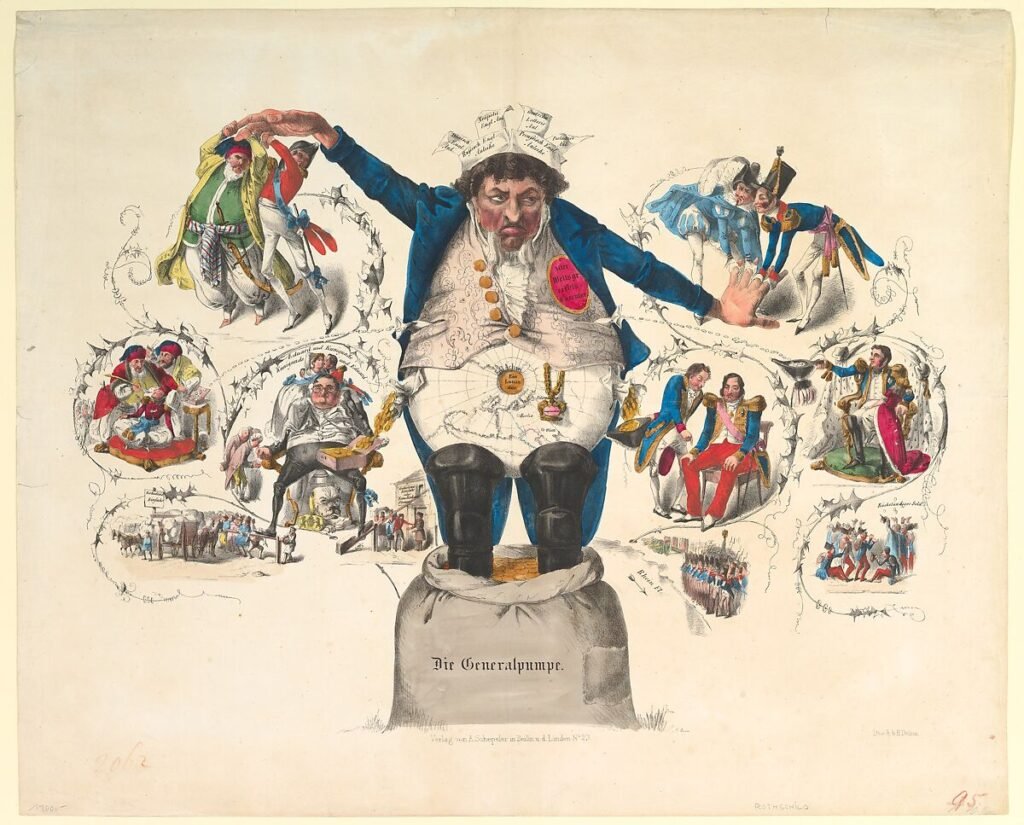
There is a logical incoherence at the center of the economic mythology that has never been resolved — because it has never needed to be.
If Jewish communities controlled the financial systems of the nations they inhabited — if they manipulated credit, monopolized capital, pulled the strings of kings and parliaments — then how were they so relentlessly and catastrophically persecuted? How were they expelled from England in 1290, from France repeatedly, from Spain in 1492? How were they confined to ghettos, subjected to pogroms, stripped of citizenship, and ultimately murdered in industrial quantities in the twentieth century? A community that controls everything does not end in this condition.
The myth has no answer to this question because it does not operate on evidence. It operates on fear. And fear does not require internal consistency — it requires a shape that fits the anxiety of the moment. The accusation inflates when a scapegoat is needed and deflates when it becomes inconvenient. The mythology is elastic precisely because it was never descriptive. It was always instrumental.
The cage will change. The industries will change. The name attached to the accusation will change. Shylock acquired other names — each generation modernizing the figure and mistaking the updated costume for a new discovery. The governing logic was already built in the twelfth century, refined in the fifteenth, codified in the sixteenth. It required no further invention. Only inheritance.What that inheritance looked like in the centuries that followed — how it mutated through the printing press, through racial science, through industrial propaganda, through the digital networks of the present — is the examination that awaits. The trap was set in the Middle Ages. The myth is still running.

Discover more from Many Lamps, One Flame
Subscribe to get the latest posts sent to your email.
Excellent piece! I would add that Christians not lending on interest was based on their adopting and reinterpreting biblical passages originally directed at Jews. The Jews also observed those biblical laws. However, the specific language of those laws says not to charge interest to one’s fellow Israelites. One can lend at interest to a “foreigner.” So, the Jews also did not lend on interest, but only among themselves. The Christians adoption of the Hebrew bible as their “Old Testament” and broader reading of the biblical verses in Exodus 22:25, Leviticus 25:36–37, and Deuteronomy 23:20–21 resulted in their placing a restriction upon themselves, an opportunity for non-Christians whose professions were restricted in other ways, and the ensuing resentment.
Your work is extraordinary!
We are growing with each writing ✍️