
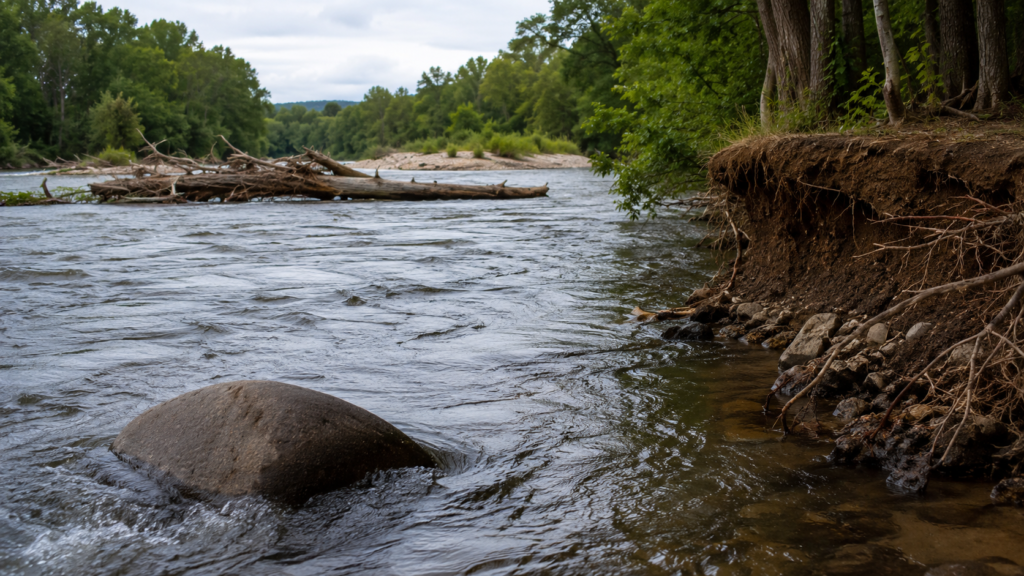
A river runs past a stone and past the bank on the same day, at the same volume, carrying the same load of silt. Give it a century. The stone is smaller and smoother than it was, its edges gone, its surface polished along the line the water travels. The bank is not there at all. The current worked underneath it, hollowed out the soil beneath the root mass, and one spring the whole shelf calved off and went downstream.
Nothing was added to the water in either case. No malice entered it at the bank and no favor at the stone. The same current did both things over the same hundred years. What differed was how each stood in relation to the flow: the stone sat in the current and let it pass; the bank stood across it.
Geologists have a vocabulary for this that involves no intention whatsoever. The arrangement is still worth holding onto, because it describes something other than rivers.
Orientation Is Not Alignment
Orientation answers one question: which way am I facing? It is a matter of the compass, and it can be settled in an instant. A person can turn toward something—can want it genuinely, know its name, know its direction—and be finished with the turning in the time it takes to decide.
Alignment asks the harder question. Does the rest of me follow where I am facing?
The two come apart constantly. A person oriented toward generosity is pulled sideways by fear about money. A person oriented toward honesty is dragged crosswise by the particular humiliation of admitting one thing to one person. Appetite runs one direction and habit another, and the stated direction of a life becomes a flag planted somewhere the body never goes. None of this requires hypocrisy. Orientation is cheap and alignment is expensive, and the distance between them is where most of a life is actually lived.
There is a second asymmetry, and it matters more than the first. The flow does not have to be produced. The current already runs, the channel already exists, and nothing has to be summoned into being by anyone’s effort. In that sense alignment is the natural state—of creation, which is arranged for it.
It is not the natural state of human beings. We drift. We are reactive and forgetful and easily turned, and we mistake the direction we last faced for the direction we are currently moving. That is the entire reason avodahexists: not to create the current, which needs nothing from anyone, but to keep returning the vessel to its angle.
What Discernment Cannot Do
Reinhold Niebuhr’s prayer asks for three things: serenity to accept what cannot be changed, courage to change what can, and wisdom to know the difference. It has been recited in church basements and hospital rooms for the better part of a century, and its durability is not an accident. Within the question it asks, it is exact.
But notice what the question is. It is a question about discernment—about telling one category from another. Discernment is orientation. It establishes which way to face. It has not yet said anything about whether the rest follows.
There is also a region of experience the binary does not reach. Some things can be changed and are not mine to change: the marriage of a friend, the choices of an adult child, the direction of an institution that will not have me. Some things cannot be changed and form me anyway: illness, grief, love, the accident of where I was born, the fact of my own death. Neither set is a candidate for courage, and neither is a candidate for serenity in the sense the prayer means it. They are not problems awaiting classification. They are conditions a person stands inside of, and the only question they permit is how.
The Vessel and the Flow
Kabbalah has a name for the current: shefa, the flow of divine abundance descending through the worlds toward manifestation. Its defining property here is that it does not wait to be summoned. It descends because descending is what it does. The vessel does not originate it. What becomes of it after that—whether it is received, passed along, or obstructed—depends on the vessel enormously. But the current itself is not authored from below, and what the vessel can do is stand at an angle to it.
Misalignment, in this vocabulary, is a vessel presenting its side to what is pouring. Nothing has been withheld. The flow arrives exactly as it would have arrived. It simply is not received, and what is not received runs off and pools somewhere it was not meant to go.
The structure through which it descends is usually drawn as a diagram, which is unfortunate, because it is better understood as a watercourse. The middle pillar—Keter through Tiferet to Yesod and down into Malkhut—is the channel, the line along which the current actually runs. Chesed and Gevurah are the banks.
This is worth being careful about. The banks are not obstacles and not errors. A watercourse without banks is not a river but a swamp, spread thin across everything and moving nowhere. Chesed unbanked is flood; Gevurah unfed is dry channel. Tiferet is therefore not a compromise struck between them, not a midpoint arrived at by splitting the difference. It is the channel in which neither bank becomes the river.
Which gives malformation a definition, and one that has nothing to do with deviation from an ideal shape. Formation gives a vessel its form. Alignment determines whether that form transmits or obstructs. A malformed vessel is not a vessel that came out different from some template. It is a vessel that cannot carry the current cleanly—and because the current does not stop, what it cannot carry cleanly it carries badly.
That is also the whole account of the sitra achra, the Other Side. It does not originate a current. It has no flow of its own to offer and no independent power to exercise. It lives on diverted current—on what runs off the vessel standing crosswise, on what arrived and found no channel. Resistance is borrowed force turned sideways.
What the Words Are Made Of
None of this is a cosmology imported from outside and laid over ordinary practice like a transparency. It is already inside the liturgy, and it arrived there by two different routes.
Sometimes Kabbalah found the current running beneath words that were already old. Barukh atah—blessed are You—opens nearly every Jewish blessing and is centuries older than any medieval mystic. The plain reading is praise: the worshipper directs glory upward toward its object. Rabbi Chaim of Volozhin rejects that reading outright in Nefesh HaChayim, Gate II, chapter 2, and he argues it from the sources rather than from mysticism. When G‑d asks Rabbi Yishmael for a blessing at Berakhot 7a, what Yishmael offers is not praise but a petition for mercy. Barukh is an expression of increase and expansion—the sense it plainly carries where Scripture speaks of blessing food, or blessing the fruit of the womb, in which praise is not what is meant.
He is careful about what is being increased. Not the essence of the Ein Sof, which is beyond any blessing and cannot be named at all. What can be increased is G‑d’s relation to the worlds and His manifestation within them. The wider Kabbalistic tradition gives that increase a name he does not use here. A berakhah participates in hamshakhah: a drawing down, a conducting of abundance into the world.
The mental picture inverts. Not human, then praise, then Heaven. Source, then flow, then vessel, then world. The one praying is not calling compliments upstream. He is standing in the channel.
That reading is contested. Rabbeinu Chananel and others hold that blessing is exactly praise, and the dispute is old and unresolved. What is not disputed is the sequence: the words came first, and the reading came after.
Sometimes, though, Kabbalah wrote new words expressly to stand in the current. Lecha Dodi is sung on Friday night in synagogues of every denomination, and it was composed in sixteenth-century Safed by Shlomo Halevi Alkabetz, whose name is spelled out by the opening letters of its stanzas. It is not a hymn about Shabbat. It is a hymn about reception—p’nei Shabbat n’kabbelah, let us receive the face of Shabbat; bo’i kallah, come, bride—and in most rites the congregation turns bodily toward the door at the final stanza and bows. A room full of people physically turns to receive something arriving. The gesture is the argument.
Christian liturgy carries the same structure in its own room. The Sanctus sits at the center of the Eucharistic prayer, and it is Isaiah 6:3—the seraphic cry, kadosh, kadosh, kadosh—recited weekly by people who have generally never been told where it comes from, or what the prophet was watching when he heard it.
The structure of that inheritance is the point. Isaiah did not compose the cry. He overheard it, already underway, and reported what he had walked in on. Every liturgy that takes it up puts the congregation in the same position he was in: joining something that was being sung before they arrived and will go on after they stop.
And here is what matters. Understanding does not manufacture what the liturgy assumes. The Bride does not begin approaching because a congregation has read Alkabetz. Knowledge deepens the vessel’s relation to the act, sometimes immeasurably; it does not create the act, and it does not create the flow. The words do not wait for the worshipper to understand their history before carrying it.
The current does not begin when the vessel learns the word for water.
Two Ways to Be Wrong
Everything to this point describes geometry, and geometry turns dangerous the moment it is applied to human beings without a check, because it dissolves responsibility. If misalignment is only the angle a vessel happens to sit at, no one is answerable for anything and the argument reduces to an unlucky arrangement of furniture.
So the distinction has to be stated plainly. Misalignment describes position. Resistance describes will.
A person sits crosswise to the current through ignorance, through injury, through the shape a childhood pressed into them, through fear, through habit worn so deep it no longer registers as a choice, through simple circumstance. Much of it happens without knowing. Some of it was done to them. A vessel is not always crooked because it chose to be crooked, and treating every misalignment as a moral failure is both false and cruel.
Resistance is something else. It begins where the direction is sufficiently known and is deliberately opposed—where a person can see where the current runs and braces against it anyway. That is where bechirah enters, and it enters only there.
The two produce different malformations and carry different weight. But they share an outcome, and the shared outcome is why the distinction cannot be used as an exit. Neither the drifted vessel nor the braced one receives what is pouring. Culpability differs. What reaches the vessel does not.
What the Water Cannot Be Asked to Do
Shoftim closes with a law that sits outside every gate the rest of the portion spent itself building. A body is found in open country between towns. No one witnessed the killing and no one can determine who did it. The elders measure the distance from the corpse to the surrounding towns, and the elders of the nearest town take a heifer that has never been worked and bring it down to a nachal eitan—a place Deuteronomy 21:4 specifies is neither tilled nor sown. There they break its neck, wash their hands over it, and declare that their hands did not shed this blood and their eyes did not see it done.
What a nachal eitan is has never been settled. Rashi, following Sifrei and the discussion at Sotah 45b, reads eitan as hard—a valley of rock that was never worked and never could be. Ramban follows him, as do the Septuagint, Onkelos, the Jerusalem Targums, the Vulgate, and Saadia. Maimonides reads it instead as a wadi of perennial water, and nearly every modern translation has gone with him. The one other appearance of the phrase in Scripture supports the water reading: at Amos 5:24, justice rolls down like waters and righteousness like an eitan stream, standing in direct parallel to mayim. Which means the phrase makes its only other appearance in the great image of justice as unstoppable current—and turns up here, at the one place where justice cannot be done.
The two readings part company on nearly everything and land in the same place on one thing. Stone that will not break to a plow, or water that will not leave the ground long enough to be planted: either way, this is land that will never be made productive, and by law it is never to be worked again afterward. That is the site the Torah selects.
Nothing is solved. No one is charged. The death is not investigated, avenged, or explained. The ritual does not pretend to repair what happened, and it does not ask the water to carry the death away.
What it does is establish a truthful relation to what cannot be repaired. The elders name the limit of their own responsibility aloud, in the one kind of place that will never yield anything to anyone. Not a courtroom. Not an altar. Ground that cannot be turned to use, chosen deliberately for the admission that repair is unavailable.
This is where acceptance stops being resignation. Something can be repairable in principle and not repairable by me, or not by us, or not now. A relationship can be theoretically reconcilable and require a second person who is unwilling or dead. Restitution can be owed to someone who cannot be found. To keep insisting in such cases that restoration remains available is not faithfulness. It is a refusal to stand in the current as it actually runs. Sometimes alignment with reality means ceasing to call restoration possible when it is not.
What the River Carries Forward
Rivers make ground. A sandbar is real—it holds weight, it can be stood on, it is genuinely somewhere—and it is composed entirely of what the current dropped when it slowed. Larger water makes islands the same way. Whoever reaches one has arrived at solid ground, and the solid ground is made of river, sits in the current, and will be rearranged by the next flood.
This is not a disappointment. Crossing is a true description of a passage. The far bank exists. It is also the water.
A tree falls into a river and for a while it is wreckage—an obstruction, a hazard, a loss. Then fungi and insects and current work on it, its material breaks down, and it enters the soil somewhere downstream and feeds what grows there. The moral usually drawn from this is that nothing is wasted and everything is eventually redeemed.
That moral is false, and the falseness is worth stating precisely. The tree becomes soil because the years it spent growing left something the river could still work with once the form was gone. Formation before the fall determined what formation after it would have to work on. Not everything that goes under arrives with that. Some of what enters the water fouls it. Some of it lodges against a narrows and diverts the current into a channel it should never have cut, and the damage is downstream and years later and no longer anybody’s to answer for. Some of it settles on the bottom and stays there, neither nourishing nor obstructing, simply gone.
Formation continues regardless. Nothing that enters the water is exempted from being carried, worked on, broken down, and turned into something else. What is not guaranteed is what it becomes. The water cannot manufacture substance where none was formed. It can only go on forming what it receives.
The river does not redeem what enters it. It carries forward what was already there.
What Alignment Cannot Promise
There is a version of all this that turns alignment into insurance—stand rightly and the water will treat you gently, keep the vessel straight and the flow will do no harm. Nothing in the structure supports it. The stone is not spared. It is worked on for a century without pause and it ends up smaller than it began. Alignment did not exempt it from the river. Alignment determined what the river was able to make of it.
So the thing being asked for was never protection. The current reaches what it reaches. The flood line moves, and ground that stood safely above it for a generation is inside it by morning. What alignment governs is not whether one is carried, which was never in question, but what the carrying will have to work with.

Discover more from Many Lamps, One Flame
Subscribe to get the latest posts sent to your email.