Skip to content
newlogo t
  • Home
  • Reflections
  • Influences
  • Podcast
  • Thematic Guide
  • About
  • Calendar
Search
newlogo t
  • Home
  • Reflections
  • Influences
  • Podcast
  • Thematic Guide
  • About
  • Calendar

The Philosophers Who Refused the Leap

1 Comment / Reflections in the Well / Eliyahu (נר הדרשן)

There are serious minds—not shallow ones, not cowards—who looked at the same river, understood it with full clarity, and drew the opposite conclusion. Some made the strongest case available for why the paddle is an illusion and the far bank is not there. That position will not be answered by dismissal.

The Philosophers Who Refused the Leap Read More »

Parashat Bechukotai

Leave a Comment / From the Scroll / Eliyahu (נר הדרשן)

The Hebrew is not according to My statutes, and not My statutes as object. B’chukotai—in them. Inside them, as you move. Rashi refuses to let the phrase mean simply keeping the commandments, since the commandments are named separately in the very same verse. Something prior is being asked for.

Parashat Bechukotai Read More »

I Never Knew You

Leave a Comment / Under the Lectionary / Eliyahu (נר הדרשן)

The verdict is not addressed to the indifferent or the hostile. It is addressed to the ones who arrived carrying everything they had done—who prophesied in the name, cast out demons in the name, performed wonders in the name. The Sermon ends not with a teaching but with a sentence.

I Never Knew You Read More »

Parashat Behar

Leave a Comment / From the Scroll / Eliyahu (נר הדרשן)

What is sold in Torah is not the land. It is the number of harvests remaining before the next Jubilee. The land itself cannot be permanently conveyed, because it was never the seller’s to convey—ki li ha’aretz, for the land is Mine. This is not an economic law. It is a claim about ownership as such.

Parashat Behar Read More »

The Sickness Unto Life

Leave a Comment / Reflections in the Well / Eliyahu (נר הדרשן)

There is a suffering with no obvious cause. The body is intact, the material conditions are met, nothing has gone catastrophically wrong in any way that can be pointed to and named—and something at the center of the self is persistently wrong anyway. Kierkegaard called it despair, and called it a beginning.

The Sickness Unto Life Read More »

You Will Know Them By Their Fruit

1 Comment / Under the Lectionary / Eliyahu (נר הדרשן)

The wolf does not announce himself and the false prophet wears no sign. They come in sheep’s clothing—the forms, the language, the role. And the clothing is not always a deliberate disguise. Often it grew there naturally, worn by someone who never decided to deceive anyone.

You Will Know Them By Their Fruit Read More »

Parashat Emor

Leave a Comment / From the Scroll / Eliyahu (נר הדרשן)

Holiday is holy day with the holiness worn smooth. Two words became one, the sacred qualifier dissolved, and what remained was a day off work. But moed does not mean festival. It means appointed time—what two parties make when they agree to be in the same place because the relationship requires it.

Parashat Emor Read More »

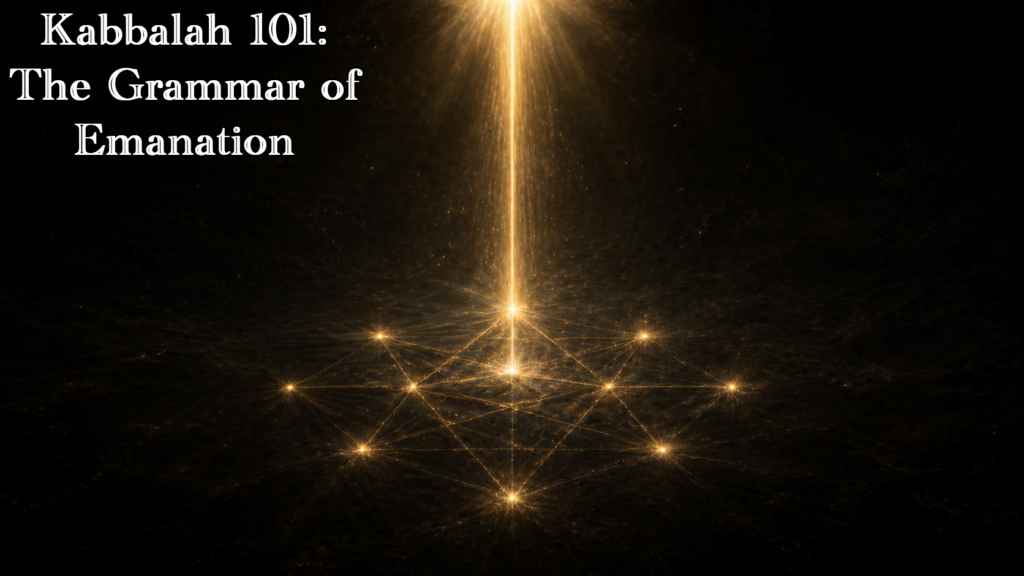
Kabbalah 101: The Grammar of Emanation

Leave a Comment / Reflections in the Well / Eliyahu (נר הדרשן)

The diagram turns up everywhere—synagogue walls, the margins of medieval manuscripts, the screens of people who met it in passing and could not stop thinking about it. It is not a picture of the Divine, a hierarchy of power, a map of the afterlife, or a system of correspondences. It maps emanation.

Kabbalah 101: The Grammar of Emanation Read More »

The Narrow Way

Leave a Comment / Under the Lectionary / Eliyahu (נר הדרשן)

The image is ancient and the audience already knows it. Two gates, two roads, two crowds of vastly different sizes, two destinations. This is not an innovation. It is the oldest Jewish teaching about the shape of the moral life, pressed to its sharpest point—and beneath that, something more precise still.

The Narrow Way Read More »

Parashat Kedoshim

Leave a Comment / From the Scroll / Eliyahu (נר הדרשן)

Kadosh does not mean morally elevated or spiritually refined. Its root meaning is set apart—distinct, other, not blurred into its surroundings. Rabbi El’azar derives the command from zar, a stranger: one who does not join with what is not his. Holiness here is the maintenance of a boundary.

Parashat Kedoshim Read More »

← Previous 1 … 6 7 8 … 14 Next →

About James Nerlinger

My spiritual path has been anything but linear. I began life in the Catholic tradition, but quickly grew curious about the many ways human beings have sought truth. That curiosity led me through the world’s great religions and philosophies, tracing their influence on cultures, history, and the human imagination. For a time, I became a devoted spiritualist, until I set those studies aside to live more fully in the world of man—only to find that world unsatisfying, and the deeper questions still calling me back.

I write under the name Eliyahu (נר הדרשן)—“Lamp of the Interpreter”—a reflection of my commitment to bridging traditions and illuminating sacred text through close reading, contemplative practice, and interfaith dialogue.

Today, my journey continues with a focus on Judaism, Torah, and Kabbalah, while remaining open to wisdom wherever it is found. Along the way, I’ve wrestled with Aristotle and Plato, listened to Solzhenitsyn and Nietzsche, studied the Zohar and the Rambam, and reflected on insights from Asian sages whose words still echo across centuries.

Many Lamps, One Flame is a place to share that ongoing exploration—a meeting ground for traditions, philosophies, and seekers. Not to offer final answers, but to kindle sparks: reflections meant to remind us that though the lamps may differ, the flame at their heart is the same.

Contact

Thoughts?  Comments?  Discussion?

eliyahu@manylampsoneflame.com

Buy Me a Coffee

Email

Copyright © 2026 Many Lamps, One Flame