
A Special Pascha Essay—Part Two of Five
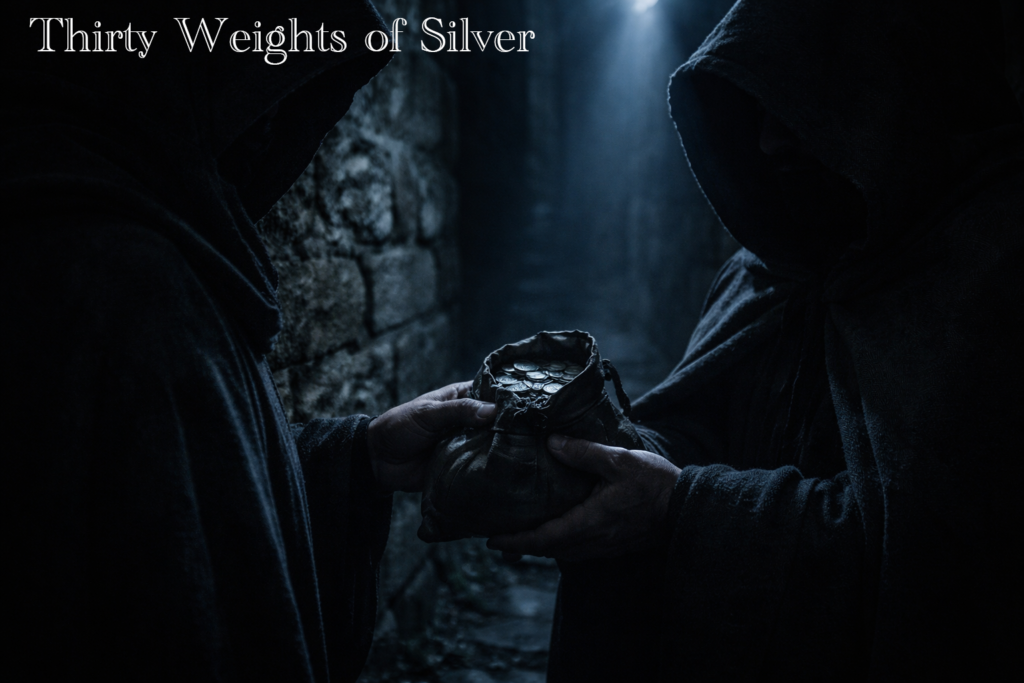
Thirty pieces of silver. Counted into a hand in the dark, somewhere in Jerusalem, while the city was still full of Passover pilgrims and the smell of sacrifice still hung in the air from the Temple courts. The amount was not arbitrary. Zechariah 11:12 names it as the price a shepherd receives when dismissed—a wage so insulting that G‑d tells the prophet to throw it to the potter. Exodus 21:32 names it as the compensation paid when a slave is gored to death by an ox. Thirty pieces of silver is what something is worth when it is worth very little. Matthew knows exactly what he is citing. The weight of the silver is also the weight of the insult.
What Judas thought he was doing with it is the question the text refuses to answer cleanly—and that refusal is where the essay begins.
The Betrayer and the Field of Blood
Judas Iscariot has been carrying the weight of two thousand years of interpretation, most of it ungenerous. The tradition that accumulated around him—the hooked nose of medieval iconography, the yellow cloak, the permanently sinister role in Passion plays across centuries—tells us more about the communities that produced those images than about the man himself. What the text actually gives us is considerably more complicated and considerably more human.
Matthew’s account frames the thirty pieces of silver as the fulfillment of Zechariah 11:12–13—a prophecy about a dismissed shepherd, the price thrown to the potter in the house of the Lord. This is deliberate Matthean typology, staged rather than incidental, the evangelist constructing the betrayal as the culmination of a prophetic arc. Whether the historical event mapped so cleanly onto Zechariah is a separate question from whether Matthew intends us to read it that way. He does.
What Judas intended is genuinely unclear, and the theories are none of them comfortable. The Gospel of John presents him as a thief who had been stealing from the common purse—a straightforwardly mercenary reading that strips the act of any complexity. The Synoptics are less certain. Some scholars have suggested Judas may have been attempting to force Jesus’ hand—believing that arrest would trigger a Messianic intervention, that the movement would be compelled to reveal its power under pressure, and that the whole transaction would end very differently than it did. If so, the remorse that follows makes a different kind of sense: not the remorse of a man who always intended betrayal, but the remorse of a man who catastrophically miscalculated.
The remorse is in the text and cannot be wished away. Judas returns the thirty pieces of silver to the chief priests and elders, saying I have sinned by betraying innocent blood. They are not interested. What is that to us? See to it yourself. The irony is structural: the men who engineered the arrest are washing their hands of the blood money while Pilate is washing his hands of the blood itself. Everyone is washing. No one is clean.
The priests refuse to put the silver back in the treasury because it is blood money—it is not lawful to put it into the treasury. Their scrupulousness about Temple finance operates in full while they have just condemned an innocent man to death. That irony does not require underlining. It simply sits there in the text, doing its work.
The End Justifies the Means
Then the two deaths. And here the tradition fractures in a way that cannot be harmonized without dishonesty.
Matthew 27:5 says Judas went and hanged himself. Acts 1:18 says he fell headlong, his body burst open in the middle, and all his bowels gushed out—and that the field was purchased with his silver, not the priests’. These are not variations on the same account. They are two different accounts of how Judas died, preserved in two texts from the same broader literary tradition, written in different registers and serving different narrative purposes. The harmonizing tradition that attempts to combine them—perhaps he hanged himself and then fell when the rope broke—is doing the text a disservice. Sit in the tension.
The Acts account is doing something the hanging account is not. A body that bursts open from the inside, that is undone at the center, that spills what it contained—this is theological anatomy. The betrayal has become literalized in the flesh. What Judas carried inside him has destroyed him from within. The body becomes the argument.
Then there is the saying, preserved in Mark 14:21 and Matthew 26:24: woe to that man by whom the Son of Man is betrayed. It would have been better for that man if he had not been born. This is one of the hardest sentences in the Gospel tradition, and it deserves to be treated as such rather than softened into a rhetorical flourish.
In a Jewish framework, the saying invokes the category of one whose portion in the world to come is forfeit—a severity reserved for the gravest transgressions. But the saying also opens a door that cannot be easily closed: if it would have been better for Judas not to have been born, if his role in the Passion was foreknown and foretold, then what exactly is the nature of his guilt? Was he necessary? Could the arrest, the trial, the crucifixion have happened without him? If Zechariah prophesied the thirty pieces of silver, if the scattering of the disciples was foretold in Zechariah 13:7, if the whole sequence was written in advance—then in what sense was Judas freely choosing anything?
Augustine wrestled with this directly in City of G‑d I.17, asking whether Judas’ suicide was compounded sin or the fruit of despair—and concluding that neither the betrayal nor the death that followed can be separated from the question of what Judas knew and chose. For Augustine, the foreknowledge of G‑d does not abolish human freedom; it encompasses it. Calvin, writing in Institutes of the Christian Religion III.23, pressed the predestination question harder: Judas was the instrument of a divine purpose he could not have resisted, and yet his guilt is not thereby diminished. Calvin’s position is coherent and unsatisfying in equal measure. The text does not resolve the tension, and neither do the greatest minds that have sat with it.
That refusal to resolve is not a failure of the text. It is the text being honest about something that cannot be made tidy: that the same act can be foreknown and freely chosen, necessary and culpable, all at once. The tradition that has spent two thousand years trying to make Judas either a villain or a hero is avoiding the harder thing the text is actually asking us to sit with.
The Garden
The garden is called Gethsemane—gat shmanim in Hebrew, the oil press. Jesus goes there with the disciples after the supper, as was apparently his custom during the festival week. John 18:2 notes that Judas knew the place because Jesus often met there with his disciples. It was not a hiding place. It was a habit.
What happens there before the arrest is one of the most humanly exposed moments in the entire Gospel tradition. Jesus prays three times that the cup be taken from him. Three times he returns to find the disciples asleep. The spirit is willing but the flesh is weak—he says it about them, but it describes something he is also living in those hours. The sweat like drops of blood in Luke’s account—whether literal or figurative—is the body registering what is coming. He knows. He goes anyway. That movement from the prayer to the rising and going forward is the moral center of the Passion narrative, and it happens before anyone arrives with torches.
The arrival of the arresting party raises a question that the text handles awkwardly and that scholarship has not fully resolved. Who exactly comes to Gethsemane? The Synoptics speak of a crowd with swords and clubs, sent from the chief priests and elders. John 18:3 mentions a speira—a Roman cohort—alongside officers from the chief priests and Pharisees. A full Roman cohort would be several hundred soldiers, which strains credibility for a night arrest in a garden. The word may be used loosely. But the presence of Roman soldiers at the arrest in John’s account, absent in the Synoptics, is a seam in the narrative worth examining.
The Levitical guard—the temple police force—had jurisdiction over the Temple mount and its precincts. Gethsemane is on the Mount of Olives, outside that jurisdiction. An arrest conducted by temple officers in Gethsemane is legally awkward. The narrative has been shaped by later theological concerns about who bears responsibility for the arrest. That shaping does not necessarily mean the details are invented—historical memory and theological purpose are not mutually exclusive—but it means the seams should be named rather than papered over.
Judas arrives ahead of the arresting party and identifies Jesus with a kiss. The intimacy of the gesture as the instrument of betrayal is something the text does not labor—it doesn’t need to. A kiss is what a student gives a teacher in greeting. The servant of the high priest named Malchus loses his ear to a sword—Peter’s sword in John’s account, an unnamed disciple’s in the Synoptics. In Luke alone the ear is restored. The last healing Jesus performs before his death is the healing of a wound inflicted by his own defender, on behalf of his enemy. The pattern of the ministry compressed into a single gesture.
And then they all fled.
The Scattering
Then all the disciples deserted him and fled. Mark 14:50. It is the most honest sentence in the Passion narrative, and almost certainly among the most historically reliable details in the entire account. No community constructing a founding narrative for religious purposes invents the moment when all its founders ran away. The criterion of embarrassment operates here with full force: this detail survived into the written record because it happened, because it was too well known to suppress, because the people who had been there were still alive when the Gospels were being composed.
But the flight requires the tension it deserves rather than simple moral condemnation.
Had the disciples stayed and been arrested alongside Jesus, what follows does not happen. There is no resurrection community gathered in Jerusalem. There is no Pentecost. There are no letters of Paul, no Gospels, no movement that spreads along Roman roads to the edges of the empire. The scattering that looks like abandonment—that is abandonment, in the plain human sense—is also the condition of possibility for everything that follows. The grain of wheat must fall into the ground alone. The shepherd is struck so that the sheep scatter, and the scattering is what preserves them to be gathered again.
This does not excuse the flight. It complicates it. Both things are true at once, and the tradition that sentimentalizes the disciples into heroes or condemns them as cowards is avoiding the harder reading the text is actually offering.
Peter is the most complicated figure here precisely because he does not simply flee. He follows at a distance—to the courtyard of the high priest, close enough to warm himself at a fire, close enough to be recognized by a servant girl, close enough to be asked three times whether he knows the man. And three times, before the cock crows, he says he does not. His partial courage produces a more complete failure than simple flight would have. The others ran and were absent. Peter stayed and denied. Which is worse is a question the text leaves to the reader, because what the text is actually interested in is what comes after: the rock on whom the community is built is the man who, in the moment of crisis, said three times that he did not know his teacher.
The predestination question does not release us here. Jesus had quoted Zechariah 13:7 at the Last Supper—strike the shepherd and the sheep will scatter—as explicit prediction of exactly this moment. The scattering was foretold. Peter’s denial was foretold—the cock crowing before three denials, Jesus naming it at the table before it happened. If it was foretold, was it inevitable? If it was inevitable, in what sense were the disciples choosing? The same question that haunts Judas haunts Gethsemane. The text will not close it. It is not the kind of question that closes.
The Trial and Its Machinery
What happens between the arrest in Gethsemane and the crucifixion on Golgotha involves two distinct proceedings—one before Jewish authorities and one before Rome—and both have been subject to centuries of theological construction that makes the historical substrate difficult to see clearly.
The Sanhedrin hearing is the first problem. Jewish law as codified in the Mishnah, tractate Sanhedrin, prohibits capital trials at night, on the eve of a Sabbath or festival, and requires a minimum of two sessions on consecutive days before a death sentence can be pronounced. The Passion narratives place the hearing at night, during Passover. Whether the Mishnaic regulations were in force in their later codified form during the first century is debated—the Mishnah was compiled after 70 CE, and rabbinic law developed considerably in the aftermath of the Temple’s destruction. But the legal problems with the proceedings as described are real, and naming them is not an attack on the tradition. It is reading it carefully.
What likely occurred is an interrogation rather than a formal trial in the technical legal sense—a preliminary examination by Temple authorities to establish the charge before handing the matter to Roman jurisdiction. Rome reserved the right of capital punishment to itself. Jewish authorities could not execute. Whatever determination the Sanhedrin reached, the death sentence required Pilate.
Aquinas, in Summa Theologica III, Q.47, asks who bears the cause of the Passion—and gives an answer carefully structured to distribute rather than concentrate guilt. Christ willed his own death as an act of obedience; those who handed him over acted from malice and ignorance in varying degrees; even Pilate’s complicity is examined with precision. What Aquinas will not do is place collective guilt on any people. That precision matters, and it stands in sharp contrast to what would come later.
Which brings us to Pilate, and the need to see him clearly.
The Gospel portrait of Pontius Pilate is of a reluctant administrator, genuinely uncertain of Jesus’ guilt, pressured by a mob into a verdict he does not want to give. This portrait requires significant historical correction. Philo of Alexandria, in Legatio ad Gaium 299–
305, describes Pilate in terms that bear no resemblance to the Gospel figure: a man of inflexible, merciless, and obstinate character, whose administration was marked by briberies, insults, robberies, outrages, wanton injuries, executions without trial, and endless savage ferocity. Josephus, in Antiquities of the Jews XVIII.3, records multiple incidents in which Pilate deliberately provoked Jewish religious sensibility. This is not a man who agonized over the execution of a Jewish teacher from Galilee.
David Flusser of the Hebrew University, a major Israeli scholar of early Christianity and Second Temple Judaism, brought a distinctive analytical lens to the trial narrative in Jesus. Reading the proceedings as a historian fluent in Second Temple Jewish institutional life, Flusser’s work points toward the conclusion that the portrait of Jewish leadership as the primary engine of the crucifixion reflects the social pressures facing the communities that produced the Gospels far more than it reflects how the proceedings actually unfolded. A Jewish scholar working in that direction is not a minor corroboration. It is the argument approached from the inside.
The Gospel Pilate is a diplomatic construction, and understanding why that construction was necessary is more important than pretending it is historically accurate. A movement spreading through the Roman empire needed Rome to be exonerated. As Christianity moved into Gentile majority communities and sought legal tolerance from Roman authorities, a narrative in which Pilate tried to free Jesus and was overruled by Jewish pressure served real institutional needs. The cost of that construction—the transfer of primary guilt from Roman imperial machinery to Jewish leadership—has been paid, at compound interest, across two thousand years of Christian anti-Judaism.
Barabbas is where the historical and the theological become genuinely difficult to separate, and the essay should not pretend otherwise.
The custom of releasing a prisoner at Passover as a gesture of goodwill to the Jewish population has no corroboration outside the Gospels. No Roman source mentions it. No Jewish source mentions it. That does not prove it did not exist—absence of evidence is not evidence of absence, and Roman administration was capable of tactical gestures toward subject populations. But it cannot be verified, and saying so is honesty rather than skepticism.
The name itself is where the text becomes most theologically charged. Barabbas is Bar Abba in Aramaic—son of the father. The crowd is choosing between two men who can be designated son of the father: one who has taken up arms and killed, one who has refused violence and healed. Whether or not the custom of Paschal release was historical, whether or not Barabbas was a historical figure, the scene the Gospel constructs is doing unmistakable theological work. A narrative can be historically unverifiable and theologically purposeful simultaneously. That is not a contradiction. That is how the Gospel writers worked—as theologians with sources, not as journalists with notebooks.
The Blood and Its Aftermath
Matthew 27:25 requires its own sustained treatment because it is not merely a verse. It is a wound that has not yet fully healed.
His blood be on us and on our children. In its original context—a crowd in a public proceeding invoking standard legal language of accepting responsibility for a verdict—the phrase is formulaic. It appears in analogous forms elsewhere in the Hebrew Bible. Nothing in its original first-century Jewish setting implies a hereditary curse, a permanent indictment across generations, a theological designation of collective guilt for all Jews in all times. That reading was a construction, and it was a deliberate one.
When the verse likely entered the tradition is a matter of scholarly debate. The most defensible position is that it reflects Matthean redaction in the aftermath of 70 CE, when the destruction of Jerusalem was already being interpreted in some Christian circles as divine punishment for the rejection of Jesus. A community trying to explain catastrophe reaches for the explanation that confirms its existing narrative. The verse is doing apologetic work for that community. That is not a charitable reading. It is an accurate one.
What it was subsequently transformed into is one of the most consequential distortions in religious history. The blood curse—the permanent, hereditary, collective guilt of the Jewish people for the death of Jesus—became a foundation of Christian teaching for nearly two millennia. It authorized the pogroms, the expulsions, the blood libel, the charge of deicide that Nostra Aetate would not formally repudiate until October 28, 1965. It generated the theological conditions in which the Holocaust became possible within a civilization that called itself Christian.
And it lived not only in doctrine. It lived in performance. And it found, in the sixteenth century, its most consequential modern architect.
Martin Luther had not always spoken of the Jews this way. His early writing, That Jesus Christ Was Born a Jew(1523), argued for tolerant engagement—not from respect, but from the missionary hope that Jews might be converted to the reformed faith once freed from Catholic distortion. When that conversion did not come, tolerance curdled into something far darker. By 1543, Luther had produced Von den Jüden und ihren Lügen—On the Jews and Their Lies—a systematic, vicious document that drew directly on the blood curse tradition and went considerably further. He called for the burning of synagogues, the destruction of Jewish homes, the confiscation of Jewish writings, the prohibition of rabbis from teaching, and the forced labor of Jewish people. He was not a fringe voice. He was the most influential Protestant theologian in Europe, a man whose name was already attached to a reformation that was reshaping the continent.
Luther did not invent Christian anti-Judaism. He received a tradition already centuries old—patristic polemic, the blood libel, the charge of deicide—and he enhanced, expanded, and intensified it, giving it fresh theological justification at the precise moment when his personal authority was at its historical height. The Reformation that shattered one form of ecclesiastical power did not dismantle the antisemitic theological substrate. Luther rebuilt it with new timber and handed it to a Protestant world that carried his name. He stands, without serious rival, as the most influential architect of modern Christian anti-Judaism.
The line from Von den Jüden und ihren Lügen to the twentieth century is not a long one. Nazi propagandists cited Luther approvingly. Julius Streicher, on trial at Nuremberg, invoked Luther in his defense. The ideology that would, centuries later, produce the gas chambers did not emerge from nowhere. It grew in soil that Christian theology had been preparing for centuries—and Luther had fertilized it more thoroughly than almost anyone before him.
And it lived not only in doctrine and text. It lived in performance.
In 1633, the village of Oberammergau in Bavaria was in the grip of the plague sweeping Europe during the Thirty Years’ War. The village made a vow: they would perform the story of the Passion of Christ every ten years, and in return they asked to be spared. The plague stopped. They have kept the vow across nearly four centuries—through the Enlightenment, through the Napoleonic wars, through two world wars, into the twenty-first century. The cast is drawn entirely from village residents; to perform in the Passion Play you must be born in Oberammergau or have lived there for twenty years. It is one of the longest continuous traditions of embodied religious performance in the world.
For most of that history, the script carried the blood curse in its full force. The Jewish characters were portrayed in the terms that centuries of Christian anti-Judaism—Catholic and Protestant alike, patristic and Lutheran alike—had established: conspiratorial, bloodthirsty, the engineers of an innocent man’s death. The 1934 production was reviewed approvingly by Adolf Hitler and Nazi circles, who attended at least one performance.
Nostra Aetate—the Declaration on the Relation of the Church with Non-Christian Religions—was issued by the Second Vatican Council on October 28, 1965. It formally repudiated the charge of collective Jewish guilt for the crucifixion, stating that what happened in the Passion cannot be blamed upon all Jews then living, nor upon the Jews of today. It was a formal reversal of a position the Church had carried, in various forms, for nearly two millennia.
The Oberammergau script was not substantially reformed until the 1990 and 2000 productions—twenty-five to thirty-five years after Nostra Aetate. The gap between the formal declaration and the living practice is not an anomaly. It is the rule. Doctrine travels faster than culture. Institutional repentance moves through official channels long before it moves through the embodied practice of communities that have been performing a narrative for four hundred years. A verse inserted into a Gospel in the first century was still being performed in a Bavarian village square in the twentieth century, shaping how a watching audience understood who was responsible for the death of Jesus.
Matthew 27:25 did not remain confined to the text. It was carried forward into history, and the bodies it walked over are beyond counting.

Discover more from Many Lamps, One Flame
Subscribe to get the latest posts sent to your email.