
A Special Pascha Essay—Part Four of Five
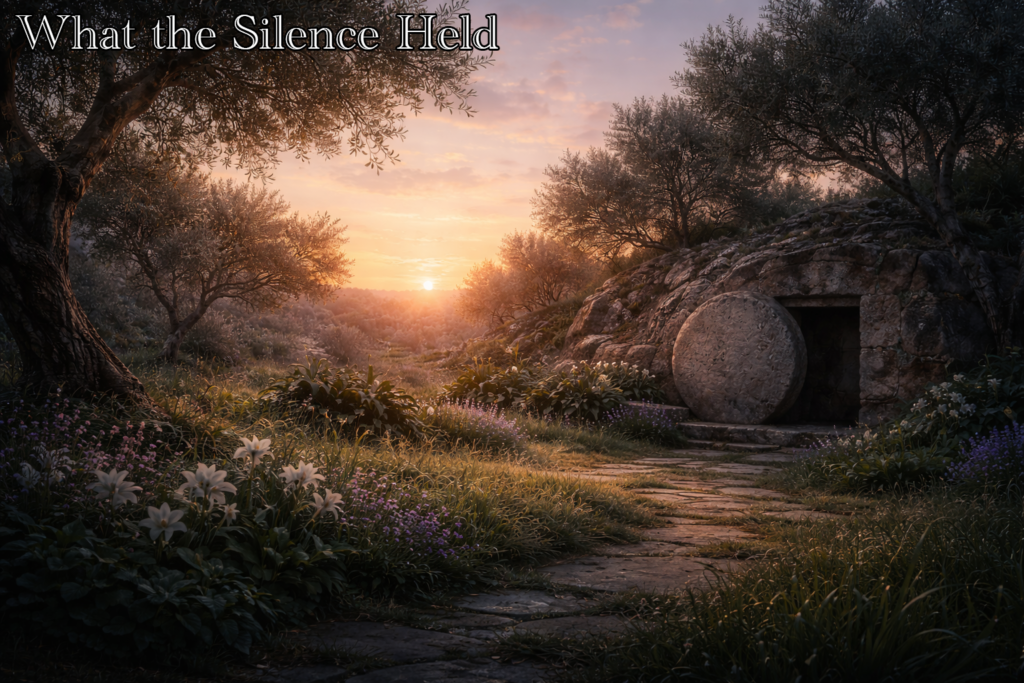
The city is quiet. Shabbat is ending. The first pale suggestion of light has not yet reached the horizon over Jerusalem, and the streets are empty in the way that streets are only empty when something has just finished and something else has not yet begun. In a garden outside the city walls, a stone seals a tomb. Soldiers stand watch. The Passover pilgrims who swelled the city to bursting five days ago have begun the long journey home.
The silence the tomb is holding is the silence that the entire series of essays has been moving toward—the silence after the silver was counted in the dark, after the prayer in the garden and the flight, after the trial and the machinery of empire grinding forward, after the wood and the nails and the seven last words and the stone rolled into place at sundown. Four pieces of writing have been building toward this silence. The question is what it holds.
The women know where the tomb is. They are already preparing to go back.
The Empty Tomb
They come to finish what Shabbat interrupted. Not to witness a miracle—to tend to a body. They bring spices for burial preparation, arriving at first light, asking each other on the way who will roll the stone back for them. That question is in the text. They are not expecting what they find.
The stone is already rolled back. The tomb is empty.
What happens next the four Gospels cannot agree on, and the disagreements are not trivial or easily harmonized. Mark 16:1–8—almost certainly the earliest Gospel, and what many scholars regard as the original ending before later hands added verses 9–20—has a young man in white sitting inside the tomb. He tells the women that Jesus has risen and instructs them to go tell the disciples. The women flee. They say nothing to anyone, for they were afraid. That is where the original Mark ends. No appearances. No reunion. No triumph. An empty tomb, a mysterious figure, terrified women, and silence.
Matthew 28 has an earthquake and an angel whose appearance is like lightning and whose clothing is white as snow. Luke 24 has two men in dazzling clothes. John 20 has two angels in white sitting where the body had been, one at the head and one at the feet, and then Mary Magdalene alone outside the tomb, weeping, encountering a figure she takes for the gardener. The number of figures, their description, what they say, who is present—none of it aligns across the four accounts. This is not a problem to be resolved by harmonization. It is evidence of independent streams of memory, each reaching for the same event from different angles, each shaped by the theological concerns of its community.
What the empty tomb alone establishes is limited and must be stated clearly. It establishes that the tomb was found empty. It does not establish what happened to the body. The possibilities the tradition itself acknowledges—theft, relocation, resurrection—are the same possibilities historians have debated ever since. The empty tomb is the beginning of the question, not the answer to it. The answer, if there is one, comes from what happened next.
She Supposed Him to Be the Gardener
Mary Magdalene is alone at the tomb in John 20:1–18, weeping, when she encounters the risen Jesus. She does not recognize him. She supposes him to be the gardener—which is either a failure of perception or a recognition the text is deliberately deferring—until he speaks her name.
Mary.
And she turns. And she says Rabboni—my teacher. In Aramaic. The most intimate address in the text, the language of her formation, the word that a student uses for the teacher to whom she has given her allegiance.
She is then sent: go and tell my brothers. The word for sent is the root of apostolos—apostle. She is sent by the risen Christ himself to announce the resurrection to the other disciples. She is the first witness and the first one commissioned. The tradition eventually called her apostola apostolorum—the apostle to the apostles—though it took centuries for that designation to be taken seriously, and the weight of patriarchal church structure worked consistently to suppress it.
The evidentiary point is the same we noted at the cross: no one constructing a resurrection narrative for strategic effect in a first-century Jewish context makes a woman the primary witness unless that is what the tradition remembered. The criterion of embarrassment applies here with the same force it applies to the disciples’ flight. This detail is in the text because it happened.
The garden itself is doing something in John’s account. The crucifixion was near a garden. Gethsemane was a garden. And now the resurrection happens in a garden, before sunrise, with a woman’s name spoken in the dark. John is reaching back to Genesis—to the first garden, the place of original rupture, the ground from which humanity was expelled. The resurrection happens in a garden. The reversal is geographical before it is theological.
On the Road: The Scriptures Opened
The road to Emmaus—Luke 24:13–35—is the richest of the resurrection accounts and the one that most directly names what the entire preceding tradition was doing.
Two disciples, not of the Twelve, walking from Jerusalem to Emmaus—seven miles, three hours on foot, the whole weight of the weekend pressing on them. A stranger joins them on the road and asks what they are discussing. They are astonished that anyone in Jerusalem doesn’t know. They tell him everything: the arrest, the condemnation, the crucifixion, and now this—some of the women went to the tomb and found it empty, and angels said he was alive, but they had not seen him.
The stranger’s response is not comfort. It is exegesis.
O foolish ones, and slow of heart to believe all that the prophets have spoken! Was it not necessary that the Christ should suffer these things and enter into his glory? Then, beginning with Moses and all the prophets, he interprets to them in all the scriptures the things concerning himself.
Luke does not quote what he said. He gives us the frame and leaves the content to the reader’s knowledge—which is an invitation. We know what was there on those seven miles of road, because we know what the scriptures contain.
The suffering servant of Isaiah 52–53: he was despised and rejected by men, a man of sorrows and acquainted with grief; surely he has borne our griefs and carried our sorrows; he was pierced for our transgressions, crushed for our iniquities; upon him was the chastisement that brought us peace, and with his wounds we are healed. No passage in the Hebrew Bible has generated more interpretive controversy, more contested ground between Jewish and Christian reading traditions. On the road to Emmaus, the stranger is walking them through it—not superseding the Jewish reading, not replacing it, but offering a reading from within the text that the Christian tradition would make its own across the centuries.
The pierced one of Zechariah 12:10: they will look on me, the one they have pierced, and they shall mourn for him as one mourns for an only child. Already cited in John’s account of the spear thrust at the cross. On the road it is being read backward from the event into its prophetic root—the text illuminating what happened and what happened illuminating the text.
Psalm 22—which began with the cry of dereliction from the cross and ends in vindication that reaches forward across generations: they will proclaim his righteousness to a people yet unborn: he has done it. The Psalm that Jesus quoted dying is the Psalm that ends in a declaration that something has been accomplished. The stranger on the road is showing them that the cry of abandonment was not the end of the Psalm—that the disciples had stopped reading too soon.
Daniel 12:2: and many of those who sleep in the dust of the earth shall awake, some to everlasting life, and some to shame and everlasting contempt. The resurrection hope embedded in the prophetic tradition, the expectation that had been developing across the Second Temple period. The stranger is showing them that what happened three days ago belongs to a conversation the tradition had already been having—that it is not a rupture in the story but its turning point.
The Passover lamb. The blood on the doorposts. The korban Pesach whose blood marked the threshold and turned death aside. The cup of redemption poured in the upper room. The thread that began at the first Passover has been running through everything—through the Temple sacrifice, through the supper in the upper room, through the cross on the 14th of Nisan, and now through a road walked in the late afternoon where a stranger opens the scriptures to show that the lamb and the blood and the cup were always pointing here.
This is the methodology of this entire series enacted on a road. Beginning with Moses and all the prophets. Finding what was buried beneath the surface of a familiar text. Excavating what the tradition was always reaching toward beneath the layers of conventional reading. What the stranger does in seven miles of walking is what this series has been attempting across four pieces: showing that the depth was always there, that the connections were always real, that the fire beneath the many lamps has been the same fire from the beginning.
They arrive at Emmaus. It is evening, the day far spent, and they urge him to stay. He takes bread. He blesses it. He breaks it. He gives it to them.
And their eyes are opened.
And they recognize him.
And he vanishes from their sight.
The moment of recognition is not intellectual—it is not the argument that opens their eyes, though the argument was real and the hearts were burning with it for seven miles. The recognition comes in the breaking of bread. The same gesture that transformed the Passover meal in the upper room, that the disciples had watched from his hands on the night of the arrest, that has been carried forward in the community’s practice since—that gesture, enacted at a table in Emmaus, is the point of contact between the living Jesus and the risen one. Zachor again. Memory as re-enactment, the past made present in a repeated action.
Did not our hearts burn within us while he talked to us on the road, while he opened to us the scriptures?They felt it before they understood it. Truth registered in the body before the mind caught up. The burning heart is the oldest form of recognition.
They get up immediately. It is night. The road is dark. They have just walked seven miles. They walk back to Jerusalem.
That reversal—turning back toward the city they had been leaving in defeat, walking toward it in the dark carrying something they have to tell—is the resurrection in miniature. The direction of travel changes. That is what the resurrection does.
The Room, the Wounds, and the Doubter
The upper room—doors locked, the community sealed inside its fear. Jesus appearing among them without the doors opening: Shalom. Peace. Not triumph. Not rebuke for the flight and the denial. Not a reckoning. Peace.
The wounds are shown, not hidden. Hands and side. The risen body carries the marks of what was done to it. Augustine, treating the resurrection body in City of G‑d XXII, argues that the marks of martyrdom belong to the resurrection body not as defects but as ornaments—the wounds of the Passion carried forward as part of the risen identity. The body that suffered is the body that rose.
Thomas is absent the first time. When told, he will not believe without physical evidence: unless I see in his hands the mark of the nails, and place my finger into the mark of the nails, and place my hand into his side, I will never believe. Eight days later Jesus appears again, and Thomas is given exactly what he asked for. My Lord and my G‑d—the highest Christological confession in the entire Gospel of John, spoken by the one who doubted, in the moment of being met in his doubt rather than punished for it.
Aquinas, in Summa Theologica III, Q.55, treats the appearances systematically—why they were necessary, why they were not continuous, why Thomas’s doubt was providentially useful. His answer to the Thomas question is characteristically precise: the doubt of Thomas serves the faith of those who come after, because his insistence on evidence and the record of his being met in it provides a form of testimony that confident belief alone could not. The doubter becomes, paradoxically, a witness more useful to later generations than the ones who believed without requiring evidence.
Calvin, in the Institutes II.16, insists that the resurrection cannot be separated from the crucifixion as a distinct event—together they constitute one saving act, neither complete without the other. The death without the resurrection is defeat. The resurrection without the death is spectacle. The structural point—that the resurrection is inseparable from what preceded it, that it cannot be understood apart from the cross and the tomb and the Passover that preceded those—is exactly what the series has been building.
Matthew’s Galilee appearance—the eleven on a mountain, some worshipping, some still doubting, and the Great Commission given to both groups without distinction. The doubters receive the commission alongside the worshippers. The resurrection community is not constituted by certainty. It is constituted by the commission given across the gap of unresolved uncertainty.
John’s epilogue at the lake—the disciples fishing all night, catching nothing, a figure on the shore calling to them, the net suddenly unable to be hauled in. The beloved disciple recognizing him first: It is the Lord. Peter throwing himself into the water. Breakfast on a charcoal fire by the shore—fish and bread, an ordinary meal. And then the three-fold restoration: do you love me? One question for each denial, the same number, the wound addressed directly and without drama over an ordinary meal by the shore of the lake where the ministry began.
The Earliest Account
1 Corinthians 15, written in the 50s CE, before any Gospel reached its final written form. The earliest resurrection testimony we possess, in Paul’s own hand.
For I delivered to you as of first importance what I also received: that Christ died for our sins in accordance with the scriptures, that he was buried, that he was raised on the third day in accordance with the scriptures, and that he appeared to Cephas, then to the twelve. Then he appeared to more than five hundred brothers at one time, most of whom are still alive, though some have fallen asleep. Then he appeared to James, then to all the apostles. Last of all, as to one untimely born, he appeared also to me.
Five hundred witnesses at once—no Gospel mentions this. An appearance to James, Jesus’ brother, who was not a disciple during the ministry and who appears in the Gospel tradition as skeptical of Jesus during his lifetime. James becomes, after this encounter, the leader of the Jerusalem community. The appearance to Paul himself, placed last—ektroma, untimely born, a premature infant, one born out of sequence, outside the normal order.
Paul’s account does not mention the empty tomb. He does not describe appearances in physical terms. He is handing on a tradition he received and adding his own encounter to the list, treating it as belonging to the same category as all the others. Whether Paul’s Damascus road experience was visionary, experiential, or physical in the same sense as the Gospel appearances—Paul does not say. What he says is that it happened and that it changed everything.
Then the argument that has no parallel in the New Testament for sheer logical directness: if Christ has not been raised, your faith is futile and you are still in your sins. Then those also who have fallen asleep in Christ have perished. If in Christ we have hope in this life only, we are of all people most to be pitied. Paul is not offering sentiment. He is stating the load-bearing wall of the entire structure. Remove the resurrection and the building falls. He knows it, says it plainly, and does not flinch from the implication: if this is not true, we are to be pitied above all people.
The Man from Tarsus
Saul of Tarsus—whom Acts presents as a Pharisee trained under Gamaliel—was zealous for Torah and actively persecuting the early Jesus movement. Acts also records his presence at the stoning of Stephen—the first martyr, whose death is recorded in Acts 7—and was on his way to Damascus with letters authorizing arrests when the encounter happened.
Three accounts appear in Acts—Acts 9, Acts 22, Acts 26—and they do not fully agree. In one account his companions hear the voice but see nothing; in another they see the light but hear nothing. The inconsistency is in the text and should be named rather than harmonized. Accounts of transformative encounters often contain this kind of variability. The inconsistency does not diminish the event; it is characteristic of how such events are remembered and transmitted.
In Galatians 1:11–17, Paul describes it himself, insisting on the independence of his testimony from human transmission: I did not receive it from any man, nor was I taught it, but I received it through a revelation—apokalypsis—of Jesus Christ. Not a vision. Not a physical appearance in the Gospel sense. An apokalypsis—an uncovering, a drawing back of the veil, the language of prophetic commissioning. He who had set me apart before I was born and called me by his grace was pleased to reveal his Son to me. This is Jeremiah’s language. Isaiah’s language. Paul is placing his encounter in the tradition of the Hebrew prophets called from before their birth, not in the tradition of the Easter morning appearances.
The man who hunted the followers of Jesus becomes the movement’s most prolific theologian and letter-writer, the one whose thought shapes Christian doctrine more than any of the Twelve. He never met Jesus during the ministry. He received no instruction from the Jerusalem apostles—he insists on this in Galatians, passionately, because his authority depends on the independence of his call. He is the anomaly, the one untimely born, whose testimony cannot be fully assimilated to the Gospel appearance narratives—and whose theological interpretation of the resurrection becomes the foundation on which Augustine, Aquinas, Calvin, and every subsequent Christian systematic theology is built.
What Judaism Knew
The resurrection claim did not land in a theological vacuum. Second Temple Judaism had been developing a resurrection theology across the centuries preceding the first, and what Jesus’ followers were claiming was both continuous with that development and unprecedented in a specific way that requires careful attention.
The Sadducees—the Temple priestly aristocracy whose political role shaped the trial and crucifixion—did not believe in resurrection. They read Torah strictly, and resurrection as a doctrine does not appear explicitly in the Five Books of Moses. The Pharisees believed in it, drawing on Daniel 12:2, on Isaiah 26:19, on the theology of bodily resurrection as divine vindication that had developed in the Maccabean period among those who died for Torah. The disagreement was live and active—Paul exploits it brilliantly when on trial before the Sanhedrin in Acts 23, declaring himself a Pharisee and saying the whole case against him concerns the resurrection of the dead, immediately fracturing his accusers along sectarian lines.
The Pharisaic resurrection was eschatological—general, at the end of days, for all the righteous. What the earliest followers of Jesus were claiming was different in kind: the particular resurrection of a specific individual, in the middle of history, as the firstfruits and guarantee of the general resurrection to come. N.T. Wright, in The Resurrection of the Son of G‑d, has argued with extraordinary thoroughness that this specific claim has no adequate precedent in Jewish thought and no adequate explanation short of the event itself. The disciples were not claiming that Jesus had gone to heaven, or that his spirit survived, or that he lived on in their memory. They were claiming something their own tradition had no category for—and the very novelty of the claim is part of its historical credibility.
David Flusser of the Hebrew University, one of the most significant Israeli scholars of early Christianity and Second Temple Judaism in the twentieth century, approached the resurrection question with the rigorous historical seriousness it deserves. In Jesus, his landmark study, Flusser argues that Jesus is recoverable as a coherent, historically plausible first-century Jewish teacher whose teaching and whose fate make sense within the Judaism of his time. His engagement with the resurrection is neither credulous nor dismissive—it is the engagement of a scholar who takes the historical evidence seriously and refuses to resolve it prematurely in either direction. His voice in this conversation is irreplaceable precisely because of who he is: an observant Jew reading the Gospel accounts as Jewish documents, in their Jewish context, with the tools of a serious Second Temple scholar.
Rabbi David Zaslow and Joseph Lieberman, in Jesus: First-Century Rabbi, approach the same territory from an explicitly rabbinical perspective. Their argument—that Jesus is intelligible as a Jewish teacher who never left Judaism, whose teachings are continuous with the halachic and midrashic tradition of his time—is not a concession to Christianity but a reclamation of a figure the Jewish tradition has too long ceded to Christian interpretation. The resurrection, in their reading, belongs to the conversation Judaism was already having about death, vindication, and the faithfulness of G‑d. They do not resolve the historical question. They insist that it is, properly understood, a Jewish question as much as a Christian one.
The interfaith reach here is genuine and must be stated carefully. The dying and rising pattern—the divine that descends into mortality and returns—appears in traditions far older and wider than Christianity. The framework of many lamps and one flame reads these convergences as evidence of a shared human recognition that the traditions are all reaching toward. What the resurrection adds to that framework is the claim that the recognition became event—that what the traditions were gesturing toward arrived in a specific garden, on a specific morning, to a specific woman who heard her name spoken and turned. Many lamps have carried this flame. The question the resurrection poses is whether the flame was, on one particular morning before sunrise, the source rather than the reflection.
The Question Historians Ask
N.T. Wright’s case for the bodily resurrection as historical event—the most rigorous scholarly argument for the traditional claim—rests on two pillars: the empty tomb, which early Christian preaching in Jerusalem required to be publicly verifiable, and the appearances, attested in multiple independent streams simultaneously. The transformation of the community, Wright argues, is the datum that demands accounting above all else.
Rudolf Bultmann’s demythologizing project—the resurrection as existential truth about human existence rather than historical occurrence—represents the most influential twentieth-century alternative. For Bultmann, the kerygma must be separated from the mythological worldview in which it is embedded; what the resurrection means for human existence in the face of death is accessible independent of the historical question. Many serious theologians have found this position untenable—it empties the specific claim of its content—but Bultmann named honestly that the historical question and the existential question are not the same question.
Gerd Lüdemann’s subjective vision hypothesis—the appearances as genuine psychological experiences generated by grief, guilt, and the cognitive processes of a traumatized community—attempts to account for the transformation of the disciples without positing a historical resurrection. The hypothesis has been challenged on historical grounds: it does not adequately explain the transformation of Paul, who was not grieving Jesus but persecuting his followers, or of James, who was skeptical during the ministry.
E.P. Sanders, in The Historical Figure of Jesus, treats the resurrection appearances as among the most historically secure facts about early Christianity—not because he adjudicates the supernatural question, but because the transformation of the disciples is a datum that requires explanation regardless of one’s metaphysical commitments. Something happened. The debate is about what.
The criterion of embarrassment applied to the women’s testimony. The criterion of multiple attestation applied to the appearance traditions—Paul, Mark, the Q material, John’s independent tradition, multiple streams simultaneously, none of them derived from the others. The sociological implausibility of a deliberate fabrication maintained under the conditions of first-century Jerusalem, where the tomb could be checked and witnesses were alive. These are the tools historians use, and they converge on the conclusion that something historically significant occurred, even if what that something was remains the most contested question in the history of religion.
The hardest historical position to sustain is that nothing at all happened. The disciples who fled the garden did not stay fled. Something turned them around. Something sent them back to Jerusalem. Something transformed a scattered and terrified community into a movement that, within a generation, had spread across the Roman empire and beyond. The stone was rolled back. The tomb was empty. A woman in a garden heard her name and turned.
What the silence held is still being argued about. That it held something is, at minimum, the hardest position to dismiss.
The Name Spoken in the Garden
Return to Mary. The pale light before sunrise. The stone rolled back. The weeping outside the empty tomb, and then the figure she takes for the gardener, and then the word that changes everything.
Mary.
Two thousand years of theology have been trying to say what happened in that moment. Councils have convened. Creeds have been composed in Greek and Latin and every language the faith traveled into. Philosophical frameworks have been imported, refined, discarded, and rebuilt. The argument continues, as it should, because the claim is enormous and the stakes are real and honest engagement with it requires more than credulity or dismissal.
The text is content to show a woman in a garden hearing her name and turning.
This series began at a table, with bread broken and a cup poured and a servant kneeling before those he was about to feed. It passed through the dark of Gethsemane and the machinery of empire and the long hours on the cross and the silence of the sealed tomb. Four pieces of writing, each one trying to recover what has been buried beneath the accumulated weight of two thousand years of institutional interpretation, polemical distortion, and theological overlay. Beginning with Moses and all the prophets. Finding the good wood beneath the rotted wood.
The resurrection is where excavation reaches its limit. There is no institutional layer to strip away here, no polemical construction to dismantle, no conventional reading that flattens a deeper one. There is only the empty tomb and the appearances and the burning hearts on the road and the broken bread and the name spoken before sunrise. The tradition that followed—the councils, the creeds, the philosophical frameworks—was trying to say what that meant. The Emmaus road shows us how: beginning with Moses and all the prophets, opening the scriptures, following the thread from the Passover lamb through the suffering servant through the pierced one through the cry of dereliction to the vindication the Psalm always contained.
The lamps are many. They have been burning across traditions and centuries, each one lit by the same flame, each one carrying the light in a different vessel. The question the resurrection poses to every tradition, and to every reader who has come this far through this series, is not whether they accept the doctrine. The question is whether they can feel what the disciples on the road felt—the burning heart, the recognition that comes before understanding, the moment when the bread is broken and the eyes are opened and the familiar thing that was always there becomes suddenly, unmistakably visible.
The women knew where the tomb was. They came back when Shabbat was over.
They found it empty.
And the silence that the tomb had held across the Shabbat was not the silence of an ending. It was the silence before a name is spoken.
Mary.

Discover more from Many Lamps, One Flame
Subscribe to get the latest posts sent to your email.