
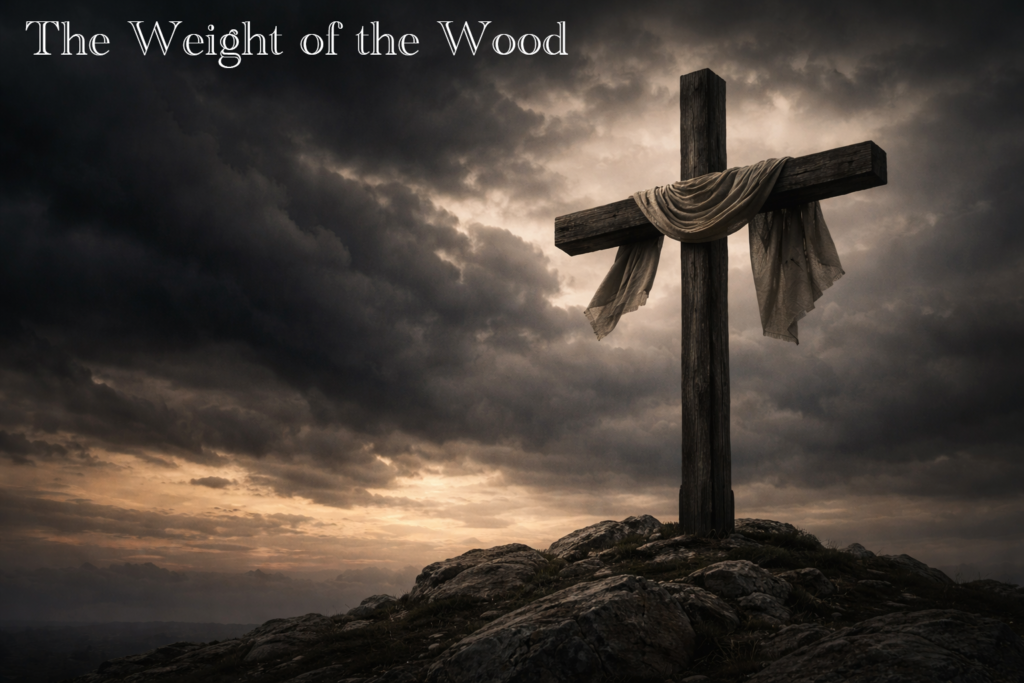
A Special Pascha Essay—Part Three of Five
The Greek word is stauros—a term that can denote an upright stake or a cross structure more broadly; the exact shape is not specified by the text. The T-shaped cross of Christian iconography, the crux immissa of later tradition, is not specified by the text and was not established by early Christian art. The shape solidified gradually across the first several centuries of the Common Era. What the word stauros tells us is that there was a vertical element. What that vertical element actually looked like is less certain than two millennia of paintings, sculptures, and devotional objects suggest.
What archaeology gives us is more specific—and more brutal. In 1968, construction workers in the Givat HaMivtar neighborhood of Jerusalem uncovered a first-century ossuary containing the bones of a man named Yehohanan. Through his right heel bone, an iron nail—still embedded—had been driven. This is the clearest direct physical evidence of crucifixion from the ancient world. It confirms the method but also its variability: Yehohanan’s arms appear to have been tied rather than nailed, the position differing from the standard iconographic depiction. Crucifixion was not a single standardized procedure. It was a form of execution adapted by its practitioners to circumstance, terrain, and the supply of materials.
The Road to Golgotha
What preceded the cross was the flogging—the flagellum, a whip with multiple leather strands weighted with bone or metal. Roman flogging before crucifixion was not symbolic. It was designed to weaken the condemned to the point where death on the cross would come more quickly. The body that arrived at Golgotha had already been significantly damaged.
The condemned carried not the full cross but the patibulum—the crossbeam—which would be attached to a vertical post already set in place at the execution site. The procession through the city was not incidental. It was theater—a public enactment of Roman power, a visible deterrent walked through populated streets so that everyone could see what awaited those who challenged imperial authority. The route mattered. The crowd mattered. The spectacle was the point.
It was during this procession that Simon of Cyrene was conscripted to carry the crossbeam when Jesus could no longer manage it. The right of angaria—compelled service—allowed Roman soldiers to draft civilians without consent. Simon was a Diaspora Jew in Jerusalem for Passover, from Cyrene in North Africa, coming in from the country when the procession passed. He was pulled from the crowd without being asked, made to carry the instrument of a stranger’s execution through the streets of the city.
Mark 15:21 names his sons: Alexander and Rufus. That detail is extraordinary. Mark names them as though his audience knows them—which almost certainly means they were known figures in the early Christian community. The father conscripted to carry the cross becomes, through some subsequent path the text does not trace, the father of men known to the community that produced the earliest Gospel. The compelled stranger at the edge of the story turns out to have a family that ended up inside it.
The canonical Gospels record little else of the procession. But the tradition has never been content to leave it bare. The Stations of the Cross—the devotional practice that walks the Passion journey in fourteen (or in some traditions fifteen) movements from condemnation to burial—developed within the Church as a way of inhabiting the road that the Gospels sketch only in outline. The impulse is ancient: pilgrims had been walking the actual streets of Jerusalem from the earliest centuries of Christianity, tracing what they believed to be the route Jesus walked. When that physical pilgrimage was impossible for most Christians, the Stations made it spiritually available anywhere. Francis of Assisi’s profound devotion to the Passion was the root of the Franciscan investment in the practice; it was Franciscan friars who, in the fourteenth and fifteenth centuries, formalized and spread the Stations across Europe. Pope Clement XII standardized the fourteen traditional stations in 1731, though the practice was already woven into church architecture long before—carved or painted panels along the nave walls of medieval churches, outdoor stations in monastic gardens and pilgrimage fields, indoor versions that allowed the faithful to make the Jerusalem walk in any parish.
The traditional fourteen stations include three falls under the weight of the cross. They include the encounter between Jesus and his mother on the road. They include Veronica—the woman who steps from the crowd to wipe his face with a cloth, whose cloth tradition says retained the image of his face, the vera icon, the true image. None of these appear in the canonical Gospels. They entered the devotional tradition through centuries of contemplative imagination, through the Church’s recognition that the bare narrative needed to be walked slowly and inhabited rather than merely read. John Paul II introduced an alternative set of Scriptural Stations in 1991—fourteen stations drawn entirely from canonical Gospel text—as an acknowledgment that the traditional stations had traveled considerably beyond the text. Both versions remain in use. The traditional fourteen remain standard in most parishes.
The modern Via Dolorosa in Jerusalem—the route marked through the Old City, walked daily by pilgrims from every part of the world—is a medieval construction. The route as marked follows a path established by Franciscan friars in the fourteenth century. The actual route Jesus walked, if the crucifixion occurred near what is now the Church of the Holy Sepulchre—as the overwhelming weight of archaeological evidence suggests—would have passed through a Jerusalem whose street plan was quite different from what exists today. Pilgrims who walk the Via Dolorosa today are walking a tradition, not a survey. That does not make the walk less real. It makes it something other than archaeology. The tradition of embodied re-enactment is its own form of truth, and has been since the first pilgrim set foot on the stones of Jerusalem and tried to imagine what happened there.
The Mechanics of the Cross
The nailing, the position, the mechanics of death by crucifixion: the body suspended from the arms bore its own weight in a way that progressively impaired the ability to exhale. To breathe, the condemned had to push up against the nail through the feet, relieving the pressure on the chest long enough to draw air, then sag back down. The cycle repeated until exhaustion made it impossible to push up any longer, and suffocation followed. Death by crucifixion was death by slow asphyxiation, measured in hours or days depending on the condition of the condemned when they were raised. A man who had been flogged severely before reaching the cross would not last as long as one who had not.
The breaking of legs—the crurifragium—was the Roman method of hastening death when circumstance required it. With the legs broken, the condemned could no longer push up to breathe, and death followed quickly. John 19:31–33 records that the soldiers came to break the legs of the three crucified men, found Jesus already dead, and broke the legs of the other two instead. The centurion’s spear thrust into Jesus’ side—from which blood and water issued—is both a confirmation of death and, in John’s Gospel, a deliberate echo of Zechariah 12:10: they will look on me, the one they have pierced.
The spear did not remain simply an instrument of execution. It became a relic, then a symbol of imperial legitimacy, accreting mythology across the medieval period. The lance now housed in the Habsburg Imperial Treasury in Vienna—known as the Heilige Lanze—was claimed by successive Holy Roman Emperors as a talisman of divine authority, its symbolic power growing with each generation. In the twentieth century that imperial symbolism took a darker turn: after the Anschluss in 1938, the lance was among the objects transferred to Nuremberg, where the Nazi regime sought to drape itself in the vestments of historical legitimacy. The instruments of the Passion became instruments of power. That transformation is its own commentary on what happens when the cross becomes an emblem of empire rather than a symbol of the one who refused it.
The instruments of the Passion became objects of power that then generated their own history. The irony at the center of that transformation is worth naming: the spear that confirmed the death of a man who refused empire became a totem of imperial ambition across two millennia. The cross that was a symbol of the one who washed his disciples’ feet became the emblem of armies. The tradition recognized this corruption and tried, repeatedly, to correct it. It has never fully succeeded.
The Last Words
The seven last words are distributed across four Gospels and are not identical in any two of them. John’s Jesus dies with regal composure—tetelestai, it is finished, a word that means completed, accomplished, brought to its end. Luke’s Jesus dies forgiving—Father, into your hands I commit my spirit. Matthew and Mark give us the only words that cut without theological cushioning:
Eli Eli lama sabachthani—My G‑d, my G‑d, why have you forsaken me.
This is Psalm 22:1, quoted in Aramaic, the cry of dereliction. It is the most raw and the most Jewish of all seven last words—a dying man reaching for Torah in his final moments, quoting the Psalms as a Jewish man in extremis would reach for the language of prayer he has known since childhood. A man on a Roman cross, speaking Aramaic, citing the Hebrew scriptures. Whatever else is happening on Golgotha, this is happening: a Jew is dying with the words of his tradition in his mouth.
Whether Jesus intends the whole Psalm or only its opening verse is a question the text deliberately leaves open. Psalm 22 begins in abandonment—why have you forsaken me, why are you so far from saving me—and ends in vindication: they will proclaim his righteousness, declaring to a people yet unborn: he has done it. The Christian tradition has often read the cry of dereliction as implying the whole Psalm, the ending as present within the opening. Whether that reading deepens or flattens the cry of abandonment is a genuine theological question. The text does not close it. The opening of the mouth that says Eli Eli and falls silent leaves the reader in exactly the position the Psalm’s original speaker occupied: in the dark, before the vindication arrives.
Those Who Stood There
The eleven are not present. The ones who argued about precedence at the Last Supper, who declared they would follow him to death, who reached for swords in the garden—they are nowhere on Golgotha. Their absence from every Passion account is as theologically significant as their presence at the supper.
The ones who are present made no declarations. They asked for nothing. They simply followed, without announcement, to the end of the road.
The Synoptic accounts place the women at some distance—watching from afar, Mark 15:40 says. Among them: Mary Magdalene; Mary the mother of James and Joses (Joseph); Salome; and others of the Galilean company unnamed. These are the women who had followed Jesus from Galilee, who had supported the movement from their own resources, who had been present throughout the ministry without occupying the positions of public prominence that the Twelve held. They are there at the cross, at the burial, and at the empty tomb. They are the thread of continuity across the entire Passion sequence. Without them, there is no thread.
John 19:25 places them closer—standing near the cross, not watching from afar. And John names someone the Synoptics do not place there at all: Mary, the mother of Jesus. She is present in John’s account at the foot of the cross, watching her son die.
Their presence is legally invisible by the standards of the world they lived in—women’s testimony did not carry the same public legal standing in the dominant legal culture of the period. And yet they are the witnesses to everything: to the death, to the place of burial, to the empty tomb on the third morning. No one constructing a resurrection narrative in a first-century Jewish context makes women the primary witnesses unless women were the primary witnesses. The tradition preserves their testimony against its own cultural grain, which is the surest sign that the testimony is genuine.
And the beloved disciple—unnamed as always in the Fourth Gospel, later identified by tradition as John son of Zebedee, though the Gospel itself never confirms this—is the one male disciple present. His presence at the cross is unique to John’s account. The tradition has further identified this figure with the John exiled to Patmos and associated with the Book of Revelation, but that identification involves two separate steps, neither of them certain. The beloved disciple at the cross, the John of the Fourth Gospel, the John of Patmos—these may be the same person, or they may represent overlapping traditions within the Johannine community. What the text will say and what tradition has added deserve to be kept distinct.
What happens between Jesus, his mother, and the beloved disciple in those final moments is among the most compressed and consequential passages in the Fourth Gospel. Woman, behold your son. Son, behold your mother. From that hour, the beloved disciple takes her into his own household. A new family is constituted at the foot of the cross—not biological but covenantal, not inherited but chosen, not the family of origin but the family of the community that will carry what he is leaving behind.
The address woman is not coldness. In John’s Gospel it is the same address Jesus uses at Cana when his mother tells him the wine has run out—and she responds by telling the servants to do whatever he says. In John’s theological vocabulary the address carries more than the personal. Mary at the cross is not only his mother. She is, in John’s reading, the community itself—the assembly of the faithful being entrusted to the beloved disciple’s care. That reading does not diminish the human dimension. It holds both simultaneously, the theological and the irreducibly personal occupying the same moment.
Luke 2:35 records Simeon’s words over the infant Jesus at the Temple presentation, addressed to Mary: and a sword will pierce your own soul too. She has carried that word for thirty years. She is watching it fall.
What she is watching is not a death in the abstract. It is the specific, prolonged destruction of a body she knows better than any other body in the world—the body she carried, labored to bring into the world, nursed, held, watched grow from infant to child to man. She knows every particular of it. And now she stands close enough to see what is being done to it, hour by hour, and she cannot stop any of it and she does not leave.
There is no theological category that fully contains what that is. Doctrine can hold the human and the divine simultaneously—can speak of redemptive suffering and providential purpose and the willing acceptance of the cross—and all of that may be true, and none of it reaches what a mother feels watching her child suffer and die. The grief is not metaphorical. The anguish is not symbolic. The body on the cross is her son, and the hours are long, and she stays.
The Stabat Mater—the grieving mother stood weeping beside the cross where her son was hanging—became one of the most set texts in Western musical history precisely because it does not try to resolve this into doctrine. Pergolesi set it. Vivaldi set it. Dvořák, Verdi, Haydn, Schubert—all of them reaching for the same image across centuries, all of them finding that no formal musical structure fully contains it, that the music keeps straining against its own form because what it is trying to hold keeps exceeding the form’s capacity. The Pietà—Michelangelo’s Mary holding the body of her dead son across her lap—became one of the most reproduced images in Western art for the same reason. The image defeats distance. It does not allow the viewer to remain comfortable.
She stood there. She watched him suffer. She was with him through the long hours in the only way she could be—present, witnessing, refusing to leave. That is not a theological statement. It is the most human thing in the entire Passion narrative, and it belongs at the center of any account that claims to take the story seriously.
The Tomb
Joseph of Arimathea appears at the cross’s end like a figure who has been waiting offstage for the right moment. A member of the council—the same council that had condemned Jesus, or at minimum had been present for the proceedings—described in John 19:38 as a secret disciple, a man who had kept his allegiance hidden out of fear. His public disciples have fled. His secret disciple steps forward.
What it cost Joseph to approach Pilate and request the body is not difficult to calculate. To claim the body of an executed criminal was to associate yourself with him publicly and permanently. The secret disciple becomes visible at the precise moment when visibility was most dangerous—when everyone else who had been visible had disappeared. The tradition does not comment on the irony. It does not need to.
Pilate grants the request. The body is taken down, wrapped in linen with spices—Nicodemus brings a mixture of myrrh and aloes in John’s account, a hundred pounds of it, an extravagance that John intends as a kingly burial—and placed in a new tomb in a garden near the place of execution. New, unused, belonging to Joseph. The burial is hasty because Shabbat is descending and the work of burial preparation cannot continue past sundown.
The women watch. They note where the tomb is. Mary Magdalene and Mary the mother of Joses (Joseph), in Mark’s account, sit opposite the tomb and observe. This detail is not incidental. The thread of witness that ran through the crucifixion continues through the burial. The women who will come to the tomb at first light on the third day know where to come because they watched where the body was laid. Their continuity of presence is what makes everything that follows possible.
Matthew 27:62–66 records that the chief priests and Pharisees go to Pilate the day after the burial and request a guard for the tomb—the only Gospel that mentions this detail. They want the stone sealed and soldiers posted so that the disciples cannot steal the body and claim a resurrection. Pilate grants this. The element appears in Matthew alone, almost certainly because it is responding to an accusation already circulating when Matthew was written: that the disciples had stolen the body and fabricated the resurrection. The guard is Matthew’s preemptive counter to that charge. It tells us as much about the polemical context in which Matthew composed as it does about what actually happened at the tomb.
And then Shabbat descends over Jerusalem.
The city that has been running at full Passover intensity for days—the pilgrims, the sacrifices, the crowds, the arrest, the trials, the execution—goes quiet. The streets empty. In the Temple courts, the Shabbat prayers rise. In a garden outside the city, a sealed tomb sits under guard in the gathering dark.
Something is either happening inside it or it is not.
The essay ends here, at the stone. What the stone contains—what the silence holds, what the third morning will find—is the subject of the next piece, and it deserves to stand alone.
The women know where the tomb is. They will come back when Shabbat is over.

Discover more from Many Lamps, One Flame
Subscribe to get the latest posts sent to your email.